School of Optometry, Chung Shan Medical University, Taichung 402, Taiwan.
J Biomed Sci. 2011 Jan 18;18(1):6. doi: 10.1186/1423-0127-18-6.
Hedgehog signalling has been implicated in prostate tumorigenesis in human subjects and mouse models, but its effects on transforming normal basal/stem cells toward malignant cancer stem cells remain poorly understood.
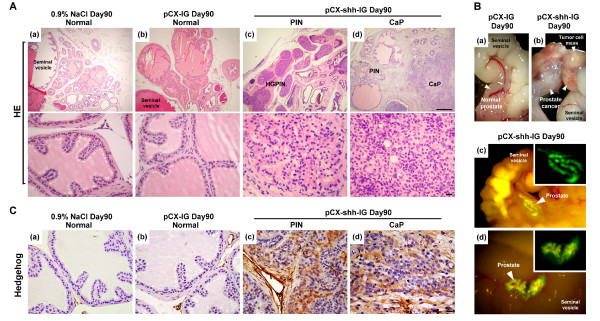
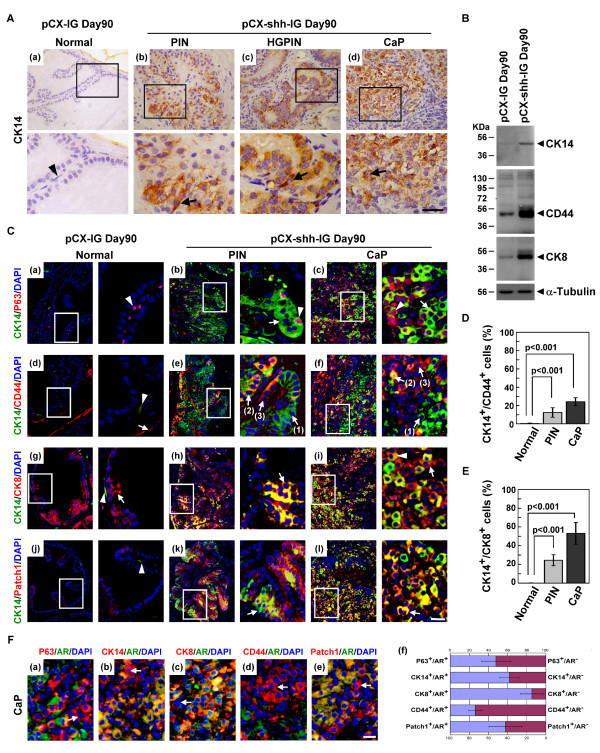
We produced pCX-shh-IG mice that overexpress Hedgehog protein persistently in adult prostates, allowing for elucidation of the mechanism during prostate cancer initiation and progression. Various markers were used to characterize and confirm the transformation of normal prostate basal/stem cells into malignant cancer stem cells under the influence of Hedgehog overexpression.
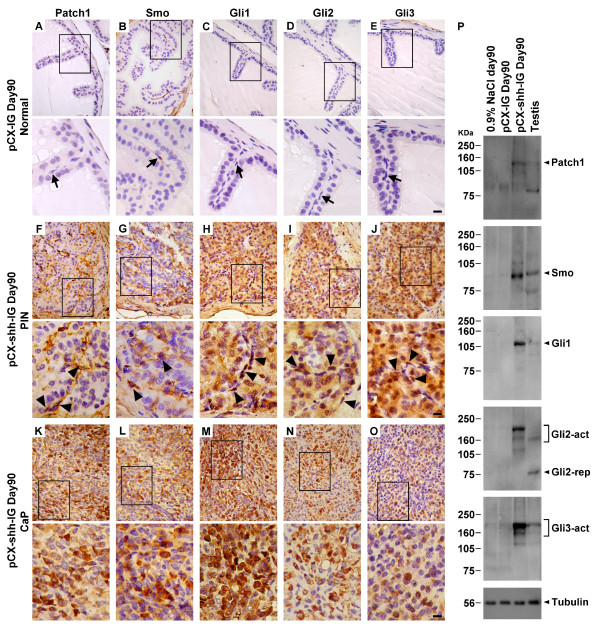
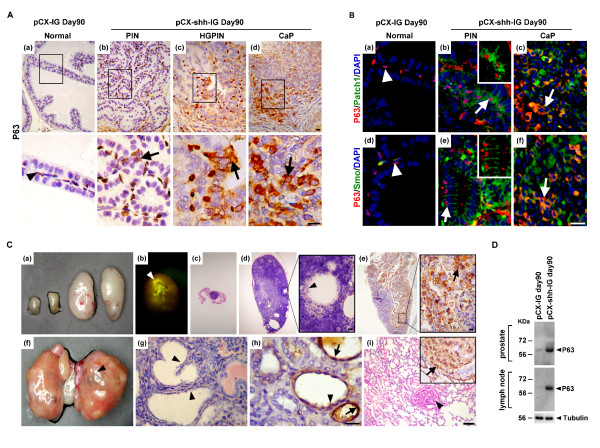
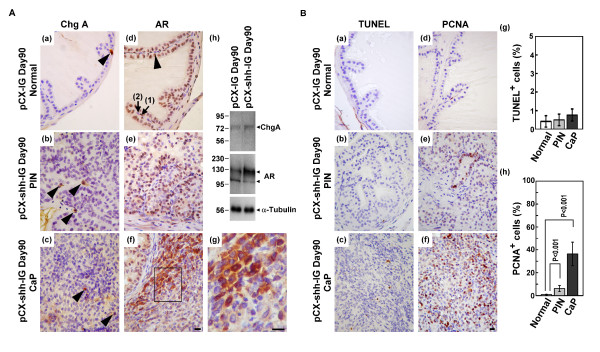
The pCX-shh-IG mice developed prostatic intraepithelial neoplasia (PIN) that led to invasive and metastatic prostate cancers within 90 days. The prostate cancer was initiated through activation of P63+ basal/stem cells along with simultaneous activation of Hedgehog signalling members, suggesting that P63+/Patch1+ and P63+/Smo+ cells may serve as cancer-initiating cells and progress into malignant prostate cancer stem cells (PCSCs). In the hyperplastic lesions and tumors, the progeny of PCSCs differentiated into cells of basal-intermediate and intermediate-luminal characteristics, whereas rare ChgA+ neuroendocrine differentiation was seen. Furthermore, in the metastatic loci within lymph nodes, kidneys, and lungs, the P63+ PCSCs formed prostate-like glandular structures, characteristic of the primitive structures during early prostate development. Besides, androgen receptor (AR) expression was detected heterogeneously during tumor progression. The existence of P63+/AR-, CK14+/AR- and CD44+/AR- progeny indicates direct procurement of AR- malignant cancer trait.
These data support a cancer stem cell scenario in which Hedgehog signalling plays important roles in transforming normal prostate basal/stem cells into PCSCs and in the progression of PCSCs into metastatic tumor cells.
Hedgehog 信号通路已被证实与人类和小鼠模型中的前列腺肿瘤发生有关,但它对将正常基底/干细胞转化为恶性癌症干细胞的影响仍知之甚少。
我们构建了 pCX-shh-IG 小鼠,使其在成年前列腺中持续过表达 Hedgehog 蛋白,从而能够阐明前列腺癌起始和进展过程中的机制。我们使用各种标志物来描述和确认 Hedgehog 过表达对正常前列腺基底/干细胞向恶性癌症干细胞转化的影响。
pCX-shh-IG 小鼠在 90 天内发展为前列腺上皮内瘤变(PIN),导致侵袭性和转移性前列腺癌。前列腺癌是通过激活 P63+基底/干细胞以及同时激活 Hedgehog 信号通路成员而引发的,这表明 P63+/Patch1+和 P63+/Smo+细胞可能作为癌症起始细胞,并进展为恶性前列腺癌干细胞(PCSCs)。在增生性病变和肿瘤中,PCSCs 的后代分化为基底-中间和中间-亮细胞特征的细胞,而罕见的 ChgA+神经内分泌分化可见。此外,在淋巴结、肾脏和肺部的转移部位,P63+PCSCs 形成了具有前列腺样腺结构的肿瘤,这是早期前列腺发育过程中的原始结构特征。此外,在肿瘤进展过程中,雄激素受体(AR)表达呈异质性。存在 P63+/AR-、CK14+/AR-和 CD44+/AR-后代表明 AR-恶性癌症特征的直接获得。
这些数据支持癌症干细胞假说,即 Hedgehog 信号通路在将正常前列腺基底/干细胞转化为 PCSCs 以及 PCSCs 向转移性肿瘤细胞的进展中发挥重要作用。