Centro de Pesquisa Boldrini, Centro Infantil Boldrini, Campinas 13083-210, SP, Brazil.
Medical Genetics Department, Faculty of Medical Sciences, State University of Campinas, Campinas 13083-970, SP, Brazil.
Genes (Basel). 2023 Sep 27;14(10):1880. doi: 10.3390/genes14101880.
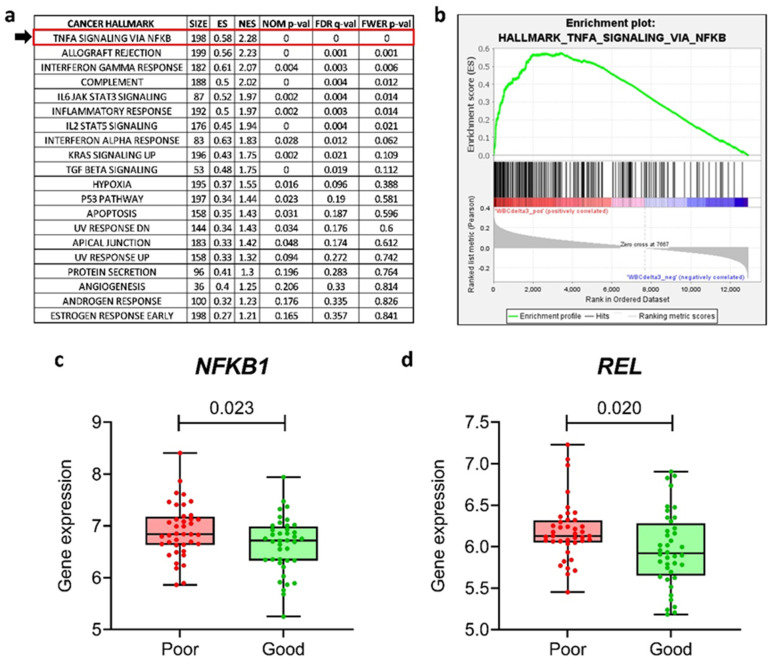
Acute lymphoblastic leukemia (ALL) is the most common childhood cancer. Although its prognosis continually improves with time, a significant proportion of patients still relapse from the disease because of the leukemia's resistance to therapy. Methotrexate (MTX), a folic-acid antagonist, is a chemotherapy agent commonly used against ALL and as an immune-system suppressant for rheumatoid arthritis that presents multiple and complex mechanisms of action and resistance. Previous studies have shown that MTX modulates the nuclear factor kappa B (NF-κB) pathway, an important family of transcription factors involved in inflammation, immunity, cell survival, and proliferation which are frequently hyperactivated in ALL. Using a gene set enrichment analysis of publicly available gene expression data from 161 newly diagnosed pediatric ALL patients, we found the (TNF-α) via to be the most enriched Cancer Hallmark in MTX-poor-responder patients. A transcriptomic analysis using a panel of ALL cell lines (six B-cell precursor acute lymphoblastic leukemia and seven T-cell acute lymphoblastic leukemia) also identified the same pathway as differentially enriched among MTX-resistant cell lines, as well as in slowly dividing cells. To better understand the crosstalk between NF-κB activity and MTX resistance, we genetically modified the cell lines to express luciferase under an NF-κB-binding-site promoter. We observed that the fold change in NF-κB activity triggered by TNF-α (but not MTX) treatment correlated with MTX resistance and proliferation across the lines. At the individual gene level, expression was directly associated with a poorer clinical response to MTX and with both an increased TNF-α-triggered NF-κB activation and MTX resistance in the cell lines. Despite these results, the pharmacological inhibition (using BAY 11-7082 and parthenolide) or stimulation (using exogenous TNF-α supplementation) of the NF-κB pathway did not alter the MTX resistance of the cell lines significantly, evidencing a complex interplay between MTX and NF-κB in ALL.
急性淋巴细胞白血病 (ALL) 是最常见的儿童癌症。尽管随着时间的推移,其预后不断改善,但由于白血病对治疗的耐药性,仍有相当一部分患者疾病复发。甲氨蝶呤 (MTX) 是一种叶酸拮抗剂,是一种常用于 ALL 的化疗药物,也是一种类风湿关节炎的免疫系统抑制剂,具有多种复杂的作用机制和耐药性。先前的研究表明,MTX 调节核因子 kappa B (NF-κB) 通路,该通路是一个重要的转录因子家族,参与炎症、免疫、细胞存活和增殖,而这些在 ALL 中经常过度激活。通过对 161 名新诊断的儿科 ALL 患者的公开基因表达数据进行基因集富集分析,我们发现(TNF-α)通过(NF-κB)途径在 MTX 低反应患者中富集最多。使用 ALL 细胞系(六个 B 细胞前体急性淋巴细胞白血病和七个 T 细胞急性淋巴细胞白血病)的转录组分析也在 MTX 耐药细胞系中以及在缓慢分裂的细胞中发现了相同的途径存在差异富集。为了更好地理解 NF-κB 活性与 MTX 耐药性之间的相互作用,我们通过在 NF-κB 结合位点启动子下表达荧光素酶的方式对细胞系进行了基因修饰。我们观察到,TNF-α(而不是 MTX)处理引发的 NF-κB 活性的变化倍数与细胞系中的 MTX 耐药性和增殖相关。在个体基因水平上,(TNFRSF1A)的表达与 MTX 治疗的临床反应较差直接相关,并且与细胞系中 TNF-α 触发的 NF-κB 激活和 MTX 耐药性增加都相关。尽管有这些结果,但 NF-κB 通路的药理学抑制(使用 BAY 11-7082 和白头翁素)或刺激(使用外源性 TNF-α 补充)并没有显著改变细胞系的 MTX 耐药性,这表明 MTX 和 NF-κB 之间在 ALL 中存在复杂的相互作用。