Solberg Andrea, Reikvam Håkon
Faculty of Medicine, University of Bergen, 5007 Bergen, Norway.
Institute of Clinical Science, Faculty of Medicine, University of Bergen, 5007 Bergen, Norway.
Life (Basel). 2023 Oct 2;13(10):2007. doi: 10.3390/life13102007.
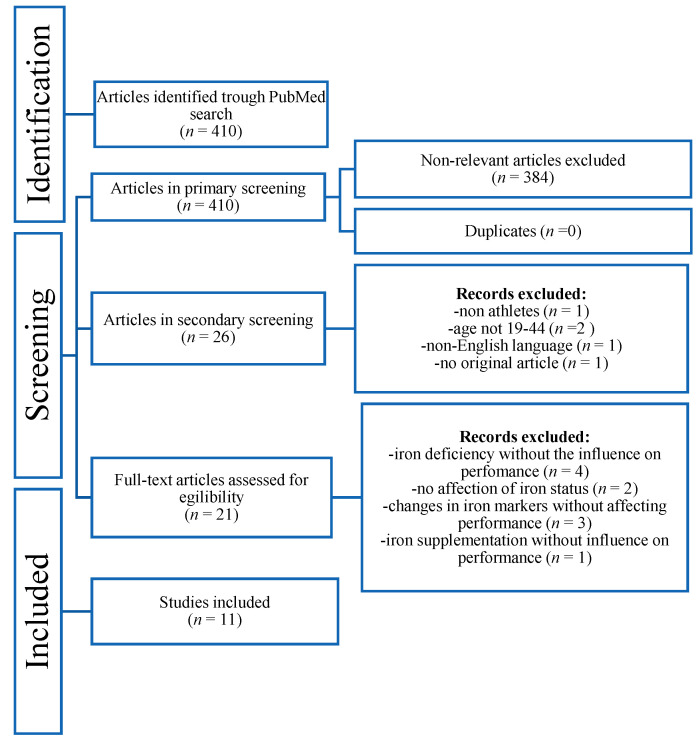
Iron is an important mineral in the body, essential for muscle function and oxygen transport. Adequate levels of iron in the blood are necessary for athletes, as iron-deficiency anemia can reduce physical performance. Several studies have investigated iron status and supplementation in iron-deficient athletes, and determined how physical strain can change iron balance and markers related to iron status. The question of how to influence and optimize iron status, as well as other markers that can affect iron metabolism, has been less thoroughly investigated. Therefore, the aim of this review is to take a closer look at the importance of iron values, iron markers, and factors that can change iron metabolism for physical performance and the extent to which physical performance can be influenced in a positive or negative way. A systematic search of the PubMed database was performed, with the use of « iron» or «iron deficiency» or «hemoglobin» AND «athletes» AND «athletic performance» as a strategy of the search. After the search, 11 articles were included in the review after the application of inclusion and exclusion criteria. Major findings include that iron supplementation had the best effect in athletes with the lowest iron status, and effects on physical performance were mostly achieved in those who were originally in a deficit. Iron supplementation could be beneficial for optimal erythropoietic response during altitude training, even in athletes with normal iron stores at baseline, but should be performed with caution. Alteration of the hepcidin response can affect the use of existing iron stores for erythropoiesis. Energy intake, and the amount of carbohydrates available, may have an impact on the post-exercise hepcidin response. Optimal vitamin D and B12 levels can possibly contribute to improved iron status and, hence, the avoidance of anemia.
铁是人体中的一种重要矿物质,对肌肉功能和氧气运输至关重要。血液中充足的铁水平对运动员来说是必要的,因为缺铁性贫血会降低体能表现。多项研究调查了缺铁运动员的铁状态及补充情况,并确定了身体应激如何改变铁平衡以及与铁状态相关的标志物。然而,关于如何影响和优化铁状态以及其他可能影响铁代谢的标志物的问题,研究得还不够深入。因此,本综述的目的是更深入地探讨铁值、铁标志物以及可改变铁代谢的因素对体能表现的重要性,以及体能表现能在多大程度上受到积极或消极的影响。我们使用 “铁” 或 “缺铁” 或 “血红蛋白” 以及 “运动员” 和 “运动表现” 作为检索策略,对PubMed数据库进行了系统检索。检索后,在应用纳入和排除标准后,11篇文章被纳入本综述。主要研究结果包括,铁补充剂对铁状态最低的运动员效果最佳,并且对体能表现的影响大多在原本铁缺乏的运动员中得以实现。即使在基线铁储备正常的运动员中,铁补充剂对高原训练期间的最佳红细胞生成反应也可能有益,但应谨慎使用。铁调素反应的改变会影响现有铁储备用于红细胞生成的利用情况。能量摄入以及可用碳水化合物的量,可能会对运动后铁调素反应产生影响。最佳的维生素D和B12水平可能有助于改善铁状态,从而避免贫血。