Karl Tanja, Schuster Anja, Stangassinger Lea Maria, Stiboller Tanja, Cadamuro Janne, Oostingh Gertie Janneke
Department of Health Sciences, Biomedical Sciences, Salzburg University of Applied Sciences, 5412 Puch/Salzburg, Austria.
Research Program of Medical Sciences, Paracelsus Medical University, 5020 Salzburg, Austria.
Vaccines (Basel). 2023 Oct 19;11(10):1615. doi: 10.3390/vaccines11101615.
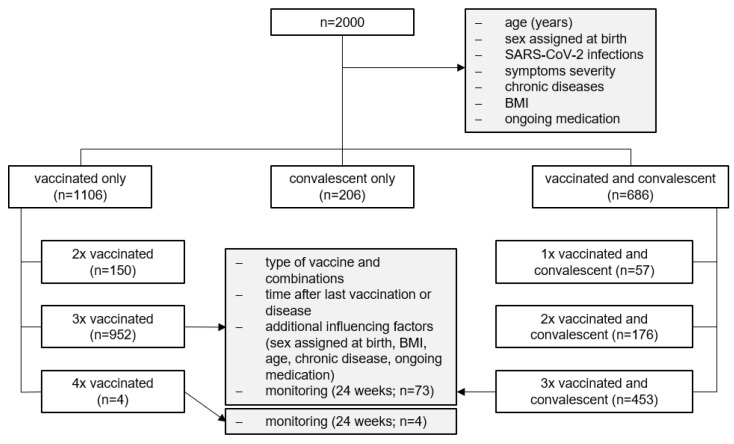
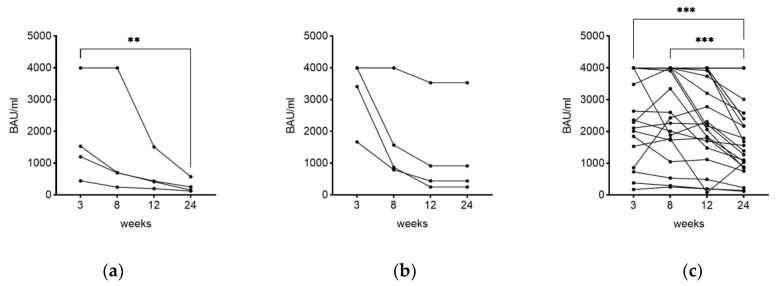
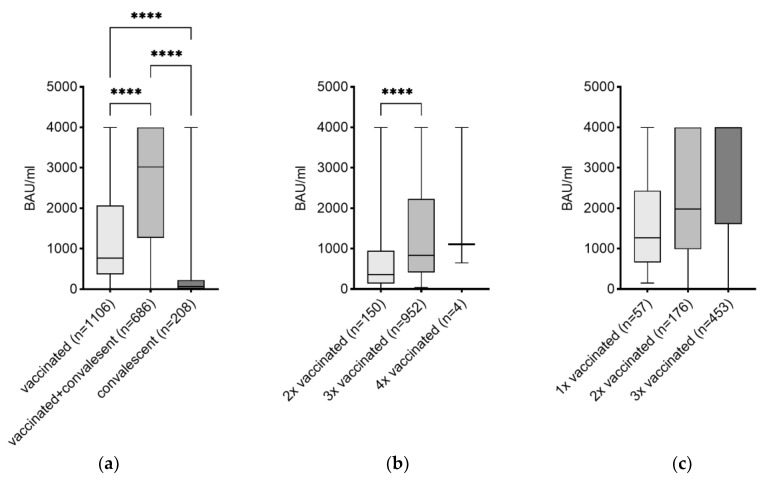
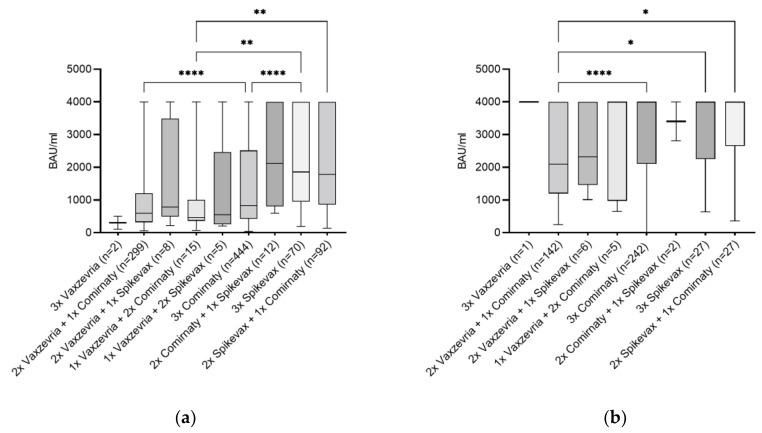
This study aimed at identifying factors influencing SARS-CoV-2-specific IgG antibody levels after vaccination and/or infection. Between January 2022 and March 2023, 2000 adults (≥18 years, Salzburg, Austria) participated in this population-based seroprevalence study by providing 3 mL of blood to detect SARS-CoV-2-specific IgG antibodies using an anti-SARS-CoV-2 IgG quantitative assay and by completing a self-designed questionnaire including anthropometric factors, vaccination information, and medical history. For 77 of the participants, a time-course study up to 24 weeks post vaccination or quarantine end was performed. Convalescent-only subjects had the lowest median antibody titer (65.6 BAU/mL) compared to vaccinated and hybrid immunized subjects (-value < 0.0001) The type of vaccine as well as vaccine combinations significantly influenced the levels of SARS-CoV-2 spike-protein-specific IgG, ranging from a median antibody level of 770.5 BAU/mL in subjects who were vaccinated only to 3020.0 BAU/mL in hybrid immunized subjects (-value < 0.0001). Over time, a significant decline in the levels of neutralizing antibodies was found. Depending on the subpopulation analyzed, further significant influencing factors included sex assigned at birth, disease severity, chronic diseases, and medication. A hybrid immunization resulted in more robust immune responses. Nevertheless, there were multiple other factors impacting these responses. This knowledge should be included in future vaccination strategies and serve as a guide in the development of personalized medicine.
本研究旨在确定影响接种疫苗和/或感染后新冠病毒特异性IgG抗体水平的因素。2022年1月至2023年3月期间,2000名成年人(≥18岁,奥地利萨尔茨堡)参与了这项基于人群的血清流行率研究,他们提供3毫升血液,使用抗新冠病毒IgG定量检测法检测新冠病毒特异性IgG抗体,并完成一份自行设计的问卷,内容包括人体测量因素、疫苗接种信息和病史。对其中77名参与者进行了长达接种疫苗后或隔离结束后24周的时间进程研究。与接种疫苗和混合免疫的受试者相比,仅康复的受试者的抗体滴度中位数最低(65.6 BAU/mL)(P值<0.0001)。疫苗类型以及疫苗组合对新冠病毒刺突蛋白特异性IgG水平有显著影响,仅接种疫苗的受试者的抗体水平中位数为770.5 BAU/mL,而混合免疫的受试者为3020.0 BAU/mL(P值<0.0001)。随着时间的推移,发现中和抗体水平显著下降。根据所分析的亚组,其他显著影响因素包括出生时指定的性别、疾病严重程度、慢性病和药物治疗。混合免疫导致更强大的免疫反应。然而,还有其他多个因素影响这些反应。这些知识应纳入未来的疫苗接种策略,并为个性化医疗的发展提供指导。