Department of Ophthalmology, University of Pittsburgh, Pittsburgh, PA, USA; Department of Bioengineering, University of Pittsburgh, Pittsburgh, PA, USA.
Department of Ophthalmology, University of Pittsburgh, Pittsburgh, PA, USA.
Exp Eye Res. 2023 Dec;237:109701. doi: 10.1016/j.exer.2023.109701. Epub 2023 Oct 26.
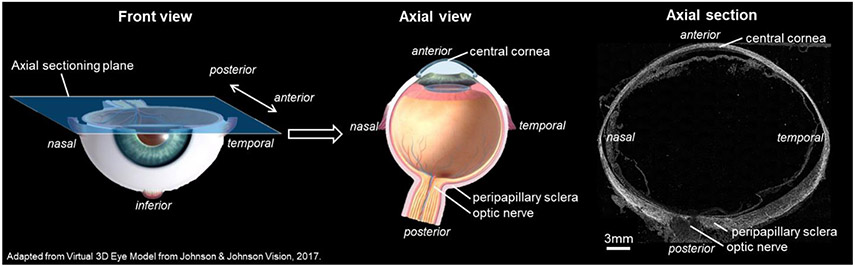
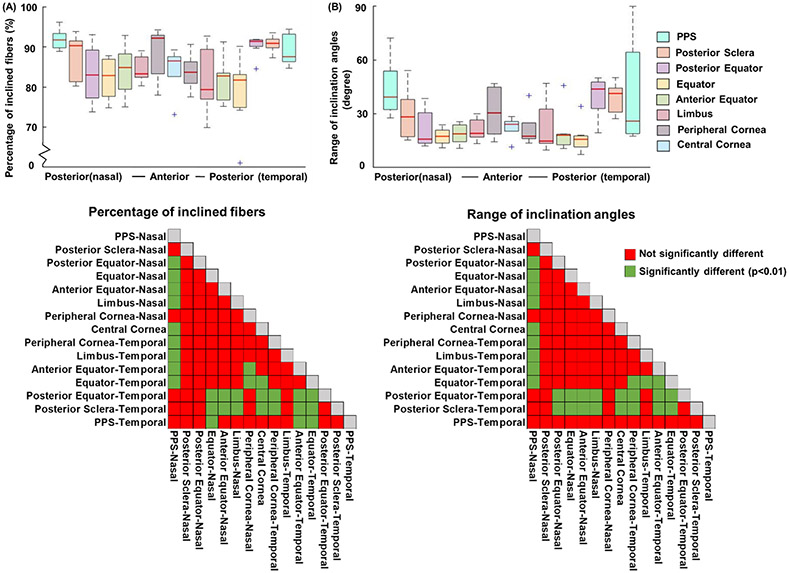
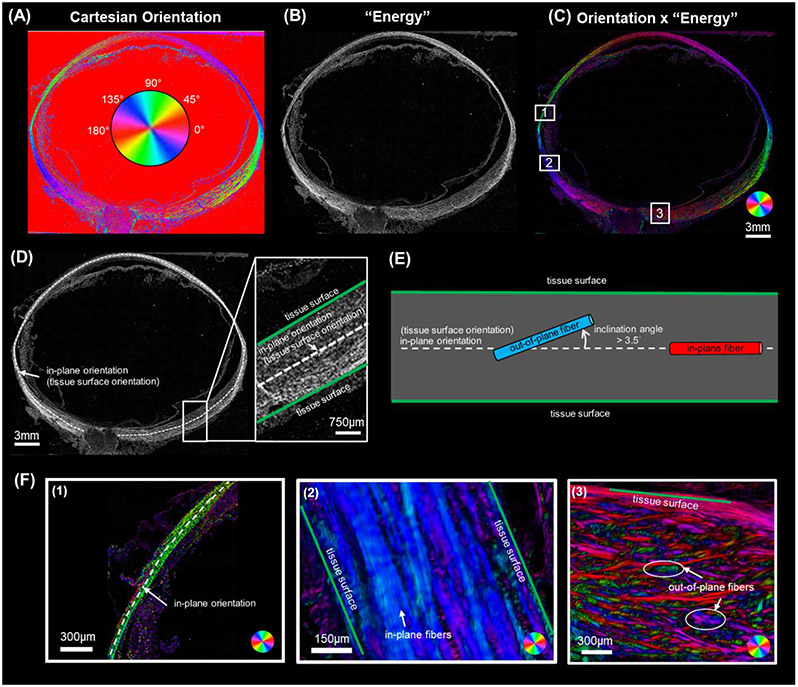
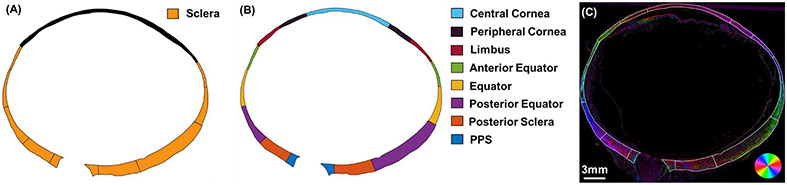
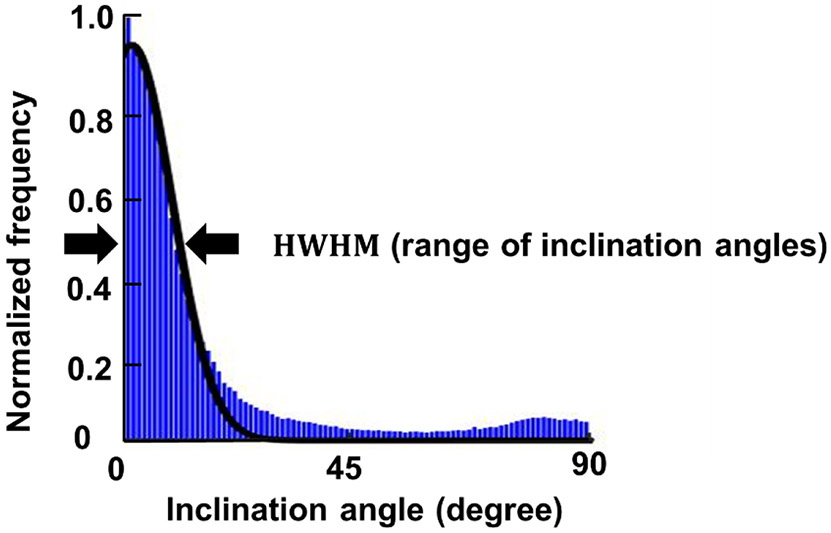
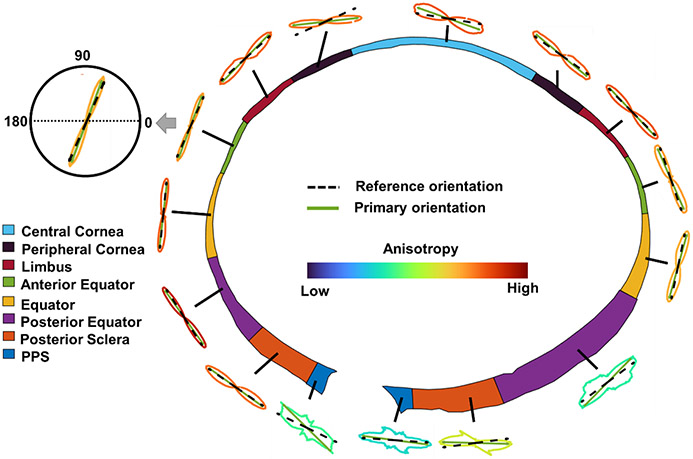
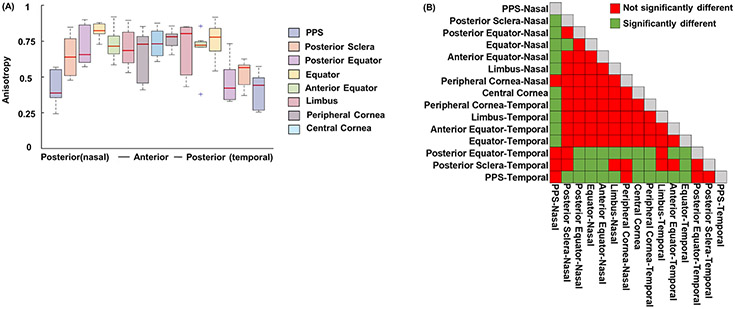
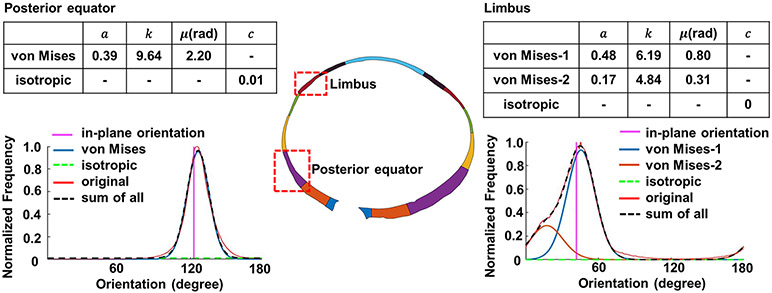
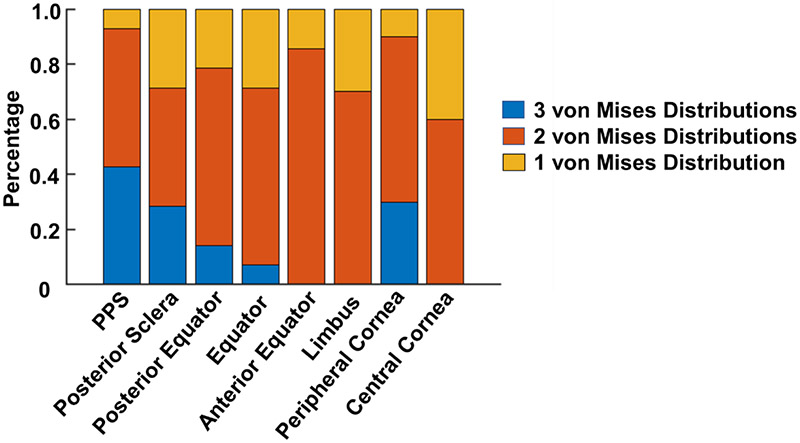
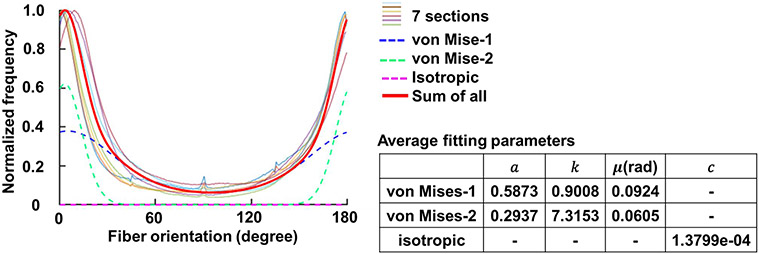
The collagen fibers of the corneoscleral shell play a central role in the eye mechanical behavior. Although it is well-known that these fibers form a complex three-dimensional interwoven structure, biomechanical and microstructural studies often assume that the fibers are aligned in-plane with the tissues. This is convenient as it removes the out-of-plane components and allows focusing on the 2D maps of in-plane fiber organization that are often quite complex. The simplification, however, risks missing potentially important aspects of the tissue architecture and mechanics. In the cornea, for instance, fibers with high in-depth inclination have been shown to be mechanically important. Outside the cornea, the in-depth fiber orientations have not been characterized, preventing a deeper understanding of their potential roles. Our goal was to characterize in-depth collagen fiber organization over the whole corneoscleral shell. Seven sheep whole-globe axial sections from eyes fixed at an IOP of 50 mmHg were imaged using polarized light microscopy to measure collagen fiber orientations and density. In-depth fiber orientation distributions and anisotropy (degree of fiber alignment) accounting for fiber density were quantified over the whole sclera and in 15 regions: central cornea, peripheral cornea, limbus, anterior equator, equator, posterior equator, posterior sclera and peripapillary sclera on both nasal and temporal sides. Orientation distributions were fitted using a combination of a uniform distribution and a sum of π-periodic von Mises distributions, each with three parameters: primary orientation μ, fiber concentration factor k, and weighting factor a. To study the features of fibers that are not in-plane, i.e., fiber inclination, we quantified the percentage of inclined fibers and the range of inclination angles (half width at half maximum of inclination angle distribution). Our measurements showed that the fibers were not uniformly in-plane but exhibited instead a wide range of in-depth orientations, with fibers significantly more aligned in-plane in the anterior parts of the globe. We found that fitting the orientation distributions required between one and three π-periodic von Mises distributions with different primary orientations and fiber concentration factors. Regions of the posterior globe, particularly on the temporal side, had a larger percentage of inclined fibers and a larger range of inclination angles than anterior and equatorial regions. Variations of orientation distributions and anisotropies may imply varying out-of-plane tissue mechanical properties around the eye globe. Out-of-plane fibers could indicate fiber interweaving, not necessarily long, inclined fibers. Effects of small-scale fiber undulations, or crimp, were minimized by using tissues from eyes at high IOPs. These fiber features also play a role in tissue stiffness and stability and are therefore also important experimental information.
巩膜壳的胶原纤维在眼球的机械行为中起着核心作用。尽管众所周知这些纤维形成了复杂的三维交织结构,但生物力学和微观结构研究通常假设纤维与组织在同一平面内排列。这很方便,因为它消除了非平面分量,并且可以专注于通常非常复杂的平面内纤维组织的 2D 图谱。然而,这种简化可能会忽略组织结构和力学的潜在重要方面。例如,在角膜中,已经证明具有高深度倾斜度的纤维在力学上很重要。在角膜外,尚未对纤维的深度取向进行特征描述,这阻止了对其潜在作用的更深入理解。我们的目标是描述整个巩膜壳中的深度胶原纤维组织。对在 IOP 为 50mmHg 下固定的 7 只绵羊全眼球轴向切片进行偏光显微镜成像,以测量胶原纤维的取向和密度。在整个巩膜和 15 个区域(中央角膜、周边角膜、角膜缘、前赤道、赤道、后赤道、后巩膜和鼻侧和颞侧的视盘周围巩膜)中定量了考虑纤维密度的深度纤维取向分布和各向异性(纤维取向程度)。通过组合使用均匀分布和 π 周期冯·米塞斯(von Mises)分布的总和来拟合取向分布,每个分布具有三个参数:主取向 μ、纤维浓度因子 k 和加权因子 a。为了研究不在同一平面内的纤维特征,即纤维倾斜度,我们定量了倾斜纤维的百分比和倾斜角度范围(倾斜角度分布的半高宽)。我们的测量结果表明,纤维不是均匀地在同一平面内,而是表现出广泛的深度取向,在前部区域的眼球中纤维更平行于平面。我们发现,拟合取向分布需要使用具有不同主取向和纤维浓度因子的一到三个 π 周期冯·米塞斯分布。后半球的区域,特别是颞侧,与前赤道区域相比,倾斜纤维的百分比和倾斜角度范围更大。取向分布和各向异性的变化可能意味着眼球周围的组织具有不同的非平面力学特性。不在同一平面内的纤维可能表示纤维交织,而不一定是长的倾斜纤维。通过使用 IOP 较高的眼睛的组织,可以最小化小尺度纤维波动或卷曲的影响。这些纤维特征在组织刚度和稳定性中也起着重要作用,因此也是重要的实验信息。