Department of Ophthalmology, Graduate School of Medicine, The University of Tokyo, 7-3-1 Hongo, Bunkyo-ku, Tokyo, 113-8655, Japan.
Department of Clinical Epidemiology and Health Economics, School of Public Health, The University of Tokyo, Tokyo, Japan.
Eye (Lond). 2024 Apr;38(5):930-936. doi: 10.1038/s41433-023-02806-3. Epub 2023 Oct 28.
BACKGROUND/OBJECTIVES: This study aimed to compare the cost-effectiveness of prophylactic laser peripheral iridotomy (LPI) with that of observation for primary angle-closure suspect (PACS) in Japan.
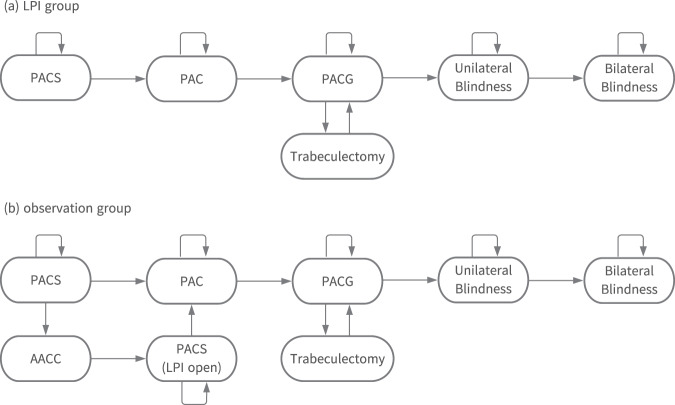
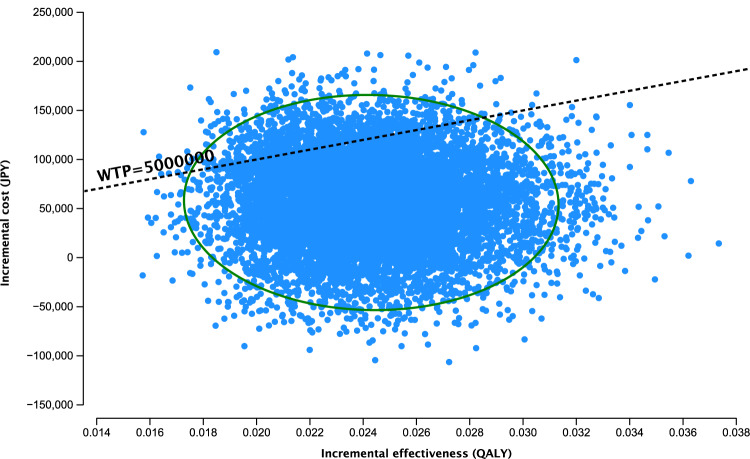
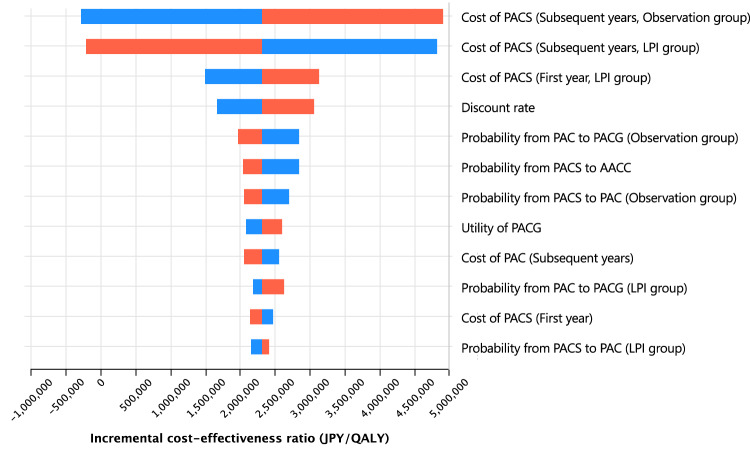
SUBJECTS/METHODS: A Markov model was developed to compare the costs and utilities of prophylactic LPI with those of observation of 40-year-old patients with PACS. In the model with a yearly cycle over a 20-year time horizon, the disease was postulated to irreversibly progress from PACS to primary angle closure, followed by primary angle-closure glaucoma, unilateral blindness, and bilateral blindness. The parameters were estimated mainly based on a recent randomised controlled trial and analyses of Japanese claims data. The incremental cost-effectiveness ratio was estimated from the healthcare payer's perspective and evaluated at the willingness-to-pay 5 million Japanese Yen per quality-adjusted life-year. The observation period and the age at entry into the cohort was changed to account for a variety of clinical courses in sensitivity analyses. We conducted one-way deterministic sensitivity analysis and probabilistic sensitivity analysis with Monte Carlo simulations with 10 000 iterations.
The incremental cost-effectiveness ratio of LPI was 2,287,662 Japanese Yen (14,298 pounds sterling) per quality-adjusted life-year, which was below the willingness-to-pay threshold. The ratios were approximately 4 and 8 million in the 15-year and 10-year time horizons, respectively. Increasing the age at entry had little influence on the incremental cost-effectiveness ratio. The deterministic and probabilistic sensitivity analyses indicated that the results were robust.
Our results indicate that prophylactic LPI for middle-aged patients with PACS is cost-effective in Japan.
背景/目的:本研究旨在比较预防性激光周边虹膜切开术(LPI)与观察对于原发性闭角型青光眼疑似患者(PACS)的成本效益。
对象/方法:建立了一个 Markov 模型,以比较预防性 LPI 与观察 40 岁 PACS 患者的成本和效用。在 20 年时间跨度的每年周期模型中,假设疾病从 PACS 不可逆地进展为原发性闭角型青光眼,然后是原发性闭角型青光眼、单侧失明和双侧失明。参数主要基于最近的一项随机对照试验和对日本索赔数据的分析进行估计。从医疗保健支付者的角度估计增量成本效益比,并以每质量调整生命年 500 万日元的意愿支付进行评估。在敏感性分析中,改变观察期和进入队列的年龄,以考虑各种临床病程。我们进行了一次确定性敏感性分析和概率敏感性分析,使用蒙特卡罗模拟进行了 10000 次迭代。
LPI 的增量成本效益比为每质量调整生命年 2287662 日元(14298 英镑),低于意愿支付阈值。在 15 年和 10 年的时间范围内,该比例分别约为 400 万和 800 万日元。进入队列的年龄增加对增量成本效益比的影响不大。确定性和概率敏感性分析表明结果是稳健的。
我们的结果表明,对于日本中年 PACS 患者,预防性 LPI 具有成本效益。