College of Pharmaceutical Sciences, Zhejiang University, Hangzhou 310058, China.
Innovation Institute for Artificial Intelligence in Medicine, Zhejiang University, Hangzhou 310018, China.
Zhejiang Da Xue Xue Bao Yi Xue Ban. 2023 Oct 19;52(5):558-566. doi: 10.3724/zdxbyxb-2023-0305.
To investigate the effects of PLK1 inhibitors on osimertinib-resistant non-small cell lung carcinoma (NSCLC) cells and the anti-tumor effect combined with osimertinib.
An osimertinib resistant NCI-H1975 cell line was induced by exposure to gradually increasing drug concentrations. Osimertinib-resistant cells were co-treated with compounds from classical tumor pathway inhibitor library and osimertinib to screen for compounds with synergistic effects with osimertinib. The Gene Set Enrichment Analysis (GSEA) was used to investigate the activated signaling pathways in osimertinib-resistant cells; sulforhodamine B (SRB) staining was used to investigate the effect of PLK1 inhibitors on osimertinib-resistant cells and the synergistic effect of PLK1 inhibitors combined with osimertinib.
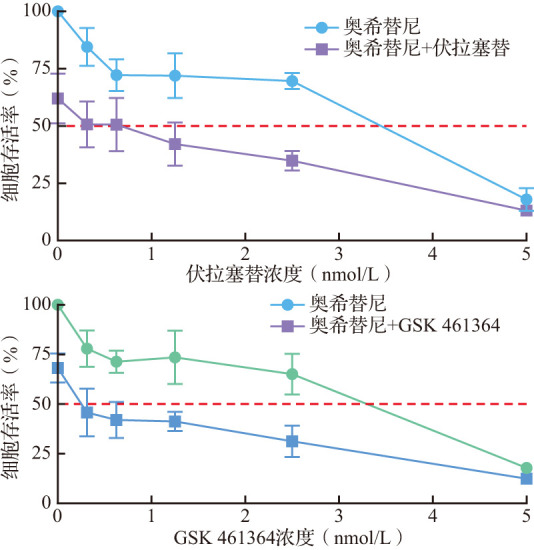
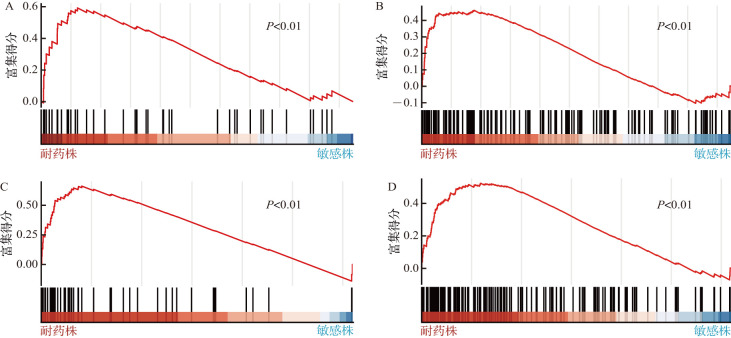
Osimertinib-resistance in NCI-H1975 cell (resistance index=43.45) was successfully established. The PLK1 inhibitors GSK 461364 and BI 2536 had synergistic effect with osimertinib. Compared with osimertinib-sensitive cells, PLK1 regulatory pathway and cell cycle pathway were significantly activated in osimertinib-resistant cells. In NSCLC patients with epidermal growth factor receptor mutations treated with osimertinib, mRNA levels were negatively correlated with progression free survival of patients (=-0.62, <0.05), indicating that excessive activation of PLK1 in NSCLC cells may cause cell resistant to osimertinib. Further experiments showed that IC of PLK1 inhibitors BI 6727 and GSK 461364 in osimertinib-resistant cells were lower than those in sensitive ones. Compared with the mono treatment of osimertinib, PLK1 inhibitors combined with osimertinib behaved significantly stronger effect on the proliferation of osimertinib-resistant cells.
PLK1 inhibitors have a synergistic effect with osimertinib on osimertinib-resistant NSCLC cells which indicates that they may have potential clinical value in the treatment of NSCLC patients with osimertinib resistance.
研究 PLK1 抑制剂对奥希替尼耐药非小细胞肺癌(NSCLC)细胞的作用及其与奥希替尼联合的抗肿瘤效果。
通过逐渐增加药物浓度诱导奥希替尼耐药 NCI-H1975 细胞系。将奥希替尼耐药细胞与经典肿瘤通路抑制剂库中的化合物联合并用,以筛选与奥希替尼具有协同作用的化合物。采用基因集富集分析(GSEA)研究奥希替尼耐药细胞中激活的信号通路;采用磺酰罗丹明 B(SRB)染色法研究 PLK1 抑制剂对奥希替尼耐药细胞的作用及 PLK1 抑制剂与奥希替尼联合的协同作用。
成功建立了 NCI-H1975 细胞的奥希替尼耐药性(耐药指数=43.45)。PLK1 抑制剂 GSK 461364 和 BI 2536 与奥希替尼具有协同作用。与奥希替尼敏感细胞相比,奥希替尼耐药细胞中 PLK1 调节通路和细胞周期通路明显激活。在接受奥希替尼治疗的携带表皮生长因子受体突变的 NSCLC 患者中,mRNA 水平与患者的无进展生存期呈负相关(=-0.62,<0.05),表明 NSCLC 细胞中 PLK1 的过度激活可能导致细胞对奥希替尼耐药。进一步的实验表明,PLK1 抑制剂 BI 6727 和 GSK 461364 在奥希替尼耐药细胞中的 IC 均低于敏感细胞。与奥希替尼单药治疗相比,PLK1 抑制剂联合奥希替尼对奥希替尼耐药细胞的增殖具有更强的抑制作用。
PLK1 抑制剂对奥希替尼耐药 NSCLC 细胞与奥希替尼具有协同作用,这表明它们在治疗奥希替尼耐药的 NSCLC 患者方面可能具有潜在的临床价值。