Stubbins Blake, Leier Andrew L, Barbeau David L, Pullen Alex, Abell Jordan T, Nie Junsheng, Zárate Marcelo A, Fidler Mary Kate
School of the Earth, Ocean and Environment, University of South Carolina, Columbia, SC, 29208, USA.
Department of Environmental Engineering and Earth Sciences, Clemson University, Clemson, SC, 29634, USA.
Nat Commun. 2023 Oct 30;14(1):6899. doi: 10.1038/s41467-023-42537-3.
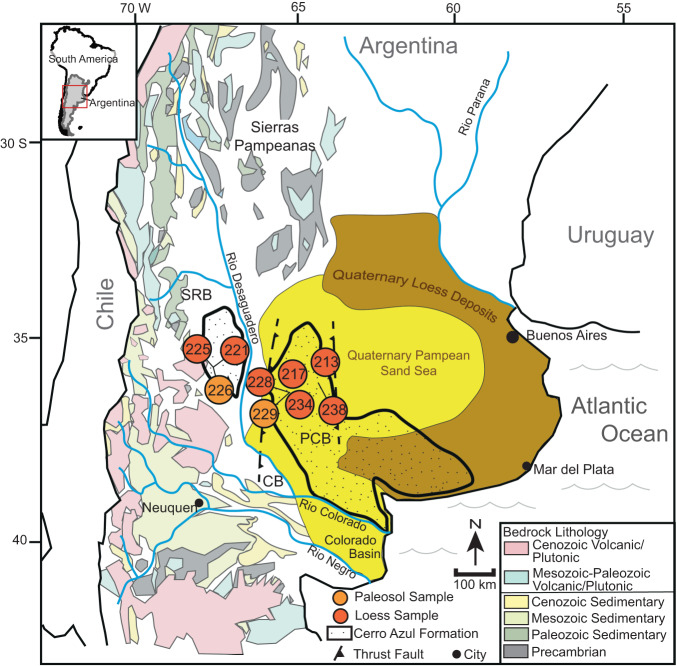
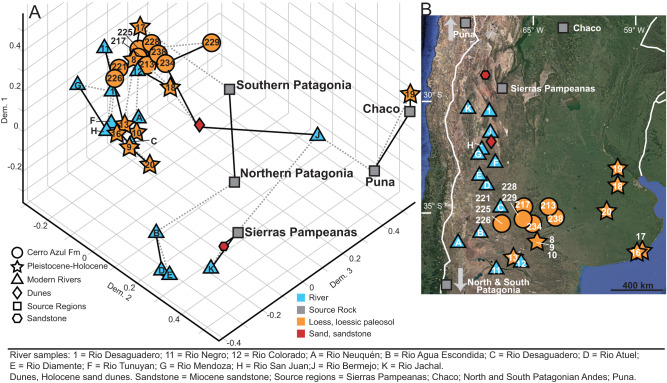
Wind-blown dust from southern South America links the terrestrial, marine, atmospheric, and biological components of Earth's climate system. The Pampas of central Argentina (33°-39° S) contain a Miocene to Holocene aeolian record that spans an important interval of global cooling. Upper Miocene sediment provenance based on n = 3299 detrital-zircon U-Pb ages is consistent with the provenance of Pleistocene-Holocene deposits, indicating the Pampas are the site of a long-lived fluvial-aeolian system that has been operating since the late Miocene. Here, we show the establishment of aeolian sedimentation in the Pampas coincided with late Miocene cooling. These findings, combined with those from the Chinese Loess Plateau (33°-39° N) underscore: (1) the role of fluvial transport in the development and maintenance of temporally persistent mid-latitude loess provinces; and (2) a global-climate forcing mechanism behind the establishment of large mid-latitude loess provinces during the late Miocene.
来自南美洲南部的风尘将地球气候系统的陆地、海洋、大气和生物成分联系在一起。阿根廷中部的潘帕斯草原(南纬约33°-39°)保存了一个从中新世到全新世的风成记录,该记录跨越了全球变冷的一个重要时期。基于n = 3299个碎屑锆石U-Pb年龄的上新世沉积物来源与更新世-全新世沉积物的来源一致,这表明潘帕斯草原是一个自中新世晚期以来一直在运作的长期河流-风成系统的所在地。在这里,我们表明潘帕斯草原风成沉积的建立与中新世晚期的变冷相吻合。这些发现,与来自中国黄土高原(北纬约33°-39°)的发现相结合,强调了:(1)河流搬运在中纬度黄土省份长期发育和维持中的作用;(2)中新世晚期大型中纬度黄土省份形成背后的全球气候强迫机制。