• 文献检索
  • 文档翻译
  • 深度研究
  • 学术资讯
  • Suppr Zotero 插件Zotero 插件
  • 邀请有礼
  • 套餐&价格
  • 历史记录
应用&插件
Suppr Zotero 插件Zotero 插件浏览器插件Mac 客户端Windows 客户端微信小程序
定价
高级版会员购买积分包购买API积分包
服务
文献检索文档翻译深度研究API 文档MCP 服务
关于我们
关于 Suppr公司介绍联系我们用户协议隐私条款
关注我们

Suppr 超能文献

核心技术专利:CN118964589B侵权必究
粤ICP备2023148730 号-1Suppr @ 2026

文献检索

告别复杂PubMed语法,用中文像聊天一样搜索,搜遍4000万医学文献。AI智能推荐,让科研检索更轻松。

立即免费搜索

文件翻译

保留排版,准确专业,支持PDF/Word/PPT等文件格式,支持 12+语言互译。

免费翻译文档

深度研究

AI帮你快速写综述,25分钟生成高质量综述,智能提取关键信息,辅助科研写作。

立即免费体验

新冠病毒疾病严重程度预测中的相关生化和血液学标志物

Associated Biochemical and Hematological Markers in COVID-19 Severity Prediction.

作者信息

Lamichhane Anit, Pokhrel Sushant, Thapa Tika Bahadur, Shrestha Ojaswee, Kadel Anuradha, Joshi Govardhan, Khanal Sudip

机构信息

Department of Laboratory Medicine, Manmohan Memorial Institute of Health Sciences, Kathmandu, Nepal.

Department of Pathology, Sumeru Hospital Pvt Ltd., Lalitpur, Nepal.

出版信息

Adv Med. 2023 Oct 19;2023:6216528. doi: 10.1155/2023/6216528. eCollection 2023.

DOI:10.1155/2023/6216528
PMID:37900669
原文链接:https://pmc.ncbi.nlm.nih.gov/articles/PMC10602699/
Abstract

BACKGROUND

The global threat of COVID-19 has created the need for researchers to investigate the disease's progression, especially through the use of biomarkers to inform interventions. This study aims to assess the correlations of laboratory parameters to determine the severity of COVID-19 infection.

METHODS

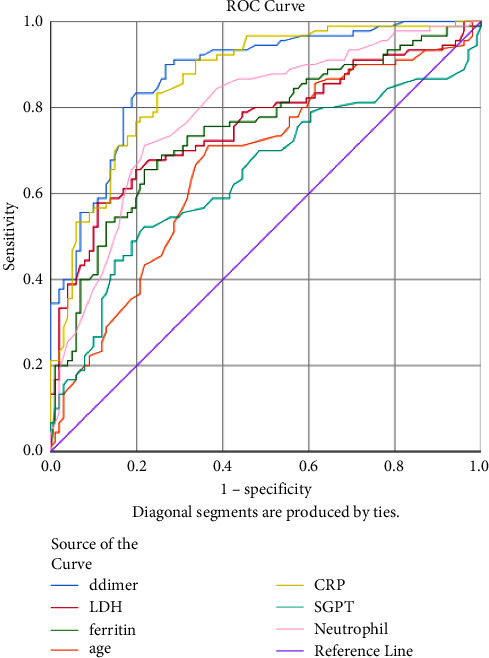
This study was conducted among 191 COVID-19 patients in Sumeru Hospital, Lalitpur, Nepal. According to their clinical outcomes, these patients were divided into severe and nonsevere groups. Inflammatory markers such as LDH, D-dimer, CRP, ferritin, complete blood cell count, liver function tests, and renal function tests were performed. Binary logistic regression analysis determined relative risk factors associated with severe COVID-19. The area under the curve (AUC) was calculated with ROC curves to assess the potential predictive value of risk factors.

RESULTS

Out of 191 patients, 38 (19.8%) subjects died due to COVID-19 complications, while 156 (81.7%) survived and were discharged from hospital. The COVID-19 severity was found in patients with older age and comorbidities such as CKD, HTN, DM, COPD, and pneumonia. Parameters such as d-dimer, CRP, LDH, SGPT, neutrophil, lymphocyte count, and LMR were significant independent risk factors for the severity of the disease. The AUC was highest for d-dimer (AUC = 0.874) with a sensitivity of 82.2% and specificity of 81.2%. Similarly, the cut-off values for other factors were age >54.5 years, D-dimer >0.91 ng/ml, CRP >82.4 mg/dl, neutrophil >78.5%, LDH >600 U/L, and SGPT >35.5 U/L, respectively.

CONCLUSION

Endorsement of biochemical and hematological parameters with their cut-off values also aids in predicting COVID-19 severity. The biomarkers such as D-dimer, CRP levels, LDH, ALT, and neutrophil count could be used to predict disease severity. So, timely analysis of these markers might allow early prediction of disease progression.

摘要

背景

新型冠状病毒肺炎(COVID-19)的全球威胁促使研究人员对该疾病的进展进行调查,特别是通过使用生物标志物来为干预措施提供依据。本研究旨在评估实验室参数之间的相关性,以确定COVID-19感染的严重程度。

方法

本研究在尼泊尔拉利特布尔须弥医院的191例COVID-19患者中进行。根据临床结果,这些患者被分为重症组和非重症组。检测了乳酸脱氢酶(LDH)、D-二聚体、C反应蛋白(CRP)、铁蛋白、全血细胞计数、肝功能检查和肾功能检查等炎症标志物。二元逻辑回归分析确定了与重症COVID-19相关的相对危险因素。通过ROC曲线计算曲线下面积(AUC),以评估危险因素的潜在预测价值。

结果

191例患者中,38例(19.8%)因COVID-19并发症死亡,156例(81.7%)存活并出院。在年龄较大以及患有慢性肾脏病(CKD)、高血压(HTN)、糖尿病(DM)、慢性阻塞性肺疾病(COPD)和肺炎等合并症的患者中发现了COVID-19的严重程度。D-二聚体、CRP、LDH、谷丙转氨酶(SGPT)、中性粒细胞、淋巴细胞计数和淋巴细胞与单核细胞比值(LMR)等参数是该疾病严重程度的显著独立危险因素。D-二聚体的AUC最高(AUC = 0.874),敏感性为82.2%,特异性为81.2%。同样,其他因素的临界值分别为年龄>54.5岁、D-二聚体>0.91 ng/ml、CRP>82.4 mg/dl、中性粒细胞>78.5%、LDH>600 U/L和SGPT>35.5 U/L。

结论

认可生化和血液学参数及其临界值也有助于预测COVID-19的严重程度。D-二聚体、CRP水平、LDH、谷丙转氨酶(ALT)和中性粒细胞计数等生物标志物可用于预测疾病严重程度。因此,及时分析这些标志物可能有助于早期预测疾病进展。
https://cdn.ncbi.nlm.nih.gov/pmc/blobs/0a19/10602699/9a3adbee8dd9/AMED2023-6216528.001.jpg

相似文献

1
Associated Biochemical and Hematological Markers in COVID-19 Severity Prediction.新冠病毒疾病严重程度预测中的相关生化和血液学标志物
Adv Med. 2023 Oct 19;2023:6216528. doi: 10.1155/2023/6216528. eCollection 2023.
2
Poor Prognostic Biochemical Markers Predicting Fatalities Caused by COVID-19: A Retrospective Observational Study From a Developing Country.预测新冠病毒疾病所致死亡的不良预后生化标志物:一项来自发展中国家的回顾性观察研究
Cureus. 2020 Aug 5;12(8):e9575. doi: 10.7759/cureus.9575.
3
Mortality in Patients of COVID-19 Infection: Biochemical Markers and its Cut-off Values for Predicting Outcome.COVID-19 感染患者的死亡率:预测结局的生化标志物及其截断值。
J Coll Physicians Surg Pak. 2022 Jan;32(1):37-41. doi: 10.29271/jcpsp.2022.01.37.
4
Can Hematological Ratios Predict Outcome of COVID-19 Patients? A Multicentric Study.血液学指标能否预测COVID-19患者的预后?一项多中心研究。
J Blood Med. 2021 Jun 29;12:505-515. doi: 10.2147/JBM.S316681. eCollection 2021.
5
Clinical, radiological, and laboratory characteristics and risk factors for severity and mortality of 289 hospitalized COVID-19 patients.289 例住院 COVID-19 患者的临床、影像学和实验室特征及严重程度和死亡率的危险因素。
Allergy. 2021 Feb;76(2):533-550. doi: 10.1111/all.14496. Epub 2020 Aug 24.
6
The predictive and prognostic role of hematologic and biochemical parameters in the emergency department among coronavirus disease 2019 patients.血液学和生化学参数在 2019 年冠状病毒病患者急诊科的预测和预后作用。
Chin J Physiol. 2021 Nov-Dec;64(6):306-311. doi: 10.4103/cjp.cjp_77_21.
7
Accuracy of routine laboratory tests to predict mortality and deterioration to severe or critical COVID-19 in people with SARS-CoV-2.常规实验室检测对预测 SARS-CoV-2 感染者死亡和病情恶化为重症或危重症 COVID-19 的准确性。
Cochrane Database Syst Rev. 2024 Aug 6;8(8):CD015050. doi: 10.1002/14651858.CD015050.pub2.
8
[Relationship between D-dimer concentration and inflammatory factors or organ function in patients with coronavirus disease 2019].2019冠状病毒病患者D-二聚体浓度与炎症因子或器官功能的关系
Zhonghua Wei Zhong Bing Ji Jiu Yi Xue. 2020 May;32(5):559-563. doi: 10.3760/cma.j.cn121430-20200414-00518.
9
Evaluation of hematological, coagulation and inflammatory biomarker's role in predicting the severity of disease in patients with COVID-19, admitted in designated COVID-19 hospital of central India.评估血液学、凝血和炎症生物标志物在预测印度中部指定 COVID-19 医院收治的 COVID-19 患者疾病严重程度中的作用。
Indian J Pathol Microbiol. 2021 Oct-Dec;64(4):735-740. doi: 10.4103/IJPM.IJPM_1350_20.
10
Association of COVID-19 Real-Time Reverse Transcription-Polymerase Chain Reaction (RT-PCR) Cycle Threshold Value With Surrogate Markers of Disease Severity.新型冠状病毒肺炎实时逆转录聚合酶链反应(RT-PCR)循环阈值与疾病严重程度替代标志物的关联
Cureus. 2022 Nov 2;14(11):e31034. doi: 10.7759/cureus.31034. eCollection 2022 Nov.

引用本文的文献

1
Extracorporeal Membrane Oxygenation Modulates the Inflammatory Milieu and Organ Failure Trajectory in Severe COVID-19 and Sepsis.体外膜肺氧合调节重症 COVID-19 和脓毒症中的炎症环境及器官衰竭进程。
J Clin Med. 2025 Jun 13;14(12):4224. doi: 10.3390/jcm14124224.
2
A Nomogram for Predicting Survival in Patients with SARS-CoV-2 Omicron Variant Pneumonia Based on Admission Data.基于入院数据预测新冠病毒奥密克戎变异株肺炎患者生存情况的列线图
Infect Drug Resist. 2025 Apr 25;18:2093-2104. doi: 10.2147/IDR.S509178. eCollection 2025.

本文引用的文献

1
Diagnostic Tools for Rapid Screening and Detection of SARS-CoV-2 Infection.用于快速筛查和检测新型冠状病毒2019感染的诊断工具
Vaccines (Basel). 2022 Jul 28;10(8):1200. doi: 10.3390/vaccines10081200.
2
An easy-to-use nomogram for predicting in-hospital mortality risk in COVID-19: a retrospective cohort study in a university hospital.用于预测 COVID-19 院内死亡率风险的易于使用的列线图:大学附属医院的回顾性队列研究。
BMC Infect Dis. 2021 Feb 5;21(1):148. doi: 10.1186/s12879-021-05845-x.
3
Identification of parameters in routine blood and coagulation tests related to the severity of COVID-19.
鉴定与 COVID-19 严重程度相关的常规血液和凝血测试中的参数。
Int J Med Sci. 2021 Jan 14;18(5):1207-1215. doi: 10.7150/ijms.47494. eCollection 2021.
4
Association between laboratory parameters and CT severity in patients infected with Covid-19: A retrospective, observational study.新型冠状病毒感染患者的实验室参数与 CT 严重程度的相关性:一项回顾性观察研究。
Am J Emerg Med. 2021 Apr;42:110-114. doi: 10.1016/j.ajem.2021.01.040. Epub 2021 Jan 20.
5
Risk factors related to the severity of COVID-19 in Wuhan.武汉 COVID-19 严重程度相关的风险因素。
Int J Med Sci. 2021 Jan 1;18(1):120-127. doi: 10.7150/ijms.47193. eCollection 2021.
6
A nomogramic model based on clinical and laboratory parameters at admission for predicting the survival of COVID-19 patients.基于入院时临床和实验室参数的列线图模型预测 COVID-19 患者的生存。
BMC Infect Dis. 2020 Nov 30;20(1):899. doi: 10.1186/s12879-020-05614-2.
7
Early changes in laboratory parameters are predictors of mortality and ICU admission in patients with COVID-19: a systematic review and meta-analysis.早期实验室参数变化可预测 COVID-19 患者的死亡率和 ICU 入住率:系统评价和荟萃分析。
Med Microbiol Immunol. 2021 Feb;210(1):33-47. doi: 10.1007/s00430-020-00696-w. Epub 2020 Nov 21.
8
C-Reactive protein as a prognostic indicator in hospitalized patients with COVID-19.C 反应蛋白作为 COVID-19 住院患者的预后指标。
PLoS One. 2020 Nov 20;15(11):e0242400. doi: 10.1371/journal.pone.0242400. eCollection 2020.
9
The role of haematological parameters in patients with COVID-19 and influenza virus infection.血液学参数在 COVID-19 和流感病毒感染患者中的作用。
Epidemiol Infect. 2020 Nov 5;148:e272. doi: 10.1017/S095026882000271X.
10
Laboratory Findings Associated With Severe Illness and Mortality Among Hospitalized Individuals With Coronavirus Disease 2019 in Eastern Massachusetts.马萨诸塞州东部住院的 2019 年冠状病毒病患者中严重疾病和死亡相关的实验室检查结果。
JAMA Netw Open. 2020 Oct 1;3(10):e2023934. doi: 10.1001/jamanetworkopen.2020.23934.