Department of Pediatrics, Peking University First Hospital, Beijing, 100034, China.
Department of Statistics, Peking University First Hospital, Beijing, 100034, China.
Eur J Pediatr. 2024 Jan;183(1):371-378. doi: 10.1007/s00431-023-05297-2. Epub 2023 Oct 31.
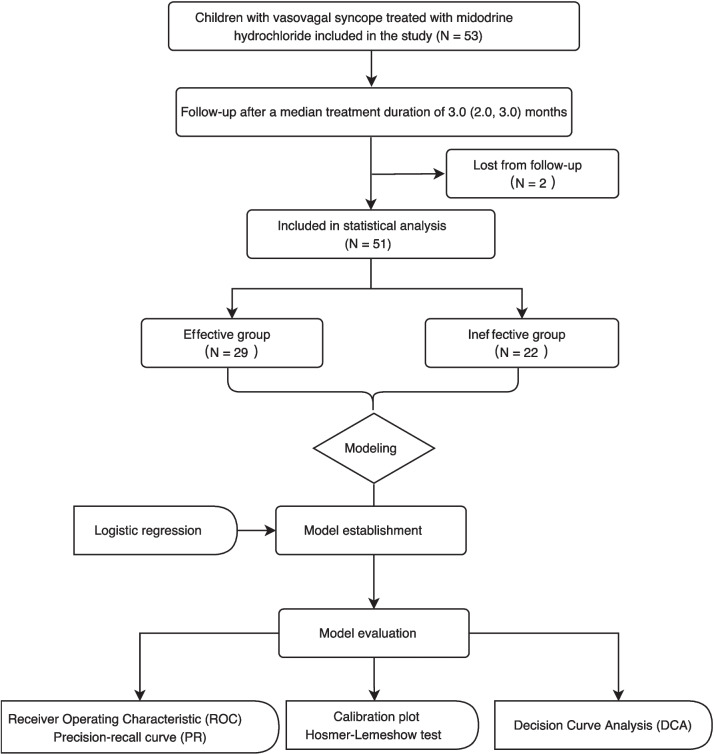
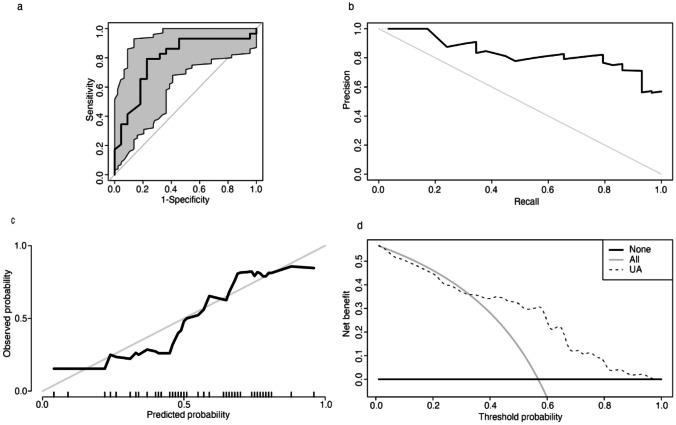
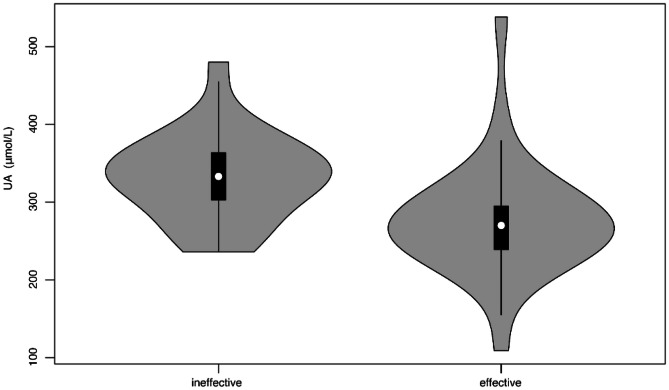
Serum uric acid (UA) level has been proven to be related to several cardiovascular and metabolic diseases. In the present study, we examined if baseline serum UA level could predict the therapeutic efficacy of midodrine hydrochloride on vasovagal syncope (VVS) in children. The pediatric VVS patients who received midodrine hydrochloride from November 2008 to October 2022 were enrolled. After a median treatment duration of 3 months, the therapeutic effect was evaluated. According to the patients' responses to midodrine hydrochloride, which was determined by the recurrence of syncope, they were divided into effective and ineffective groups. The baseline variables were explored using univariable and multivariate logistic analysis. The predictive efficacy was assessed by receiver operating characteristic curve (ROC), precision-recall curve (PR), Hosmer-Lemeshow test, calibration curve, and decision curve analysis (DCA). Totally, 53 participants were included in the study. Among the 51 patients who were successfully followed up, 29 (56.9%) responded to midodrine hydrochloride (effective group), and the other 22 (43.1%) failed to respond to midodrine hydrochloride (ineffective group). The participants in effective group had lower baseline serum UA level than those in ineffective group (276.5 ± 73 μmol/L vs. 332.7 ± 56 μmol/L, p = 0.004). Multivariable logistic analysis showed that serum UA was associated with the therapeutic response (odds ratio (OR): 0.985, 95% confidence interval (CI): 0.974-0.997, p = 0.01). ROC analysis indicated that using baseline serum UA < 299 μmol/L as a threshold value yielded a sensitivity of 77.3% and a specificity of 79.3% in predicting the treatment response to midodrine hydrochloride. The area under the PR curve was 0.833. Hosmer-Lemeshow test yielded a p value of 0.58, and calibration plot indicated that the model was well-fitted. DCA demonstrated that treatment decision depending on the baseline serum UA level resulted in a favorable net benefit. Conclusion: This pilot study suggested that the baseline serum UA level could be taken as a predictor of therapeutic effect of midodrine hydrochloride on VVS in children. What is Known: • Empirical and unselected use of midodrine hydrochloride has an unfavorable therapeutic effect on VVS in children. Serum uric acid (UA) is closely linked to cardiovascular events. What is New: • A low baseline serum UA level successfully predicts the therapeutic effectiveness of midodrine hydrochloride on VVS in children.
血清尿酸(UA)水平已被证明与多种心血管和代谢疾病有关。在本研究中,我们研究了基线血清 UA 水平是否可以预测米多君治疗儿童血管迷走性晕厥(VVS)的疗效。本研究纳入了 2008 年 11 月至 2022 年 10 月期间接受米多君治疗的儿科 VVS 患者。经过 3 个月的中位治疗时间后,评估了治疗效果。根据患者对米多君的反应(由晕厥复发确定),将他们分为有效组和无效组。使用单变量和多变量逻辑分析探索基线变量。通过受试者工作特征曲线(ROC)、精确召回曲线(PR)、Hosmer-Lemeshow 检验、校准曲线和决策曲线分析(DCA)评估预测效果。共有 53 名参与者纳入研究。在 51 名成功随访的患者中,29 名(56.9%)对米多君有反应(有效组),22 名(43.1%)对米多君无反应(无效组)。有效组患者的基线血清 UA 水平低于无效组(276.5 ± 73 μmol/L 比 332.7 ± 56 μmol/L,p = 0.004)。多变量逻辑分析显示,血清 UA 与治疗反应相关(比值比(OR):0.985,95%置信区间(CI):0.974-0.997,p = 0.01)。ROC 分析表明,将基线血清 UA < 299 μmol/L 作为阈值,预测米多君治疗反应的敏感性为 77.3%,特异性为 79.3%。PR 曲线下面积为 0.833。Hosmer-Lemeshow 检验的 p 值为 0.58,校准图表明模型拟合良好。DCA 表明,根据基线血清 UA 水平进行治疗决策可带来有利的净收益。结论:本研究表明,基线血清 UA 水平可作为预测儿童米多君治疗 VVS 疗效的指标。已知:• 经验性和非选择性使用米多君治疗儿童 VVS 的疗效不佳。血清尿酸(UA)与心血管事件密切相关。新发现:• 基线血清 UA 水平较低可成功预测米多君治疗儿童 VVS 的疗效。