Department of Ophthalmology, Copenhagen University Hospital - Rigshospitalet-Glostrup, Valdemar Hansens Vej 1-23, DK-2600, Glostrup, Denmark.
Department of Ophthalmology, University Hospital of Southern Denmark - Vejle Hospital, Beriderbakken 4, DK-7100, Vejle, Denmark.
BMC Ophthalmol. 2023 Oct 30;23(1):438. doi: 10.1186/s12886-023-03177-9.
To investigate the efficacy and safety of 0.1% and 0.01% low-dose atropine eye drops in reducing myopia progression in Danish children.
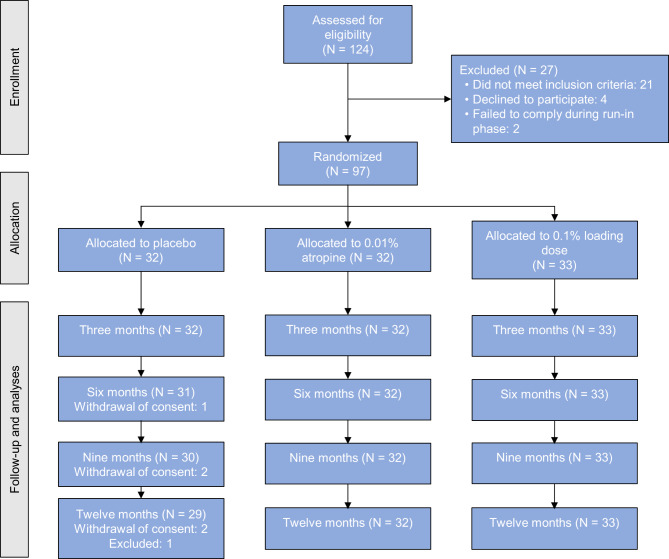
Investigator-initiated, placebo-controlled, double-masked, randomized clinical trial. Ninety-seven six- to twelve-year old myopic participants were randomized to 0.1% loading dose for six months followed by 0.01% for six months (loading dose group, Number (N) = 33), 0.01% for twelve months (0.01% group, N = 32) or vehicle for twelve months (placebo, N = 32). Primary outcomes were axial length and spherical equivalent refraction. Secondary outcomes included adverse events and reactions, choroidal thickness and ocular biometry. Outcomes were measured at baseline and three-month intervals. Data was analyzed with linear-mixed model analysis according to intention-to-treat.
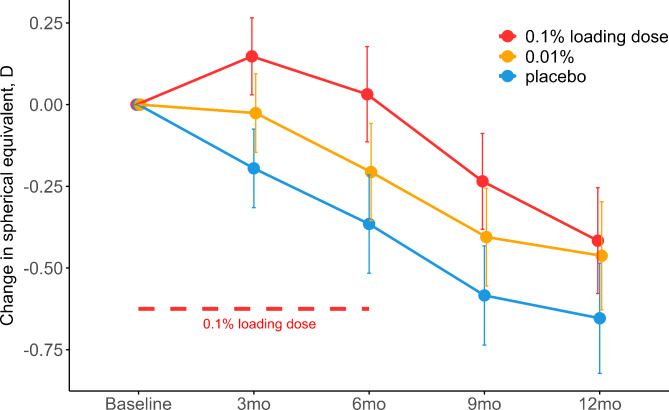
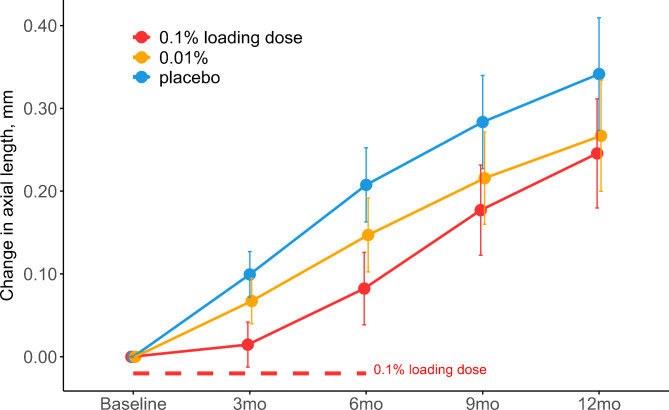
Mean axial elongation was 0.10 mm less (95% confidence interval (CI): 0.17; 0.02, adjusted-p = 0.06) in the 0.1% loading dose and 0.07 mm less (95% CI: 0.15; 0.00, adjusted-p = 0.16) in the 0.01% group at twelve months compared to placebo. Mean spherical equivalent refraction progression was 0.24 D (95% CI: 0.05; 0.42) less in the loading dose and 0.19 D (95% CI: 0.00; 0.38) less in the 0.01% groups at twelve months, compared to placebo (adjusted-p = 0.06 and 0.14, respectively). A total of 108 adverse events were reported during the initial six-month loading dose period, primarily in the loading dose group, and 14 were reported in the six months following dose switching, all deemed mild except two serious adverse events, unrelated to the intervention.
Low-dose atropine eye drops are safe over twelve months in otherwise healthy children. There may be a modest but clinically relevant reduction in myopia progression in Danish children after twelve months treatment, but the effect was statistically non-significant after multiple comparisons adjustment. After dose-switching at six months the loading dose group approached the 0.01% group, potentially indicating an early "rebound-effect".
this study was registered in the European Clinical Trials Database (EudraCT, number: 2018-001286-16) 05/11/2018 and first posted at www.
gov (NCT03911271) 11/04/2019, prior to initiation.
研究 0.1%和 0.01%低浓度阿托品滴眼液对丹麦儿童近视进展的疗效和安全性。
研究者发起、安慰剂对照、双盲、随机临床试验。97 名 6 至 12 岁近视参与者被随机分为 0.1%负荷剂量治疗 6 个月,随后 0.01%治疗 6 个月(负荷剂量组,N=33),0.01%治疗 12 个月(0.01%组,N=32)或 12 个月安慰剂(对照组,N=32)。主要结局为眼轴长度和球镜等效屈光度。次要结局包括不良反应和反应、脉络膜厚度和眼生物测量。在基线和 3 个月间隔时进行测量。根据意向治疗,采用线性混合模型分析对数据进行分析。
与安慰剂相比,12 个月时,0.1%负荷剂量组眼轴延长平均减少 0.10mm(95%置信区间(CI):0.17;0.02,调整后 p=0.06),0.01%组平均减少 0.07mm(95%CI:0.15;0.00,调整后 p=0.16)。12 个月时,负荷剂量组和 0.01%组的等效球镜屈光度进展平均分别减少 0.24D(95%CI:0.05;0.42)和 0.19D(95%CI:0.00;0.38),与安慰剂相比(调整后 p=0.06 和 0.14)。在最初的 6 个月负荷剂量期间,共报告了 108 起不良事件,主要发生在负荷剂量组,在剂量转换后 6 个月内报告了 14 起不良事件,所有不良事件均被认为是轻度的,除了 2 起与干预无关的严重不良事件。
在其他方面健康的儿童中,低浓度阿托品滴眼液在 12 个月内是安全的。在丹麦儿童中,12 个月治疗后近视进展可能有适度但具有临床意义的减少,但经过多次比较调整后,统计学上无显著意义。在 6 个月时剂量转换后,负荷剂量组接近 0.01%组,可能表明存在早期的“反弹效应”。
本研究于 2018 年 11 月 5 日在欧洲临床试验数据库(EudraCT,编号:2018-001286-16)注册,并于 2019 年 4 月 11 日在 www.clinicaltrials.gov 首次公布(NCT03911271)。