Kwak Ji Won, Lee Yong Jae, Park Byoungjin, Jung Dong Hyuk
Yonsei University Health System, Seoul, Republic of Korea.
Front Nutr. 2023 Oct 10;10:1275450. doi: 10.3389/fnut.2023.1275450. eCollection 2023.
Carcinoembryonic antigen (CEA) is a commonly used tumor marker in cancer screening. However, it has also been associated with metabolic alterations. Hepatic steatosis, the accumulation of fat in liver cells, is associated with various cardiovascular risk factors. This study investigated the risk of ischemic heart disease (IHD) in individuals with elevated CEA levels, hepatic steatosis, and their co-occurrence.
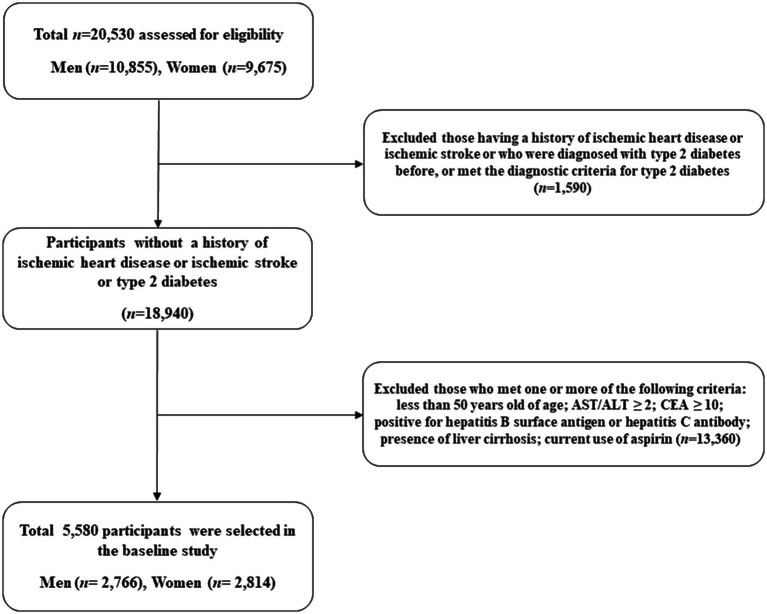
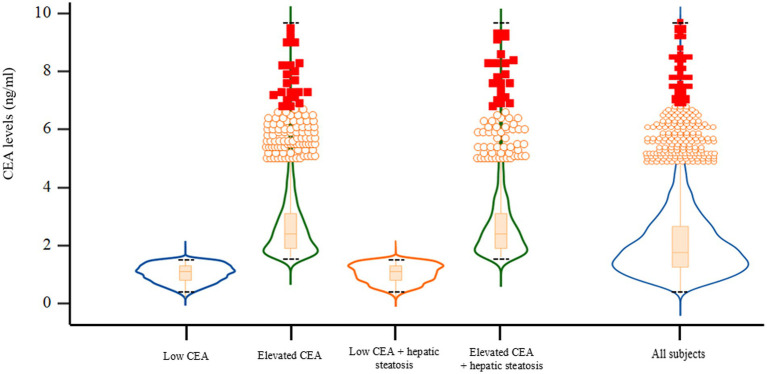
The study cohort comprised 5,580 Korean adults who underwent health examinations between November 2006 and June 2010. Data regarding baseline CEA levels, hepatic steatosis status, and development of IHD were collected. Hepatic steatosis was defined as more than two findings: deep attenuation, vascular blurring, and increased liver echogenicity on abdominal ultrasound. Participants were divided into four groups based on their CEA and hepatic steatosis status: no hepatic steatosis and low CEA (group 1), no hepatic steatosis and elevated CEA (group 2), low CEA and hepatic steatosis (group 3), and elevated CEA and hepatic steatosis (group 4).
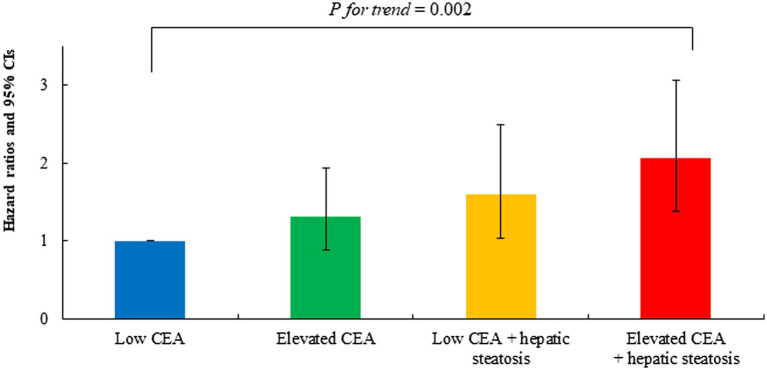
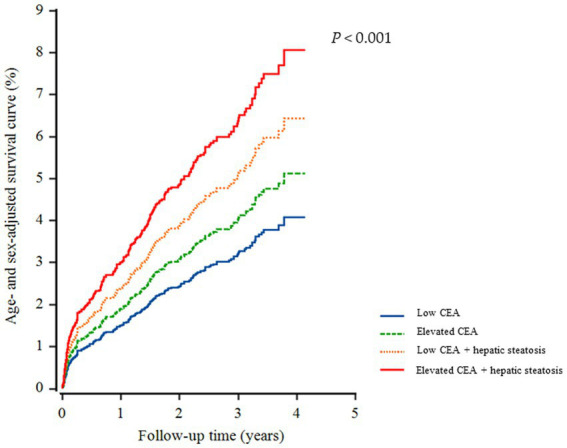
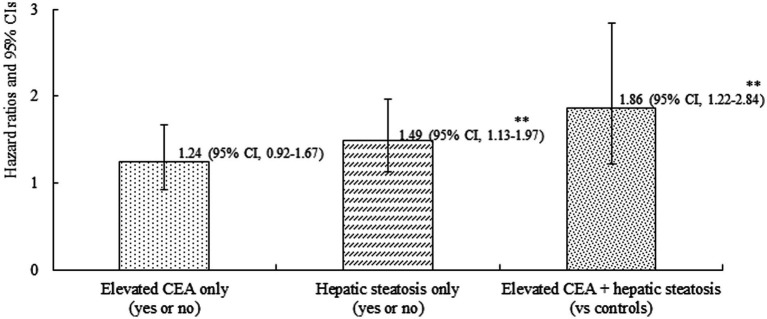
A total of 226 (4.1%) participants developed IHD during the follow-up period. Participants with elevated CEA levels and hepatic steatosis (group 4) had the highest cumulative incidence of IHD in comparison to other groups ( < 0.001). The combined effect of elevated CEA levels and hepatic steatosis showed significantly greater area under the receiver operating characteristic curve than hepatic steatosis alone ( < 0.001). Furthermore, participants with elevated CEA and hepatic steatosis (group 4) had higher risk of developing IHD compared to those with low CEA and no hepatic steatosis (group 1) (hazard ratio: 1.63, 95% confidence interval: 1.04-2.55, = 0.034).
Co-occurrence of elevated CEA levels and hepatic steatosis increases the risk of IHD. Comprehensive risk assessment is crucial to guide interventions and improve cardiovascular health in individuals with both the conditions.
癌胚抗原(CEA)是癌症筛查中常用的肿瘤标志物。然而,它也与代谢改变有关。肝脂肪变性,即肝细胞内脂肪的积累,与多种心血管危险因素相关。本研究调查了CEA水平升高、肝脂肪变性及其同时存在的个体患缺血性心脏病(IHD)的风险。
研究队列包括2006年11月至2010年6月期间接受健康检查的5580名韩国成年人。收集了关于基线CEA水平、肝脂肪变性状态和IHD发生情况的数据。肝脂肪变性定义为腹部超声检查有两项以上表现:深部衰减、血管模糊和肝脏回声增强。参与者根据其CEA和肝脂肪变性状态分为四组:无肝脂肪变性且CEA水平低(第1组)、无肝脂肪变性且CEA水平升高(第2组)、CEA水平低且有肝脂肪变性(第3组)、CEA水平升高且有肝脂肪变性(第4组)。
在随访期间,共有226名(4.1%)参与者发生了IHD。与其他组相比,CEA水平升高且有肝脂肪变性的参与者(第4组)IHD的累积发病率最高(<0.001)。CEA水平升高和肝脂肪变性的联合效应在受试者工作特征曲线下的面积显著大于单独的肝脂肪变性(<0.001)。此外,与CEA水平低且无肝脂肪变性的参与者(第1组)相比,CEA水平升高且有肝脂肪变性的参与者(第4组)发生IHD的风险更高(风险比:1.63,95%置信区间:1.04-2.55,=0.034)。
CEA水平升高和肝脂肪变性同时存在会增加IHD的风险。全面的风险评估对于指导干预措施和改善同时患有这两种疾病的个体的心血管健康至关重要。