Medical-Surgical ICU, Dupuytren Teaching Hospital, 87000, Limoges, France.
Inserm CIC 1435, Dupuytren Teaching Hospital, 87000, Limoges, France.
Crit Care. 2023 Nov 2;27(1):424. doi: 10.1186/s13054-023-04716-y.
Acute cor pulmonale (ACP) is prognostic in patients with acute respiratory distress syndrome (ARDS). Identification of paradoxical septal motion (PSM) using two-dimensional echocardiography is highly subjective. We sought to describe feature-engineered metrics derived from LV radial strain changes related to PSM in ARDS patients with ACP of various severity and to illustrate potential diagnostic and prognostic yield.
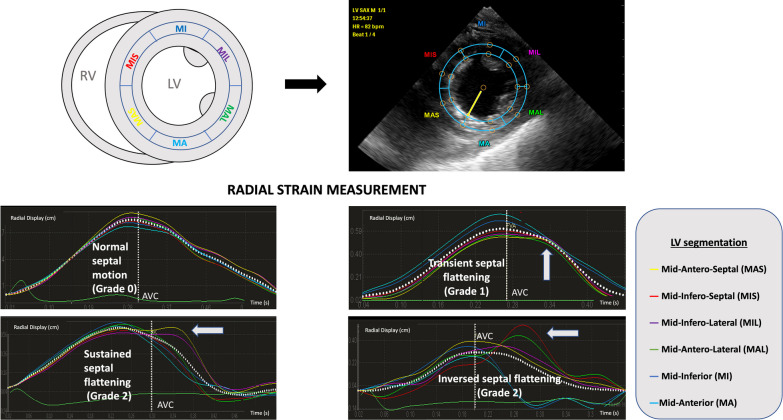
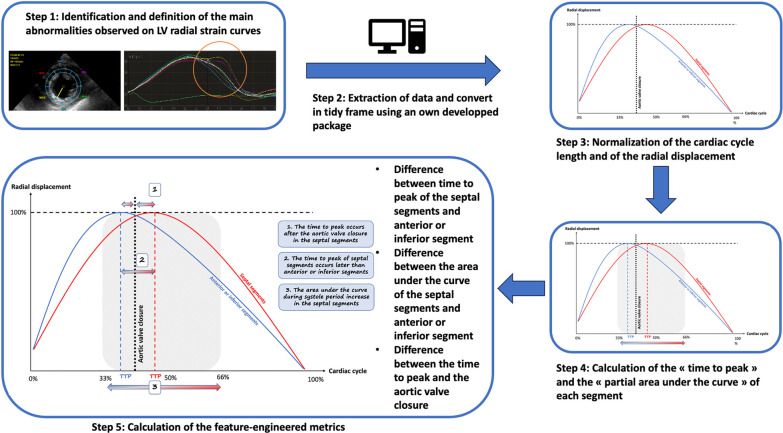
This prospective bicentric study included patients under protective ventilation for ARDS related to COVID-19 who were assessed using transesophageal echocardiography (TEE). Transgastric short-axis view at mid-papillary level was used to visually grade septal motion, using two-dimensional imaging, solely and combined with LV radial strain: normal (grade 0), transient end-systolic septal flattening (grade 1), prolonged end-systolic septal flattening or reversed septal curvature (grade 2). Inter-observer variability was calculated. Feature engineering was performed to calculate the time-to-peak and area under the strain curve in 6 LV segments. In the subset of patients with serial TEE examinations, a multivariate Cox model analysis accounting for new-onset of PSM as a time-dependent variable was used to identify parameters associated with ICU mortality.
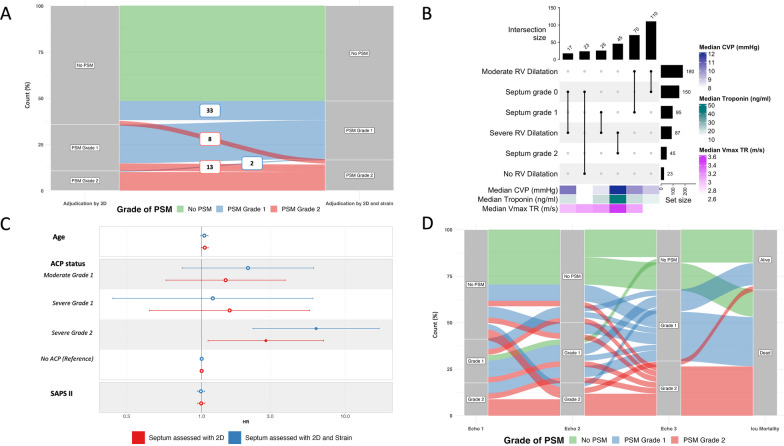
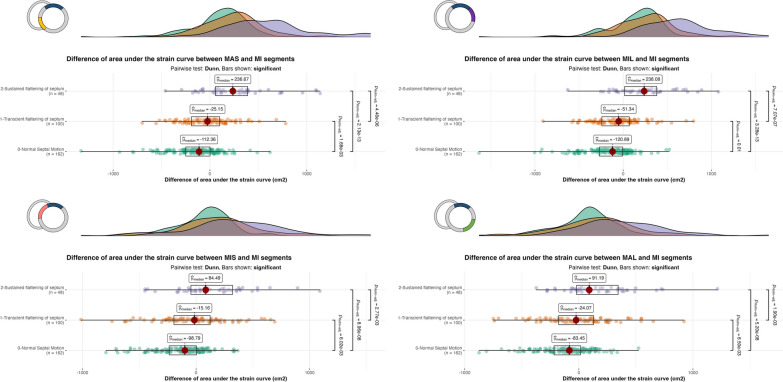
Overall, 310 TEE examinations performed in 182 patients were analyzed (age: 67 [60-72] years; men: 66%; SAPSII: 35 [29-40]). Two-dimensional assessment identified a grade 1 and grade 2 PSM in 100 (32%) and 48 (15%) examinations, respectively. Inter-rater reliability was weak using two-dimensional imaging alone (kappa = 0.49; 95% CI 0.40-0.58; p < 0.001) and increased with associated LV radial strain (kappa = 0.84, 95% CI 0.79-0.90, p < 0.001). The time-to-peak of mid-septal and mid-lateral segments occurred significantly later in systole and increased with the grade of PSM. Similarly, the area under the strain curve of these segments increased significantly with the grade of PSM, compared with mid-anterior or mid-inferior segments. Severe acute cor pulmonale with a grade 2 PSM was significantly associated with mortality. Requalification in an upper PSM grade using LV radial strain allowed to better identify patients at risk of death (HR: 6.27 [95% CI 2.28-17.2] vs. 2.80 [95% CI 1.11-7.09]).
In objectively depicting PSM and quantitatively assessing its severity, TEE LV radial strain appears as a valuable adjunct to conventional two-dimensional imaging.
急性肺心病(ACP)是急性呼吸窘迫综合征(ARDS)患者的预后指标。使用二维超声心动图识别矛盾性室间隔运动(PSM)高度主观。我们旨在描述与 ACP 严重程度不同的 ARDS 患者中与 PSM 相关的 LV 径向应变变化的特征工程指标,并说明其潜在的诊断和预后价值。
这项前瞻性的中心研究纳入了因 COVID-19 相关 ARDS 接受保护性通气的患者,使用经食管超声心动图(TEE)进行评估。使用经胃短轴切面在乳头水平中部进行二维成像,单独和联合使用 LV 径向应变对室间隔运动进行视觉分级:正常(分级 0)、短暂的收缩末期室间隔平坦(分级 1)、持续的收缩末期室间隔平坦或反向室间隔弯曲(分级 2)。计算观察者间的变异性。进行特征工程以计算 6 个 LV 节段的应变曲线的峰值时间和面积。在有连续 TEE 检查的患者亚组中,使用多变量 Cox 模型分析,将新发 PSM 作为时间依赖性变量,以确定与 ICU 死亡率相关的参数。
共分析了 182 例患者的 310 次 TEE 检查(年龄:67[60-72]岁;男性:66%;SAPSII:35[29-40])。二维评估分别在 100(32%)和 48(15%)次检查中识别出 1 级和 2 级 PSM。单独使用二维成像时,观察者间的可靠性较弱(kappa=0.49;95%CI 0.40-0.58;p<0.001),而与相关的 LV 径向应变联合使用时则增加(kappa=0.84,95%CI 0.79-0.90,p<0.001)。中隔和中侧壁中段的峰值时间在收缩期明显延迟,并随 PSM 分级增加。同样,与中前壁或中后壁节段相比,这些节段的应变曲线面积随 PSM 分级的增加而显著增加。严重的急性肺心病伴 2 级 PSM 与死亡率显著相关。使用 LV 径向应变重新分级为较高的 PSM 分级可更好地识别有死亡风险的患者(HR:6.27[95%CI 2.28-17.2] vs. 2.80[95%CI 1.11-7.09])。
在客观地描绘 PSM 并定量评估其严重程度方面,TEE LV 径向应变似乎是传统二维成像的有用补充。