Department of Biochemistry & Molecular Biology, Graduate School of Medical Science, Brain Korea 21 Project, Institute of Genetic Science, Yonsei University College of Medicine, 50-1 Yonsei-ro, Seodaemun-gu, Seoul, 03722, Republic of Korea.
Department of Life Science, College of Natural Science, Ewha Womans University, 52 Ewhayeodae-Gil, Seodaemun-gu, Seoul, 03760, Republic of Korea.
Int J Biol Sci. 2023 Oct 16;19(16):5245-5256. doi: 10.7150/ijbs.86404. eCollection 2023.
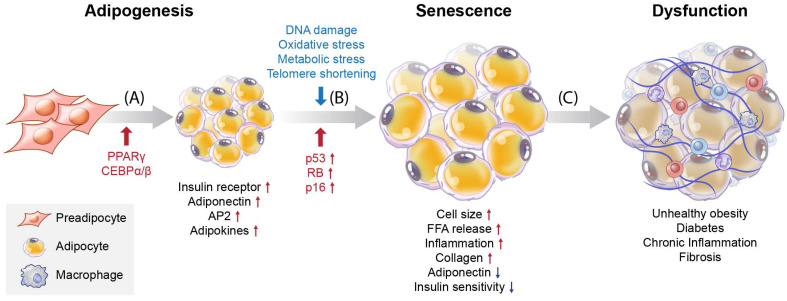
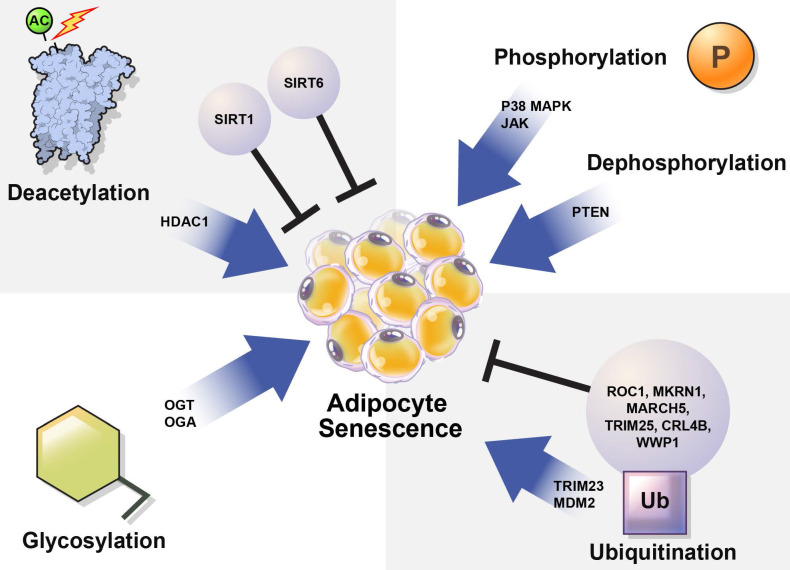
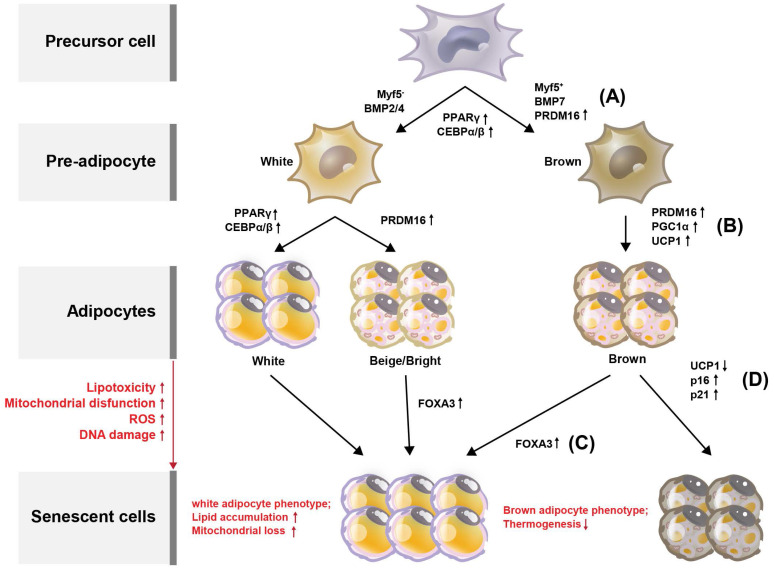
Adipocytes are adipose tissues that supply energy to the body through lipids. The two main types of adipocytes comprise white adipocytes (WAT) that store energy, and brown adipocytes (BAT), which generate heat by burning stored fat (thermogenesis). Emerging evidence indicates that dysregulated adipocyte senescence may disrupt metabolic homeostasis, leading to various diseases and aging. Adipocytes undergo senescence via irreversible cell-cycle arrest in response to DNA damage, oxidative stress, telomere dysfunction, or adipocyte over-expansion upon chronic lipid accumulation. The amount of detectable BAT decreases with age. Activation of cell cycle regulators and dysregulation of adipogenesis-regulating factors may constitute a molecular mechanism that accelerates adipocyte senescence. To better understand the regulation of adipocyte senescence, the effects of post-translational modifications (PTMs), is essential for clarifying the activity and stability of these proteins. PTMs are covalent enzymatic protein modifications introduced following protein biosynthesis, such as phosphorylation, acetylation, ubiquitination, or glycosylation. Determining the contribution of PTMs to adipocyte senescence may identify new therapeutic targets for the regulation of adipocyte senescence. In this review, we discuss a conceptual case in which PTMs regulate adipocyte senescence and explain the mechanisms underlying protein regulation, which may lead to the development of effective strategies to combat metabolic diseases.
脂肪细胞是通过脂质为身体提供能量的脂肪组织。两种主要类型的脂肪细胞包括储存能量的白色脂肪细胞(WAT)和通过燃烧储存的脂肪产生热量(产热)的棕色脂肪细胞(BAT)。新出现的证据表明,失调的脂肪细胞衰老可能破坏代谢稳态,导致各种疾病和衰老。脂肪细胞通过对 DNA 损伤、氧化应激、端粒功能障碍或慢性脂质积累导致的脂肪细胞过度扩张的不可逆细胞周期停滞而发生衰老。随着年龄的增长,可检测到的 BAT 数量减少。细胞周期调节剂的激活和脂肪生成调节因子的失调可能构成加速脂肪细胞衰老的分子机制。为了更好地理解脂肪细胞衰老的调控,翻译后修饰(PTMs)的影响对于阐明这些蛋白质的活性和稳定性至关重要。PTMs 是在蛋白质生物合成后引入的共价酶蛋白修饰,如磷酸化、乙酰化、泛素化或糖基化。确定 PTMs 对脂肪细胞衰老的贡献可能为调节脂肪细胞衰老确定新的治疗靶点。在这篇综述中,我们讨论了一个概念性案例,即 PTMs 调节脂肪细胞衰老,并解释了蛋白质调节的机制,这可能导致开发有效策略来对抗代谢疾病。