Department of Laboratory Medicine, the First Affiliated Hospital of Nanjing Medical University, Nanjing, China.
Branch of National Clinical Research Center for Laboratory Medicine, Nanjing, China.
Front Immunol. 2023 Oct 20;14:1278521. doi: 10.3389/fimmu.2023.1278521. eCollection 2023.
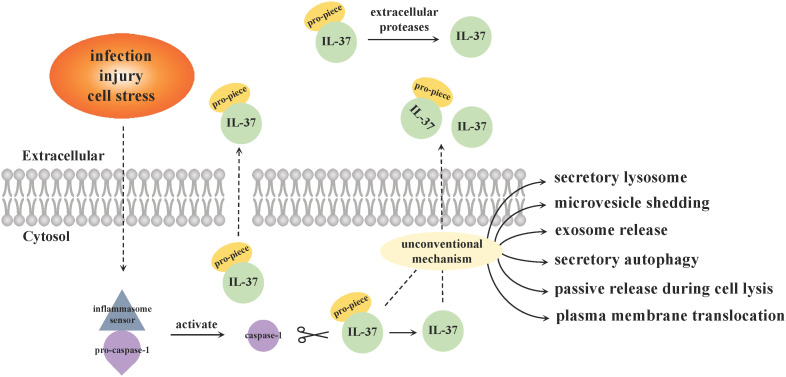
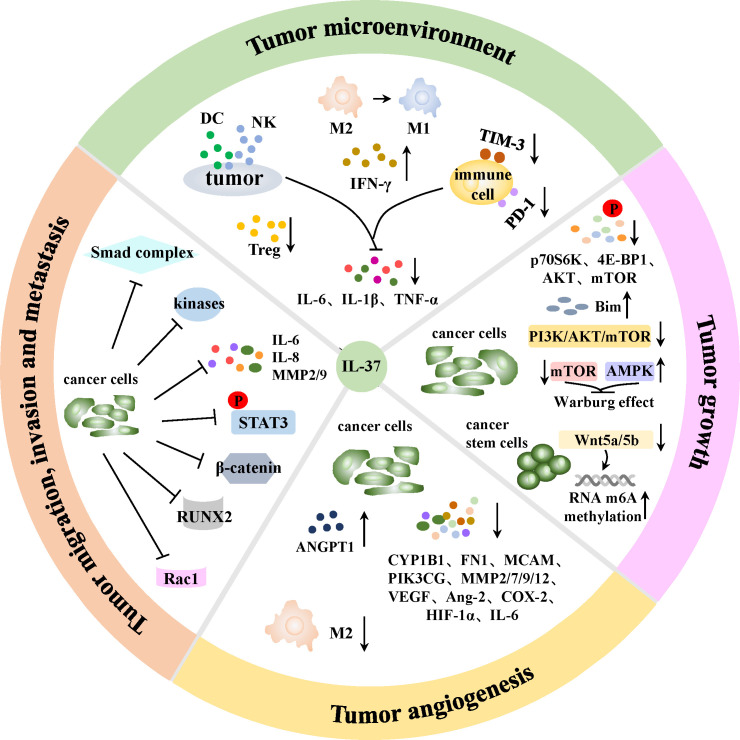
Interleukin-37 (IL-37) is a newly discovered member of IL-1 family. The cytokine was proved to have extensive protective effects in infectious diseases, allergic diseases, metabolic diseases, autoimmune diseases and tumors since its discovery. IL-37 was mainly produced by immune and some non-immune cells in response to inflammatory stimulus. The IL-37 precursors can convert into the mature forms after caspase-1 cleavage and activation intracellularly, and then bind to Smad-3 and transfer to the nucleus to inhibit the production and functions of proinflammatory cytokines; extracellularly, IL-37 binds to cell surface receptors to form IL-37/IL-18Rα/IL-1R8 complex to exert immunosuppressive function via inhibiting/activating multiple signal pathways. In addition, IL-37 can attenuate the pro-inflammatory effect of IL-18 through directly or forming an IL-37/IL-18BP/IL-18Rβ complex. Therefore, IL-37 has the ability to suppress innate and acquired immunity of the host, and effectively control inflammatory stimulation, which was considered as a new hallmark of cancer. Specifically, it is concluded that IL-37 can inhibit the growth and migration of tumor cells, prohibit angiogenesis and mediate the immunoregulation in tumor microenvironment, so as to exert effective anti-tumor effects. Importantly, latest studies also showed that IL-37 may be a novel therapeutic target for cancer monitoring. In this review, we summarize the immunoregulation roles and mechanisms of IL-37 in anti-tumor process, and discuss its progress so far and potential as tumor immunotherapy.
白细胞介素-37 (IL-37) 是白细胞介素-1 家族的新成员。自发现以来,该细胞因子已被证明在感染性疾病、过敏性疾病、代谢性疾病、自身免疫性疾病和肿瘤中具有广泛的保护作用。IL-37 主要由免疫和一些非免疫细胞在炎症刺激下产生。IL-37 前体可以在细胞内被半胱天冬酶-1 切割和激活后转化为成熟形式,然后与 Smad-3 结合并转移到核内抑制促炎细胞因子的产生和功能;细胞外,IL-37 与细胞表面受体结合形成 IL-37/IL-18Rα/IL-1R8 复合物,通过抑制/激活多种信号通路发挥免疫抑制功能。此外,IL-37 还可以通过直接作用或形成 IL-37/IL-18BP/IL-18Rβ 复合物来减弱 IL-18 的促炎作用。因此,IL-37 具有抑制宿主固有和获得性免疫的能力,并能有效控制炎症刺激,被认为是癌症的新标志。具体来说,IL-37 可以抑制肿瘤细胞的生长和迁移,抑制血管生成,并调节肿瘤微环境中的免疫调节,从而发挥有效的抗肿瘤作用。重要的是,最新的研究还表明,IL-37 可能是癌症监测的新治疗靶点。在这篇综述中,我们总结了 IL-37 在抗肿瘤过程中的免疫调节作用和机制,并讨论了其迄今为止的进展和作为肿瘤免疫治疗的潜力。