Rare Disease Laboratory, School of Life and Natural Sciences, Abdullah Gul University, Kayseri 38080, Turkey.
School of Applied Science and Engineering, Fuzhou Institute of Technology, Fuzhou 350014, China.
G3 (Bethesda). 2023 Dec 6;13(12). doi: 10.1093/g3journal/jkad227.
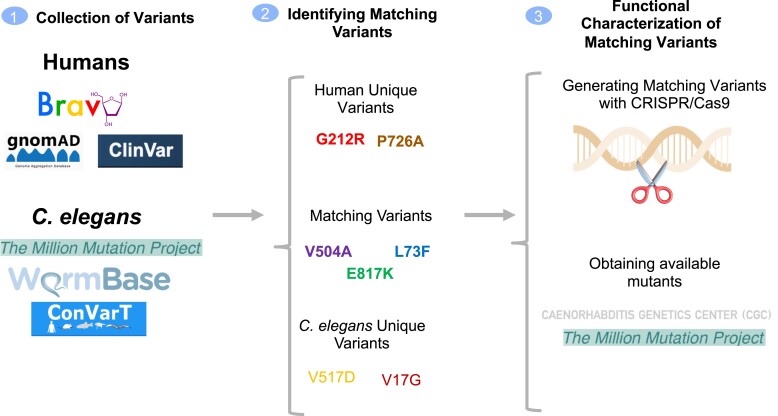
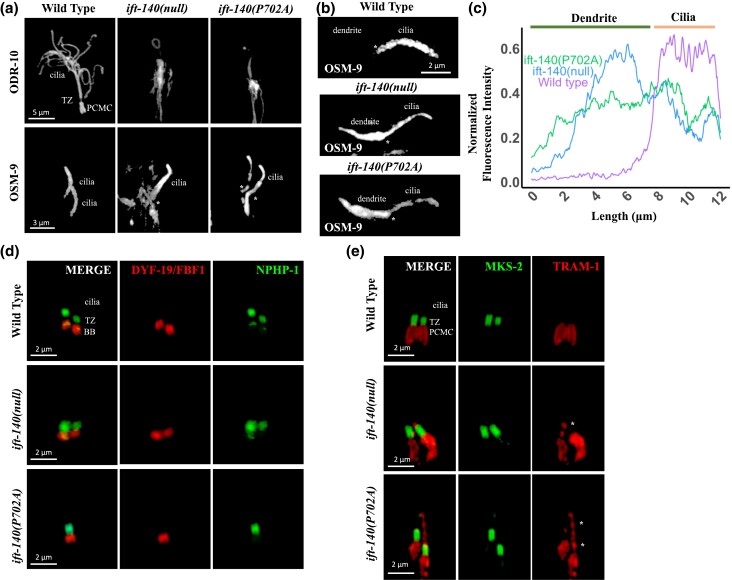
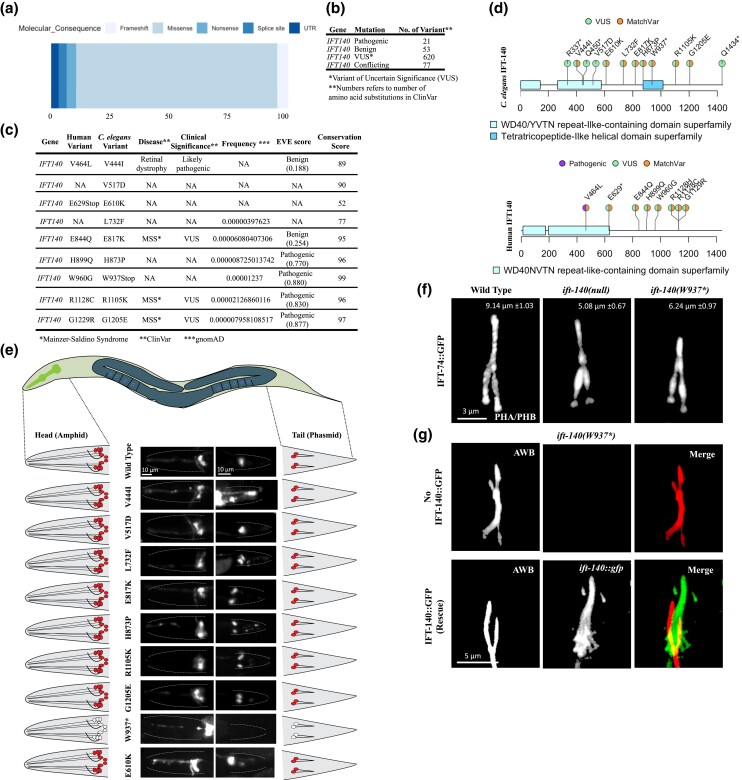
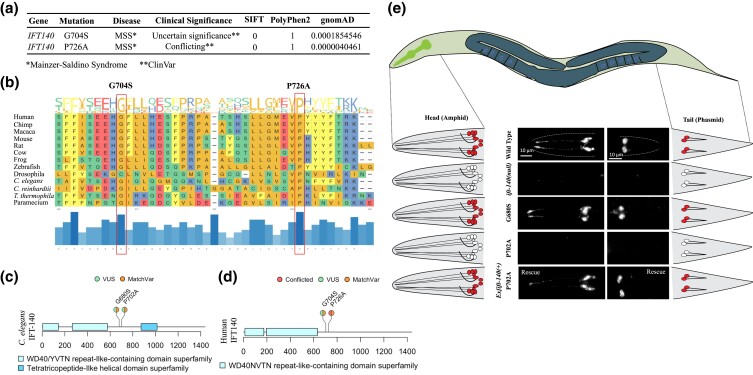
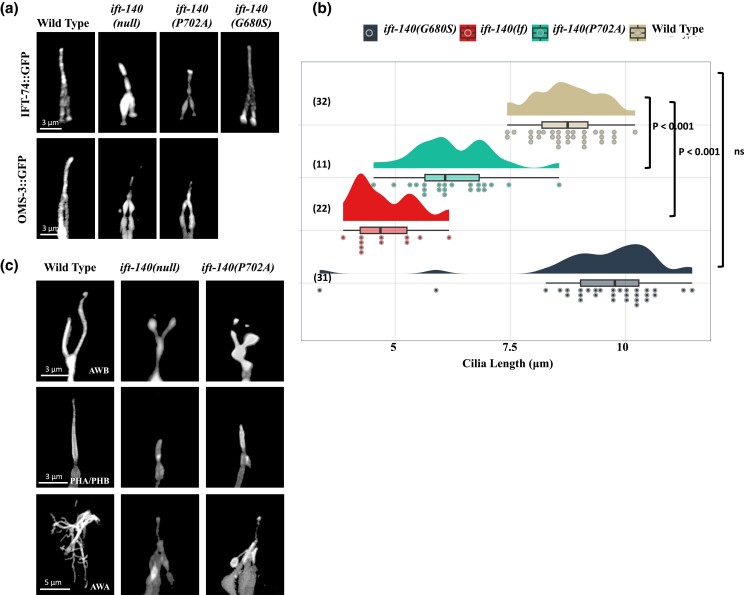
Rapid and low-cost sequencing, as well as computer analysis, have facilitated the diagnosis of many genetic diseases, resulting in a substantial rise in the number of disease-associated genes. However, genetic diagnosis of many disorders remains problematic due to the lack of interpretation for many genetic variants, especially missenses, the infeasibility of high-throughput experiments on mammals, and the shortcomings of computational prediction technologies. Additionally, the available mutant databases are not well-utilized. Toward this end, we used Caenorhabditis elegans mutant resources to delineate the functions of eight missense variants (V444I, V517D, E610K, L732F, E817K, H873P, R1105K, and G1205E) and two stop codons (W937stop and Q1434stop), including several matching variants (MatchVar) with human in ciliopathy associated IFT-140 (also called CHE-11)//IFT140 (intraflagellar transport protein 140). Moreover, MatchVars carrying C. elegans mutants, including IFT-140(G680S) and IFT-140(P702A) for the human (G704S) (dbSNP: rs150745099) and P726A (dbSNP: rs1057518064 and a conflicting variation) were created using CRISPR/Cas9. IFT140 is a key component of IFT complex A (IFT-A), which is involved in the retrograde transport of IFT along cilia and the entrance of G protein-coupled receptors into cilia. Functional analysis of all 10 variants revealed that P702A and W937stop, but not others phenocopied the ciliary phenotypes (short cilia, IFT accumulations, mislocalization of membrane proteins, and cilia entry of nonciliary proteins) of the IFT-140 null mutant, indicating that both P702A and W937stop are phenotypic in C. elegans. Our functional data offered experimental support for interpreting human variants, by using ready-to-use mutants carrying MatchVars and generating MatchVars with CRISPR/Cas9.
快速且低成本的测序技术以及计算机分析极大地促进了许多遗传性疾病的诊断,导致与疾病相关的基因数量显著增加。然而,由于许多遗传变异,特别是错义变异,缺乏解释,哺乳动物高通量实验不可行,以及计算预测技术的不足,许多疾病的遗传诊断仍然存在问题。此外,现有的突变体数据库也未得到充分利用。为此,我们利用秀丽隐杆线虫的突变体资源来描绘八个错义变异体(V444I、V517D、E610K、L732F、E817K、H873P、R1105K 和 G1205E)和两个终止密码子(W937stop 和 Q1434stop)的功能,包括与纤毛相关的内运输蛋白 140(也称为 CHE-11)//IFT140 相关的几个匹配变体(MatchVar)。此外,利用 CRISPR/Cas9 构建了包括 IFT-140(G680S)和 IFT-140(P702A)在内的 MatchVars,这些 MatchVars在人类中分别对应 G704S(dbSNP:rs150745099)和 P726A(dbSNP:rs1057518064 和一个冲突的变异)。IFT140 是 IFT 复合物 A(IFT-A)的关键组成部分,参与 IFT 沿着纤毛的逆行运输以及 G 蛋白偶联受体进入纤毛。对所有 10 个变体的功能分析表明,P702A 和 W937stop,但不是其他变体,表现出与 IFT-140 缺失突变体相似的纤毛表型(纤毛缩短、IFT 聚集、膜蛋白定位错误和非纤毛蛋白进入纤毛),这表明 P702A 和 W937stop 在秀丽隐杆线虫中都是表型的。我们的功能数据通过使用携带 MatchVars 的现成突变体和利用 CRISPR/Cas9 生成 MatchVars,为解释人类变异体提供了实验支持。