Sauer Sandra, Kriegsmann Katharina, Nientiedt Cathleen, Schmitt Anita, Müller-Tidow Carsten, Raab Marc-Steffen, Kauer Joseph
Department of Hematology, Oncology and Rheumatology, Heidelberg University Hospital, Heidelberg, Germany.
National Center for Tumor Diseases (NCT), Heidelberg University Hospital, Heidelberg, Germany.
Transfus Med Hemother. 2023 Mar 24;50(5):371-381. doi: 10.1159/000529691. eCollection 2023 Oct.
In transplant-eligible, newly diagnosed multiple myeloma (NDMM) patients, autologous peripheral blood stem cell (PBSC) collection is usually pursued after induction therapy. While induction regimens are constantly refined regarding response, their impact on PBSC collection is not fully studied. The inclusion of the anti-CD38 antibody daratumumab into induction therapy significantly improved outcomes for patients with NDMM, e.g., as part of the daratumumab, bortezomib, thalidomide, and dexamethasone (Dara-VTD) protocol. Preliminary data from the phase 3 CASSIOPEIA study proved the efficacy of Dara-VTD. While overall PBSC collection upon addition of daratumumab was reduced in the study population, more detailed analyses on the impact are missing.
We here report on PBSC mobilization and collection metrics in = 119 patients with NDMM who underwent induction therapy with bortezomib, cyclophosphamide, and dexamethasone (VCD, = 61) or Dara-VTD ( = 58).
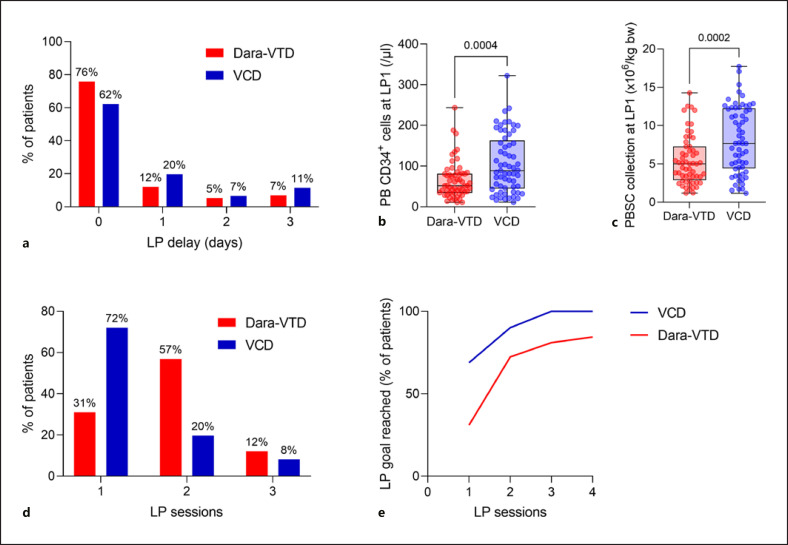
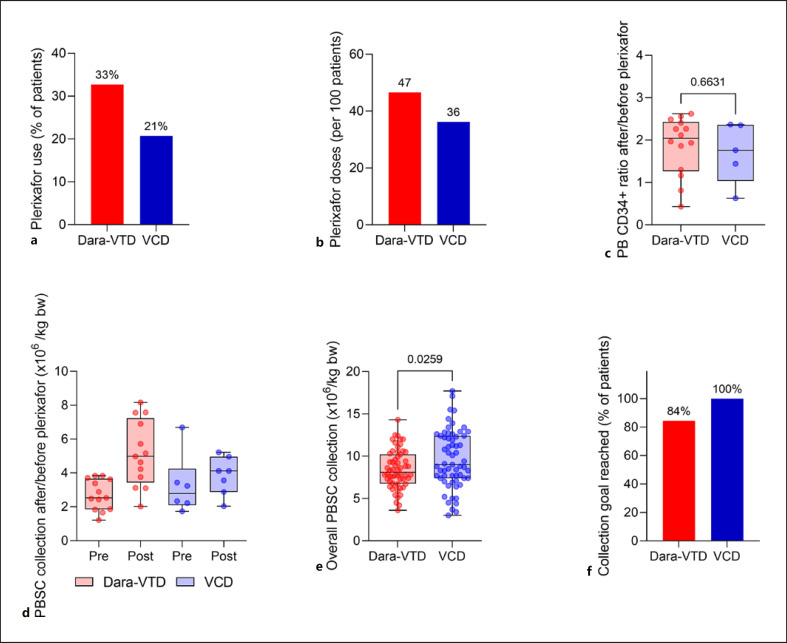
Patient characteristics were well balanced between groups. The Dara-VTD group showed improved response parameters with 66% of patients reaching at least very good partial response versus 54% in the VCD group. Dara-VTD patients exhibited inferior mobilization metrics such as peripheral blood CD34 cell count at the first leukapheresis (LP) session (65 vs. 106/μL, = 0.001), median number of LP sessions (2 vs. 1, = 0.001), and PBSC collection at first LP (5.5 vs. 8.3 × 10/kg body weight [bw], = 0.001). Utilization of plerixafor was slightly higher after Dara-VTD (33% vs. 21% of patients, = 0.143). The overall PBSC collection result was significantly lower after Dara-VTD (8.4 vs. 9.6 × 10/kg bw, = 0.026). 78% and 85% of patients successfully collected 3 transplants with ≥2 × 10 CD34 cells/kg bw in the Dara-VTD and the VCD groups, respectively.
In summary, Dara-VTD, possibly due to both anti-CD38 antibody and thalidomide exposure, imposes a limitation on PBSC collection which can be only partly overcome by utilization of plerixafor.
在适合移植的新诊断多发性骨髓瘤(NDMM)患者中,诱导治疗后通常进行自体外周血干细胞(PBSC)采集。虽然诱导方案在疗效方面不断优化,但其对PBSC采集的影响尚未得到充分研究。将抗CD38抗体达雷妥尤单抗纳入诱导治疗可显著改善NDMM患者的预后,例如作为达雷妥尤单抗、硼替佐米、沙利度胺和地塞米松(Dara-VTD)方案的一部分。3期CASSIOPEIA研究的初步数据证明了Dara-VTD的疗效。虽然在研究人群中加入达雷妥尤单抗后总体PBSC采集量减少,但缺少对其影响的更详细分析。
我们在此报告了119例接受硼替佐米、环磷酰胺和地塞米松(VCD,n = 61)或Dara-VTD(n = 58)诱导治疗的NDMM患者的PBSC动员和采集指标。
两组患者的特征均衡。Dara-VTD组的缓解参数有所改善,66%的患者至少达到非常好的部分缓解,而VCD组为54%。Dara-VTD组患者的动员指标较差,如第一次白细胞分离术(LP)时外周血CD34细胞计数(65对106/μL,P = 0.001)、LP次数中位数(2对1,P = 0.001)以及第一次LP时的PBSC采集量(5.5对8.3×10⁶/kg体重[bw],P = 0.001)。Dara-VTD治疗后普乐沙福的使用率略高(33%对21%的患者,P = 0.143)。Dara-VTD治疗后的总体PBSC采集结果显著更低(8.4对9.6×10⁶/kg bw,P = 0.026)。Dara-VTD组和VCD组分别有78%和85%的患者成功采集到≥2×10⁶ CD34细胞/kg bw的3次移植量。
总之,Dara-VTD可能由于抗CD38抗体和沙利度胺的双重作用,对PBSC采集造成限制,而使用普乐沙福只能部分克服这一限制。