Stonehill College, Neuroscience Program, Easton, MA, United States.
Stonehill College, Department of Biology, Easton, MA, United States.
Front Endocrinol (Lausanne). 2023 Oct 23;14:1286838. doi: 10.3389/fendo.2023.1286838. eCollection 2023.
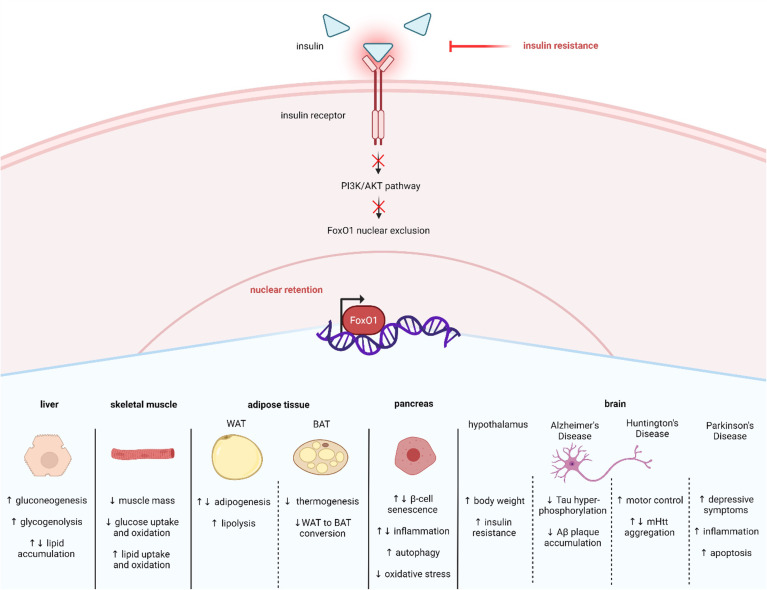
Forkhead box O (FoxO) proteins are transcription factors that mediate many aspects of physiology and thus have been targeted as therapeutics for several diseases including metabolic disorders such as type 2 diabetes mellitus (T2D). The role of FoxO1 in metabolism has been well studied, but recently FoxO1's potential for diabetes prevention and therapy has been debated. For example, studies have shown that increased FoxO1 activity in certain tissue types contributes to T2D pathology, symptoms, and comorbidities, yet in other tissue types elevated FoxO1 has been reported to alleviate symptoms associated with diabetes. Furthermore, studies have reported opposite effects of active FoxO1 in the same tissue type. For example, in the liver, FoxO1 contributes to T2D by increasing hepatic glucose production. However, FoxO1 has been shown to either increase or decrease hepatic lipogenesis as well as adipogenesis in white adipose tissue. In skeletal muscle, FoxO1 reduces glucose uptake and oxidation, promotes lipid uptake and oxidation, and increases muscle atrophy. While many studies show that FoxO1 lowers pancreatic insulin production and secretion, others show the opposite, especially in response to oxidative stress and inflammation. Elevated FoxO1 in the hypothalamus increases the risk of developing T2D. However, increased FoxO1 may mitigate Alzheimer's disease, a neurodegenerative disease strongly associated with T2D. Conversely, accumulating evidence implicates increased FoxO1 with Parkinson's disease pathogenesis. Here we review FoxO1's actions in T2D conditions in metabolic tissues that abundantly express FoxO1 and highlight some of the current studies targeting FoxO1 for T2D treatment.
叉头框蛋白 O(FoxO)是一种转录因子,介导许多生理方面,因此已被作为治疗几种疾病的靶点,包括代谢紊乱,如 2 型糖尿病(T2D)。FoxO1 在代谢中的作用已得到广泛研究,但最近 FoxO1 预防和治疗糖尿病的潜力一直存在争议。例如,研究表明,某些组织类型中 FoxO1 活性的增加导致 T2D 病理、症状和合并症,但在其他组织类型中,升高的 FoxO1 被报道可减轻与糖尿病相关的症状。此外,研究报告了活性 FoxO1 在同一组织类型中的相反作用。例如,在肝脏中,FoxO1 通过增加肝葡萄糖生成来促进 T2D。然而,FoxO1 已被证明可增加或减少肝脂肪生成以及白色脂肪组织中的脂肪生成。在骨骼肌中,FoxO1 减少葡萄糖摄取和氧化,促进脂质摄取和氧化,并增加肌肉萎缩。虽然许多研究表明 FoxO1 降低胰腺胰岛素的产生和分泌,但其他研究则表明相反,尤其是在应对氧化应激和炎症时。下丘脑 FoxO1 升高增加了患 T2D 的风险。然而,FoxO1 的升高可能减轻与 T2D 强烈相关的神经退行性疾病阿尔茨海默病。相反,越来越多的证据表明 FoxO1 与帕金森病的发病机制有关。在这里,我们综述了 FoxO1 在代谢组织中 T2D 条件下的作用,这些组织大量表达 FoxO1,并强调了一些针对 FoxO1 治疗 T2D 的当前研究。