Haramaya Institute of Technology, Haramaya University, P.O. Box 138, Dire Dawa, Ethiopia.
Ethiopian Institute of Water Resources, Addis Ababa University, P.O. Box 1176, Addis Ababa, Ethiopia.
ScientificWorldJournal. 2023 Oct 31;2023:7454137. doi: 10.1155/2023/7454137. eCollection 2023.
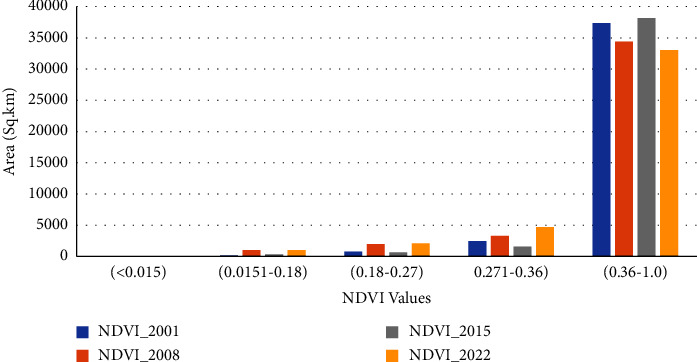
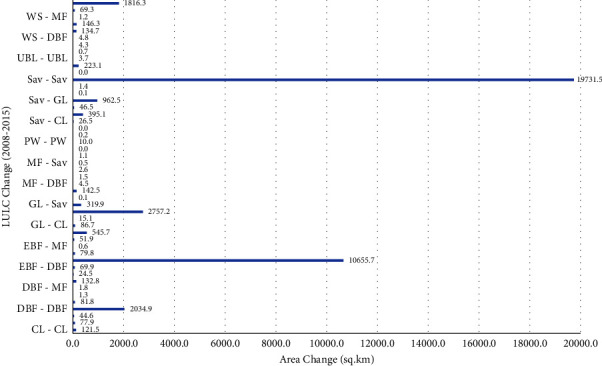
Land use and land cover (LULC) change and variability are some of the challenges to present-day water resource management. The purpose of this study was to determine LULC and Normalized Difference Vegetation Index (NDVI) fluctuations in western Ethiopia during the last 20 years. The first part of the study used MODIS LULC data for the change analysis, change detection, and spatial and temporal coverage in the study region. In the second part, the study analyzes the NDVI change and its spatial and temporal coverage. In this study, The Moderate Resolution Imaging Spectroradiometer (MODIS) satellite data were applied to determine LULC and NDVI changes over four different periods. Evergreen broadleaf forests, deciduous broadleaf forests, mixed forests, woody savannas, savannas, grasslands, permanent wetlands, croplands, urban and built-up lands, and water bodies are the LULC in the period of analysis. The overall classification accuracy for the classified image from 2001 to 2020 was 85.4% and the overall kappa statistic was 81.2%. The results indicate a substantial increase in woody savannas, deciduous broadleaf, grasslands, permanent wetlands, and mixed forest areas by 119.6%, 57.7% 45.2%, 37%, and 21.3%, respectively, followed by reductions in croplands, water bodies, savannas, and evergreen broadleaf forest by 90.1%, 19.8%, 13.2%, and 4.8%, respectively, for the catchment between 2001 and 2020. The result also showed that the area's vegetation cover increased by 64% from 2001 to 2022. This study could provide valuable information for water resource and environmental management as well as policy and decision-making.
土地利用和土地覆被(LULC)变化和变异性是当今水资源管理面临的一些挑战。本研究旨在确定过去 20 年埃塞俄比亚西部的 LULC 和归一化植被指数(NDVI)波动情况。研究的第一部分使用 MODIS LULC 数据进行变化分析、变化检测以及研究区域的时空覆盖分析。在第二部分,研究分析了 NDVI 变化及其时空覆盖情况。在本研究中,应用中分辨率成像光谱仪(MODIS)卫星数据确定了四个不同时期的 LULC 和 NDVI 变化。常绿阔叶林、落叶阔叶林、混交林、木本稀树草原、稀树草原、草地、永久性湿地、耕地、城市和建成区以及水体是分析期内的 LULC。2001 年至 2020 年分类图像的总体分类精度为 85.4%,总体kappa 统计量为 81.2%。结果表明,木本稀树草原、落叶阔叶林、草地、永久性湿地和混交林面积分别显著增加了 119.6%、57.7%、45.2%、37%和 21.3%,而耕地、水体、稀树草原和常绿阔叶林面积分别减少了 90.1%、19.8%、13.2%和 4.8%,在 2001 年至 2020 年期间,流域面积减少了 90.1%、19.8%、13.2%和 4.8%。结果还表明,该地区的植被覆盖面积从 2001 年到 2022 年增加了 64%。本研究可为水资源和环境管理以及政策和决策提供有价值的信息。