College of Nursing, Florida State University, Tallahassee, FL, 32306, USA.
Department of Epidemiology, Tulane University School of Public Health and Tropical Medicine, 1440 Canal Street Suite 2000, New Orleans, LA, 70112, USA.
Alzheimers Res Ther. 2023 Nov 10;15(1):196. doi: 10.1186/s13195-023-01343-1.
Genomic study of cognition decline while considering baseline cognition and lifestyle behaviors is scarce. We aimed to evaluate the impact of a polygenic score for general cognition on cognition decline rate, while considering baseline cognition and lifestyle behaviors, among the general population and people with diabetes, a patient group commonly affected by cognition impairment.
We tested associations of the polygenic score for general cognition with annual changing rates of cognition measures in 8 years of follow-up among 12,090 White and 3100 Black participants of the Health and Retirement Study (HRS), a nationally representative sample of adults aged 50 years and older in the USA. Cognition measures including word recall, mental status, and total cognitive score were measured biannually. To maximize sample size and length of follow-up, we treated the 2010 wave of survey as baseline, and follow-up data until 2018 were analyzed. Baseline lifestyle behaviors, APOE status, and measured cognition were sequentially adjusted. Given racial differences in polygenic score, all analyses were conducted by race.
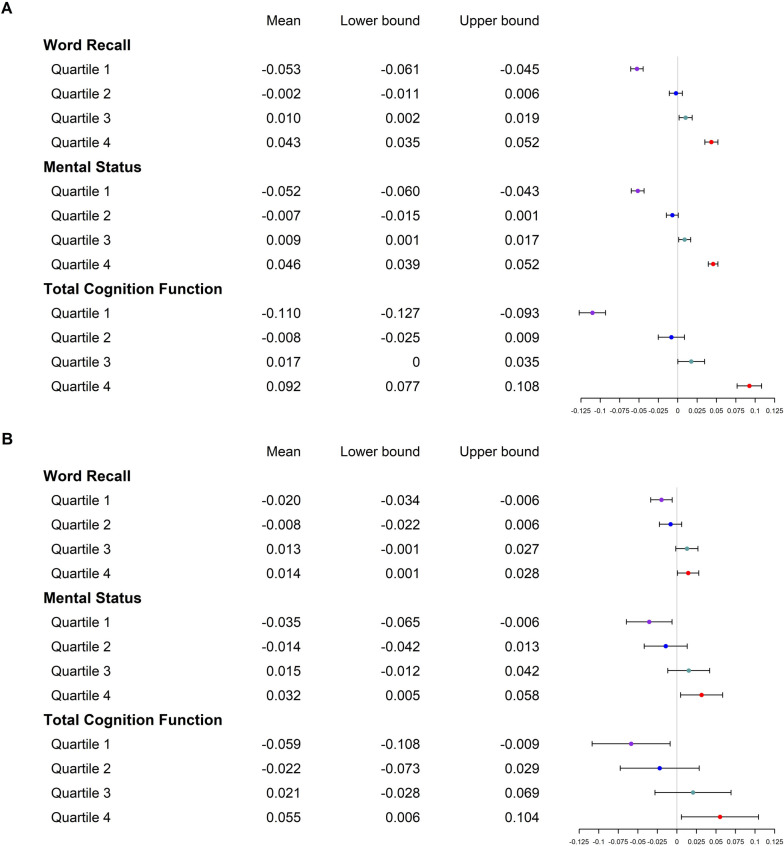
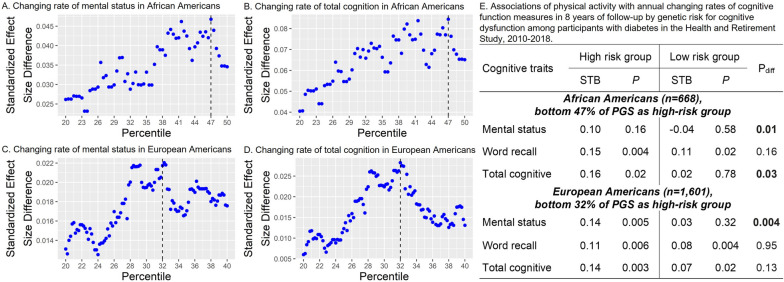
The polygenic score was significantly associated with annual changing rates of all cognition measures independent of lifestyle behaviors and APOE status. Together with age and sex, the polygenic score explained 29.9%, 15.9%, and 26.5% variances of annual changing rates of word recall, mental status, and total cognitive scores among Whites and explained 17.2%, 13.9%, and 18.7% variance of the three traits among Blacks. Among both White and Black participants, those in the top quartile of polygenic score had the three cognition measures increased annually, while those in the bottom quartile had the three cognition measures decreased annually. After further adjusting for the average cognition assessed in 3 visits around baseline, the polygenic score was still positively associated with annual changing rates of all cognition measures for White (P ≤ 2.89E - 19) but not for Black (P ≥ 0.07) participants. In addition, among participants with diabetes, physical activity offset the genetic susceptibility to decline of mental status (interaction P ≤ 0.01) and total cognitive scores (interaction P = 0.03).
Polygenic score predicted cognition changes in addition to measured cognition. Physical activity offset genetic risk for cognition decline among diabetes patients.
考虑到基线认知和生活方式行为,对认知下降进行基因组研究的研究很少。我们的目的是评估一般认知多基因评分对普通人群和糖尿病患者(受认知障碍影响的常见患者群体)认知下降率的影响,而糖尿病患者的认知下降率受基线认知和生活方式行为的影响。
我们测试了一般认知多基因评分与美国健康与退休研究(HRS)中 12090 名白人和 3100 名黑人人群 8 年随访期间认知测量每年变化率之间的关联,这是一个具有全国代表性的 50 岁及以上成年人样本。认知测量包括单词回忆、心理状态和总认知得分,每两年测量一次。为了最大限度地增加样本量和随访时间,我们将 2010 年的调查视为基线,并分析了截至 2018 年的随访数据。基线生活方式行为、APOE 状态和测量认知依次进行调整。鉴于多基因评分在种族上存在差异,所有分析均按种族进行。
多基因评分与所有认知测量的每年变化率显著相关,与生活方式行为和 APOE 状态无关。与年龄和性别一起,多基因评分解释了白人组单词回忆、心理状态和总认知得分每年变化率的 29.9%、15.9%和 26.5%的方差,解释了黑人组这三个特征的 17.2%、13.9%和 18.7%的方差。在白人和黑人参与者中,多基因评分最高四分位组的三项认知测试每年都有增加,而多基因评分最低四分位组的三项认知测试每年都有下降。在进一步调整基线周围 3 次就诊时评估的平均认知后,多基因评分与白人组所有认知测量的每年变化率仍呈正相关(P≤2.89E-19),但与黑人组无关(P≥0.07)。此外,在患有糖尿病的参与者中,体育活动抵消了心理状态(交互 P≤0.01)和总认知评分(交互 P=0.03)下降的遗传易感性。
多基因评分除了测量认知外,还可以预测认知变化。体育活动抵消了糖尿病患者认知下降的遗传风险。