Kaup Allison R, Nettiksimmons Jasmine, Harris Tamara B, Sink Kaycee M, Satterfield Suzanne, Metti Andrea L, Ayonayon Hilsa N, Yaffe Kristine
Sierra Pacific Mental Illness Research, Education, and Clinical Center, San Francisco Veterans Affairs Medical Center, San Francisco, California2Department of Psychiatry, University of California, San Francisco.
Department of Psychiatry, University of California, San Francisco.
JAMA Neurol. 2015 Mar;72(3):340-8. doi: 10.1001/jamaneurol.2014.3978.
Apolipoprotein E (APOE) ε4 is an established risk factor for cognitive decline and the development of dementia, but other factors may help to minimize its effects.
Using APOE ε4 as an indicator of high risk, we investigated factors associated with cognitive resilience among black and white older adults who are APOE ε4 carriers.
DESIGN, SETTING, AND PARTICIPANTS: Participants included 2487 community-dwelling older (aged 69-80 years at baseline) black and white adults examined at 2 community clinics in the prospective cohort Health, Aging, and Body Composition (Health ABC) study. The baseline visits occurred from May 1997 through June 1998. Our primary analytic cohort consisted of 670 APOE ε4 carriers (329 black and 341 white participants) who were free of cognitive impairment at baseline and underwent repeated cognitive testing during an 11-year follow-up (through 2008) using the Modified Mini-Mental State Examination.
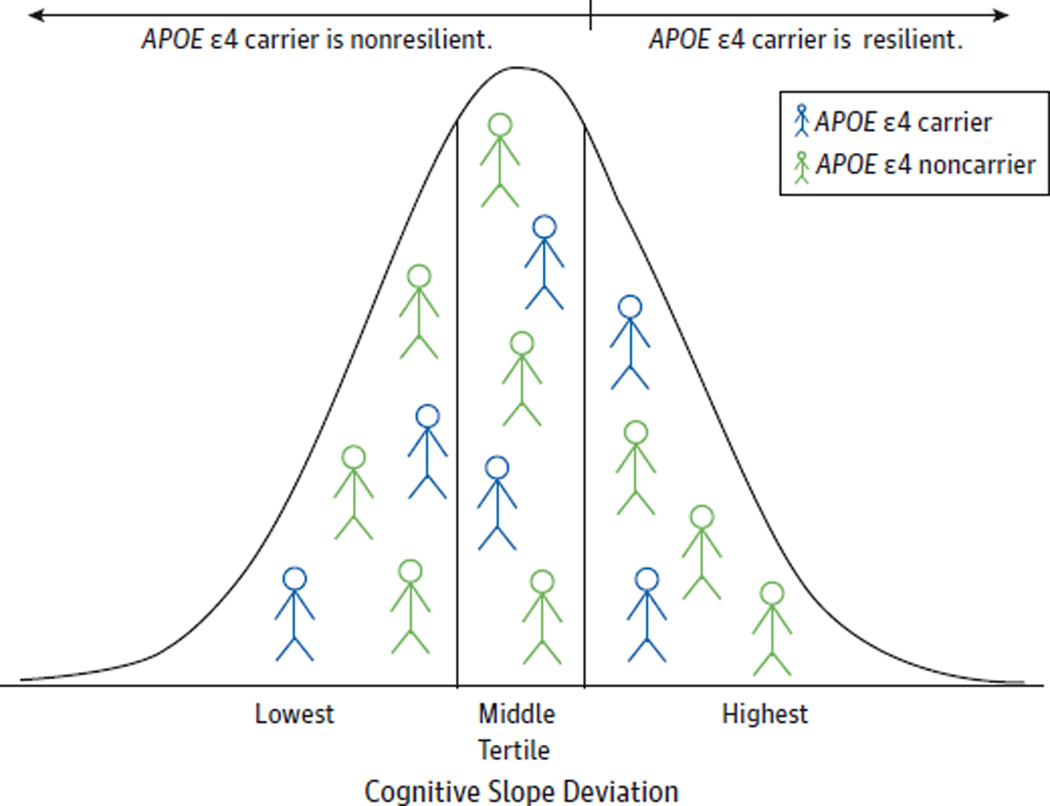
We stratified all analyses by race. Using the Modified Mini-Mental State Examination scores, we assessed normative cognitive change in the entire cohort (n = 2487) and classified the APOE ε4 carriers as being cognitively resilient vs nonresilient by comparing their cognitive trajectories with those of the entire cohort. We then conducted bivariate analyses and multivariable random forest and logistic regression analyses to explore factors predictive of cognitive resilience in APOE ε4 carriers.
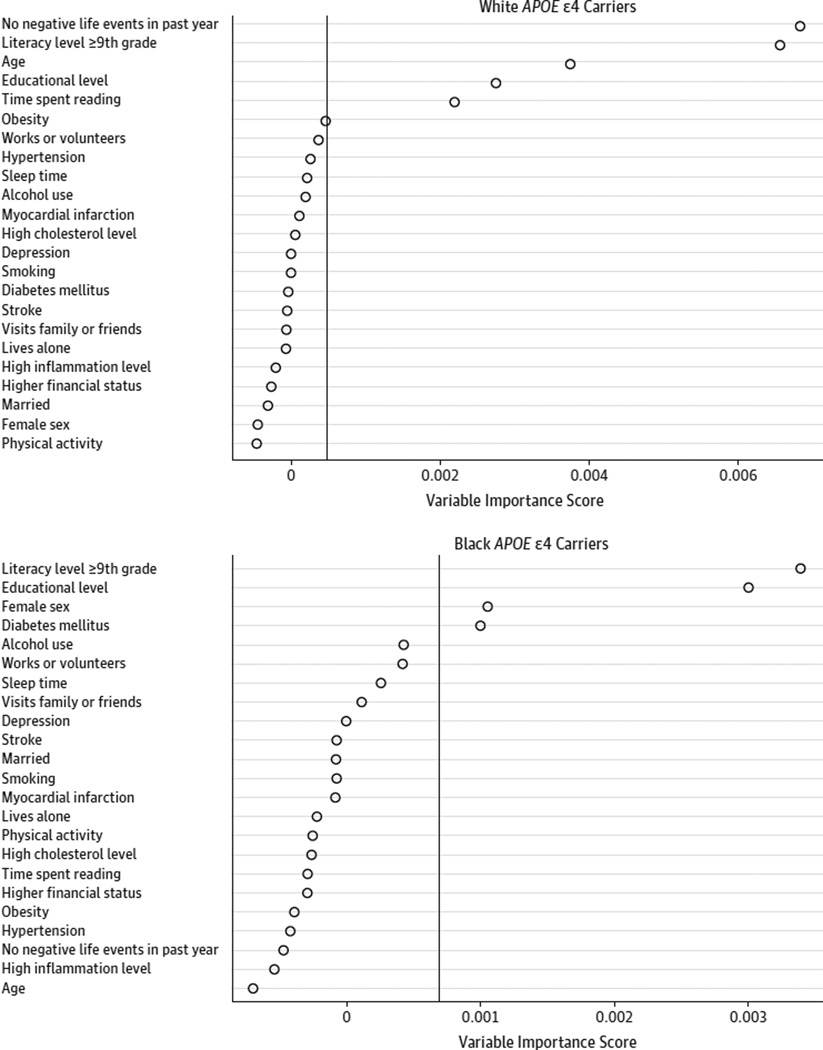
Among white APOE ε4 carriers, the strongest predictors of cognitive resilience were, in relative order of importance, no recent negative life events, a higher literacy level, advanced age, a higher educational level, and more time spent reading. Among black APOE ε4 carriers, the strongest predictors of cognitive resilience were, in relative order of importance, a higher literacy level, a higher educational level, female sex, and the absence of diabetes mellitus. In follow-up logistic regression models, higher literacy level (adjusted odds ratio [OR], 9.50 [95% CI, 2.67-60.89]), a higher educational level (adjusted OR for college graduate vs less than high school, 3.81 [95% CI, 1.13-17.56]), and age (adjusted OR for 73-76 vs 69-72 years, 2.01 [95% CI, 1.13-3.63]) had significant independent effects in predicting cognitive resilience among white APOE ε4 carriers. Among black APOE ε4 carriers, a higher literacy level (adjusted OR, 2.27 [95% CI, 1.29-4.06]) and a higher educational level (adjusted OR for high school graduate/some college vs less than high school, 2.86 [95% CI, 1.54-5.49]; adjusted OR for college graduate vs less than high school, 2.52 [95% CI, 1.14-5.62]) had significant independent effects in predicting cognitive resilience.
Although APOE ε4 carriers are at high risk for cognitive decline, our findings suggest possible intervention targets, including the enhancement of cognitive reserve and improvement of other psychosocial and health factors, to promote cognitive resilience among black and white APOE ε4 carriers.
载脂蛋白E(APOE)ε4是认知能力下降和痴呆症发展的既定风险因素,但其他因素可能有助于将其影响降至最低。
以APOE ε4作为高风险指标,我们调查了APOE ε4携带者中黑人和白人老年人认知恢复力的相关因素。
设计、地点和参与者:参与者包括2487名社区居住的老年人(基线时年龄为69 - 80岁),这些黑人和白人成年人在前瞻性队列健康、衰老和身体成分(Health ABC)研究中的2家社区诊所接受了检查。基线访视发生在1997年5月至1998年6月期间。我们的主要分析队列由670名APOE ε4携带者(329名黑人参与者和341名白人参与者)组成,他们在基线时没有认知障碍,并在11年的随访(至2008年)期间使用改良简易精神状态检查进行了多次认知测试。
我们按种族对所有分析进行分层。使用改良简易精神状态检查分数,我们评估了整个队列(n = 2487)的正常认知变化,并通过将APOE ε4携带者的认知轨迹与整个队列的认知轨迹进行比较,将APOE ε4携带者分类为认知有恢复力和无恢复力。然后,我们进行了双变量分析、多变量随机森林分析和逻辑回归分析,以探索预测APOE ε4携带者认知恢复力的因素。
在白人APOE ε4携带者中,按重要性相对顺序排列,认知恢复力的最强预测因素是近期无负面生活事件、较高的识字水平、高龄、较高的教育水平以及更多的阅读时间。在黑人APOE ε4携带者中,按重要性相对顺序排列,认知恢复力的最强预测因素是较高的识字水平、较高的教育水平、女性以及无糖尿病。在后续的逻辑回归模型中,较高的识字水平(调整后的优势比[OR],9.50[95%置信区间,2.67 - 60.89])、较高的教育水平(大学毕业生与高中以下学历相比的调整后OR,3.81[95%置信区间,1.13 - 17.56])和年龄(73 - 76岁与69 - 72岁相比的调整后OR,2.01[95%置信区间,1.13 - 3.63])在预测白人APOE ε4携带者的认知恢复力方面具有显著的独立效应。在黑人APOE ε4携带者中,较高的识字水平(调整后的OR,2.27[95%置信区间,1.29 - 4.06])和较高的教育水平(高中毕业生/大专学历与高中以下学历相比的调整后OR,2.86[95%置信区间,1.54 - 5.49];大学毕业生与高中以下学历相比的调整后OR,2.52[95%置信区间,1.14 - 5.62])在预测认知恢复力方面具有显著的独立效应。
尽管APOE ε4携带者认知能力下降的风险很高,但我们的研究结果表明了可能的干预目标,包括增强认知储备以及改善其他心理社会和健康因素,以促进黑人和白人APOE ε4携带者的认知恢复力。