Qin Qiuying, Kou Xiaoxuan, Zheng Yuanyuan, Zhou Fei, Zhang Xiaoyong, Liu Hongyan
State Key Laboratory of Organ Failure Research, Guangdong Provincial Key Laboratory of Viral Hepatitis Research, Department of Infectious Diseases, Nanfang Hospital, Southern Medical University, Guangzhou, 510515, People's Republic of China.
Key Laboratory of Infectious Diseases Research in South China (Southern Medical University), Ministry of Education, Guangzhou, People's Republic of China.
J Hepatocell Carcinoma. 2023 Nov 6;10:2009-2019. doi: 10.2147/JHC.S432054. eCollection 2023.
In recent years, a new therapeutic approach, known as immune checkpoint blockade (ICB), has been proposed as approach to improve outcomes in patients with intermediate stage (Barcelona Clinic Liver Cancer, BCLC B) or advanced stage (BCLC C) hepatocellular carcinoma (HCC). Unfortunately, only a select patients can benefit from ICB. Hence, biomarkers that can predict the success and survival of treatment are still necessary.
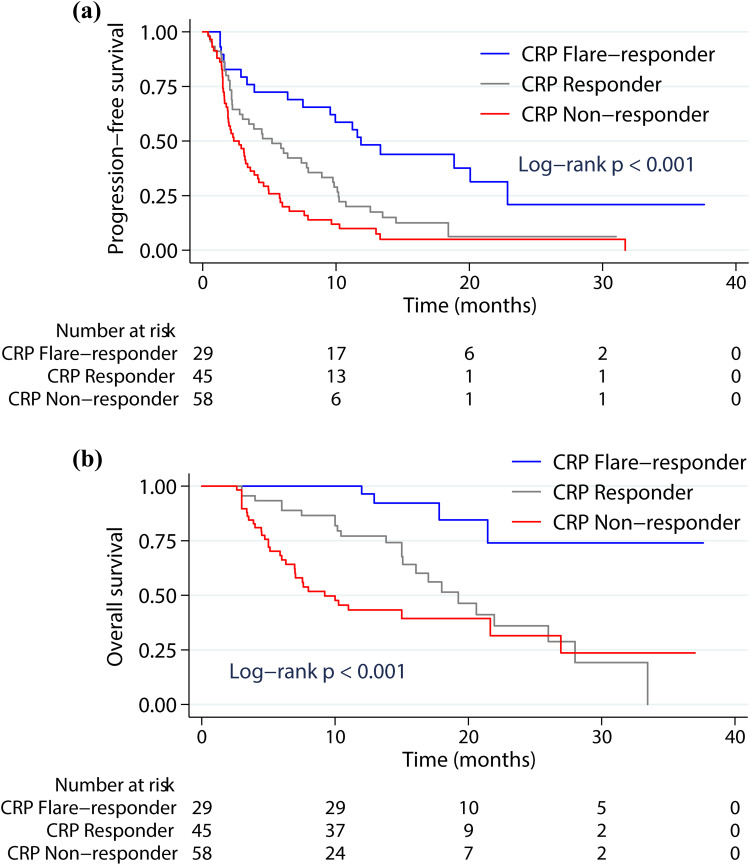
Between 2018 to 2021, 132 patients received ICB treatment for intermediate or advanced stage HCC. Based on the early kinetics of C-reactive protein (CRP), the patients were classified into three groups. The study endpoints were progression-free survival (PFS) and overall survival (OS).
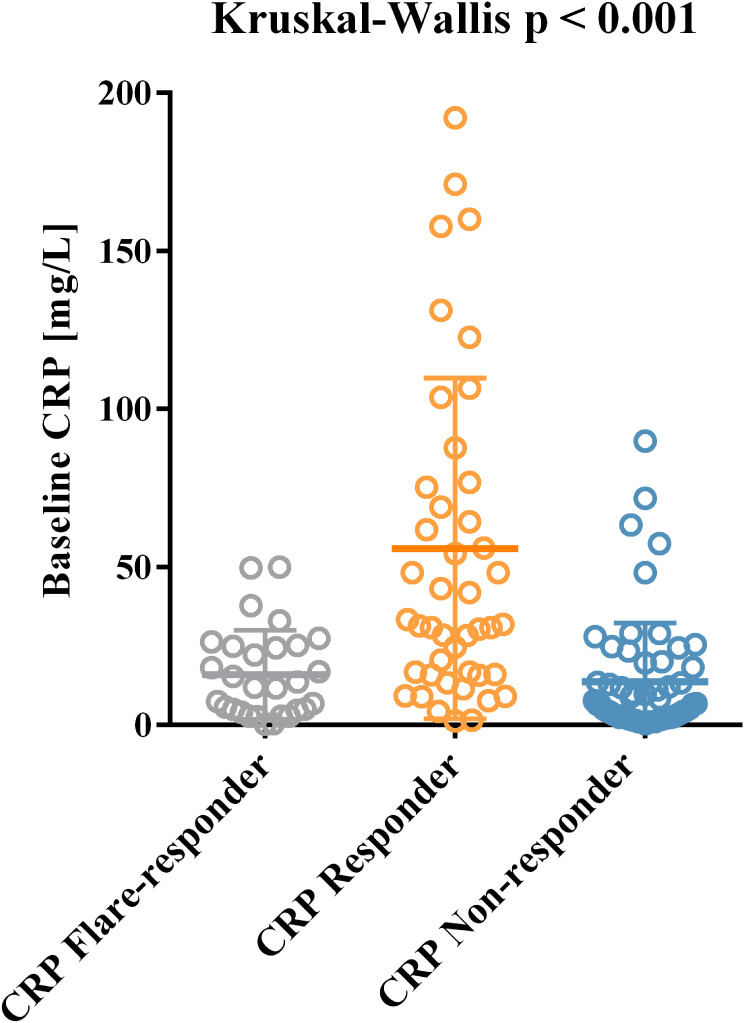
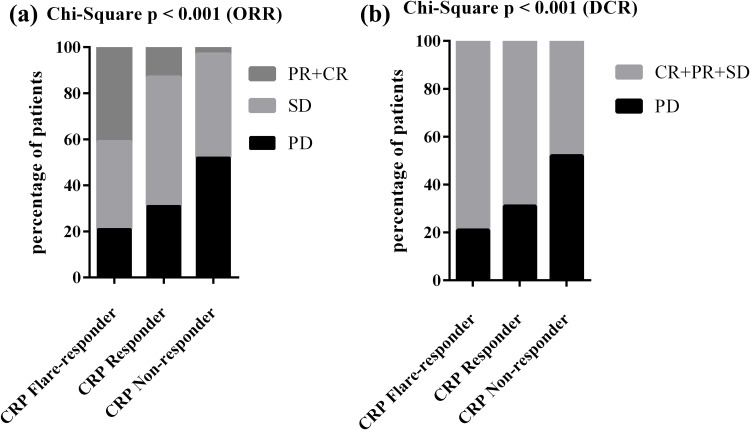
Our findings support the predictive power of early CRP kinetics in determining immunotherapy response for intermediate or advanced HCC. Objective response rates (ORR) were found in 41.2% of CRP flare-responders, 13.3% of CRP responders, and 3.5% of CRP non-responders (<0.001). Disease control rates (DCR) in the three groups were substantially different (<0.001). The improved PFS and OS were strongly correlated with the early kinetics of CRP. Compared to CRP non-responders, CRP responders, especially CRP flare-responders, had significantly longer PFS (median PFS: CRP flare-responders: 11.6 months vs CRP responders: 5.2 months vs CRP non-responders: 2.3 months, <0.001).
The CRP flare response robustly predicts the immunotherapy response and outcomes in patients with HCC. Early CRP kinetics may be an inexpensive, easily implemented and non-invasive biomarker to anticipate response to ICB therapy in intermediate or advanced HCC, with the potential to optimize treatment monitoring.
近年来,一种名为免疫检查点阻断(ICB)的新治疗方法已被提出,作为改善中期(巴塞罗那临床肝癌分期,BCLC B期)或晚期(BCLC C期)肝细胞癌(HCC)患者预后的方法。不幸的是,只有少数患者能从ICB中获益。因此,仍需要能够预测治疗成功和生存的生物标志物。
2018年至2021年期间,132例中期或晚期HCC患者接受了ICB治疗。根据C反应蛋白(CRP)的早期动力学,将患者分为三组。研究终点为无进展生存期(PFS)和总生存期(OS)。
我们的研究结果支持早期CRP动力学在确定中晚期HCC免疫治疗反应方面的预测能力。在CRP快速反应者中,客观缓解率(ORR)为41.2%,CRP反应者为13.3%,CRP无反应者为3.5%(<0.001)。三组的疾病控制率(DCR)有显著差异(<0.001)。PFS和OS的改善与CRP的早期动力学密切相关。与CRP无反应者相比,CRP反应者,尤其是CRP快速反应者,PFS显著更长(中位PFS:CRP快速反应者:11.6个月 vs CRP反应者:5.2个月 vs CRP无反应者:2.3个月,<0.001)。
CRP快速反应有力地预测了HCC患者的免疫治疗反应和预后。早期CRP动力学可能是一种廉价、易于实施且非侵入性的生物标志物,可用于预测中晚期HCC患者对ICB治疗的反应,具有优化治疗监测的潜力。