Pocino Krizia, Stefanile Annunziata, Basile Valerio, Napodano Cecilia, D'Ambrosio Francesca, Di Santo Riccardo, Callà Cinzia Anna Maria, Gulli Francesca, Saporito Raffaele, Ciasca Gabriele, Equitani Francesco, Basile Umberto, Marino Mariapaola
Unità Operativa Complessa Patologia Clinica, Ospedale Generale di Zona San Pietro Fatebenefratelli, 00189 Rome, Italy.
Clinical Pathology Unit and Cancer Biobank, Department of Research and Advanced Technologies, IRCCS Regina Elena National Cancer Institute, 00144 Rome, Italy.
J Pers Med. 2022 Dec 20;13(1):5. doi: 10.3390/jpm13010005.
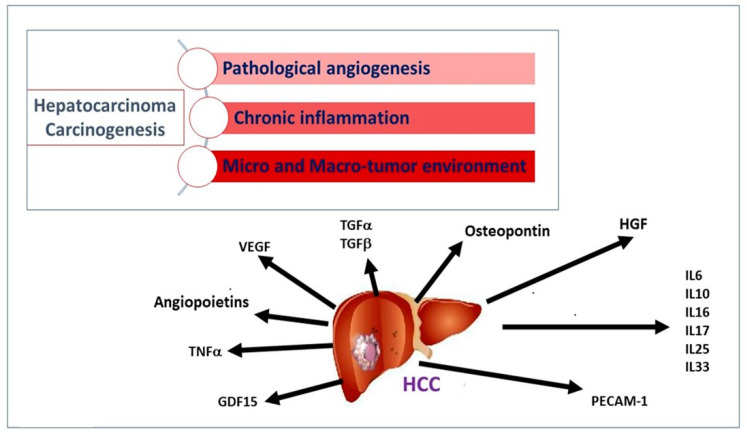
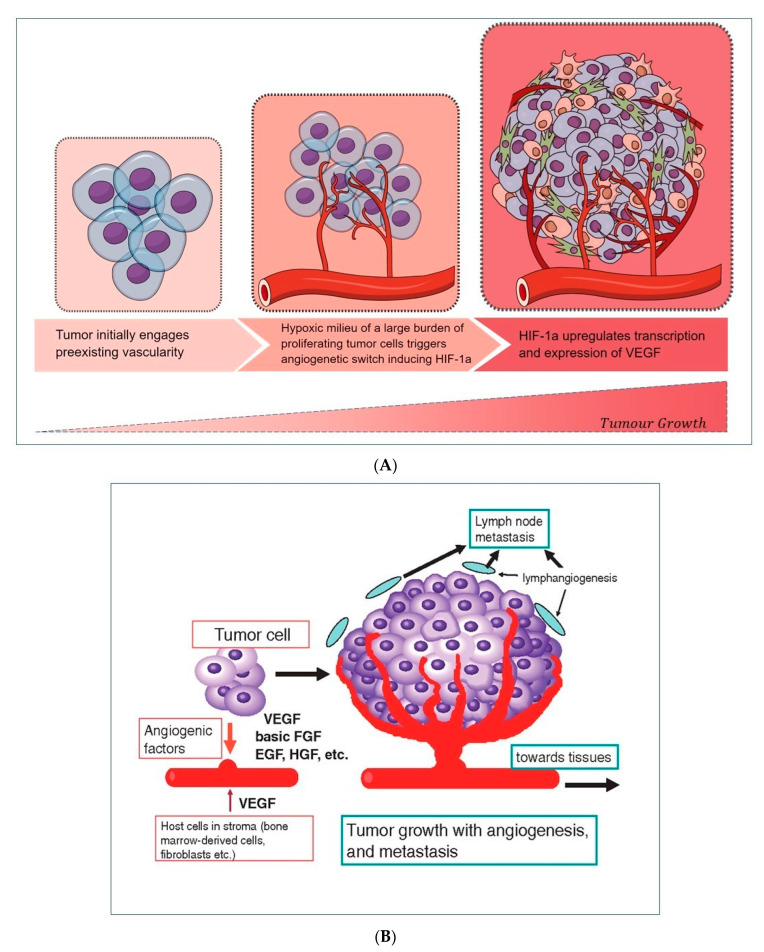
Hepatocellular carcinoma (HCC) represents a worldwide health matter with a major care burden, high prevalence, and poor prognosis. Its pathogenesis mainly varies depending on the underlying etiological factors, although it develops from liver cirrhosis in the majority of cases. This review summarizes the role of the most interesting soluble factors as biomarkers for early diagnosis and as recommended targets for treatment in accordance with the new challenges in precision medicine. In the premalignant environment, inflammatory cells release a wide range of cytokines, chemokines, growth factors, prostaglandins, and proangiogenic factors, making the liver environment more suitable for hepatocyte tumor progression that starts from acquired genetic mutations. A complex interaction of pro-inflammatory (IL-6, TNF-α) and anti-inflammatory cytokines (TGF-α and -β), pro-angiogenic molecules (including the Angiopoietins, HGF, PECAM-1, HIF-1α, VEGF), different transcription factors (NF-kB, STAT-3), and their signaling pathways are involved in the development of HCC. Since cytokines are expressed and released during the different stages of HCC progression, their measurement, by different available methods, can provide in-depth information on the identification and management of HCC.
肝细胞癌(HCC)是一个全球性的健康问题,护理负担重、患病率高且预后差。其发病机制主要因潜在病因不同而有所差异,不过在大多数情况下它是由肝硬化发展而来。本综述总结了最受关注的可溶性因子作为早期诊断生物标志物以及根据精准医学新挑战作为推荐治疗靶点的作用。在癌前环境中,炎症细胞会释放多种细胞因子、趋化因子、生长因子、前列腺素和促血管生成因子,使肝脏环境更适合从获得性基因突变开始的肝细胞肿瘤进展。促炎细胞因子(IL-6、TNF-α)和抗炎细胞因子(TGF-α和 -β)、促血管生成分子(包括血管生成素、HGF、PECAM-1、HIF-1α、VEGF)、不同转录因子(NF-kB、STAT-3)及其信号通路之间的复杂相互作用参与了HCC的发展。由于细胞因子在HCC进展的不同阶段表达和释放,通过不同现有方法对其进行检测可为HCC的识别和管理提供深入信息。