Janowicz Monika, Galus Sabina, Ciurzyńska Agnieszka, Nowacka Małgorzata
Department of Food Engineering and Process Management, Institute of Food Sciences, Warsaw University of Life Sciences-SGGW, 159c Nowoursynowska St., 02-776 Warsaw, Poland.
Polymers (Basel). 2023 Oct 26;15(21):4231. doi: 10.3390/polym15214231.
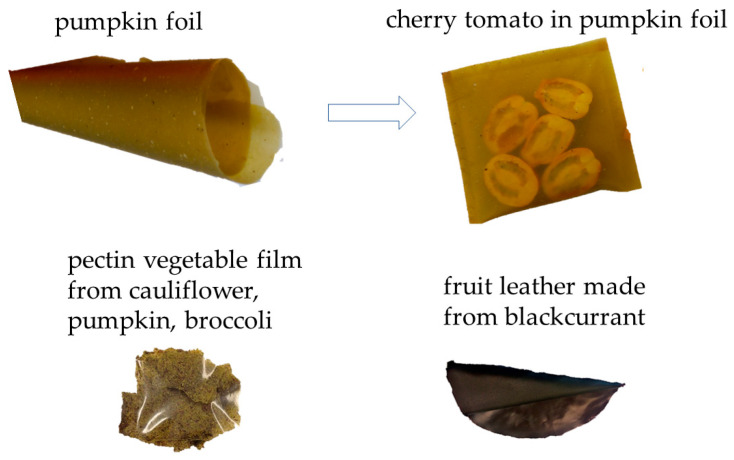
Several consumable substances, including fruit and vegetable purees, extracts, juices, and plant residue, were analyzed for their matrix-forming potential. These matrices serve as the basis for the production of edible films, sheets, and coatings that can be eaten as nutritional treats or applied to food products, thereby contributing to their overall good quality. Furthermore, this innovative approach also contributes to optimizing the performance of synthetic packaging, ultimately reducing reliance on synthetic polymers in various applications. This article explores the viability of incorporating fruits and vegetables as basic ingredients within edible films, sheets, and coatings. The utilization of fruits and vegetables in this manner becomes achievable due to the existence of polysaccharides and proteins that facilitate the formation of matrices in their makeup. Moreover, including bioactive substances like vitamins and polyphenols can impart attributes akin to active materials, such as antioxidants or antimicrobial agents. Advancing the creation of edible films, sheets, and coatings derived from fruits and vegetables holds great potential for merging the barrier and mechanical attributes of biopolymers with the nutritional and sensory qualities inherent in these natural components. These edible films made from fruits and vegetables could potentially serve as alternatives to seaweed in sushi production or even replace conventional bread, pancakes, tortillas, and lavash in the diet of people suffering from celiac disease or gluten allergy, while fruit and vegetable coatings may be used in fresh and processed food products, especially fruits and vegetables but also sweets.
对几种可食用物质进行了分析,包括果蔬泥、提取物、果汁和植物残渣,以评估它们形成基质的潜力。这些基质是生产可食用薄膜、薄片和涂层的基础,这些可食用薄膜、薄片和涂层既可以作为营养食品食用,也可以应用于食品,从而有助于提升食品的整体品质。此外,这种创新方法还有助于优化合成包装的性能,最终减少在各种应用中对合成聚合物的依赖。本文探讨了将水果和蔬菜作为基本成分纳入可食用薄膜、薄片和涂层的可行性。由于水果和蔬菜中存在有助于在其组成中形成基质的多糖和蛋白质,因此以这种方式利用水果和蔬菜成为可能。此外,包含维生素和多酚等生物活性物质可以赋予类似活性材料的特性,如抗氧化剂或抗菌剂。推进由水果和蔬菜制成的可食用薄膜、薄片和涂层的研发,对于将生物聚合物的阻隔和机械特性与这些天然成分固有的营养和感官品质相结合具有巨大潜力。这些由水果和蔬菜制成的可食用薄膜有可能在寿司生产中替代海藻,甚至可以替代患有乳糜泻或麸质过敏的人的饮食中的传统面包、煎饼、玉米饼和薄饼,而水果和蔬菜涂层可用于新鲜和加工食品,尤其是水果和蔬菜,但也包括糖果。