Senousy Hoda H, Hamoud Yousef Alhaj, Abu-Elsaoud Abdelghafar M, Mahmoud Al Zoubi Omar, Abdelbaky Nessreen F, Zia-Ur-Rehman Muhammad, Usman Muhammad, Soliman Mona H
Botany and Microbiology Department, Faculty of Science, Cairo University, Giza 12613, Egypt.
College of Hydrology and Water Recourses, Hohai University, Nanjing 210098, China.
Plants (Basel). 2023 Oct 29;12(21):3714. doi: 10.3390/plants12213714.
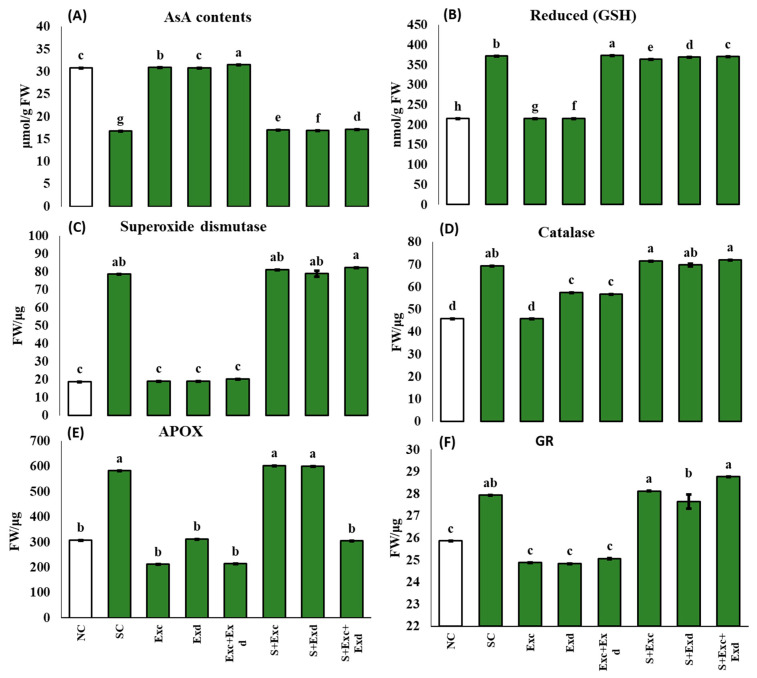
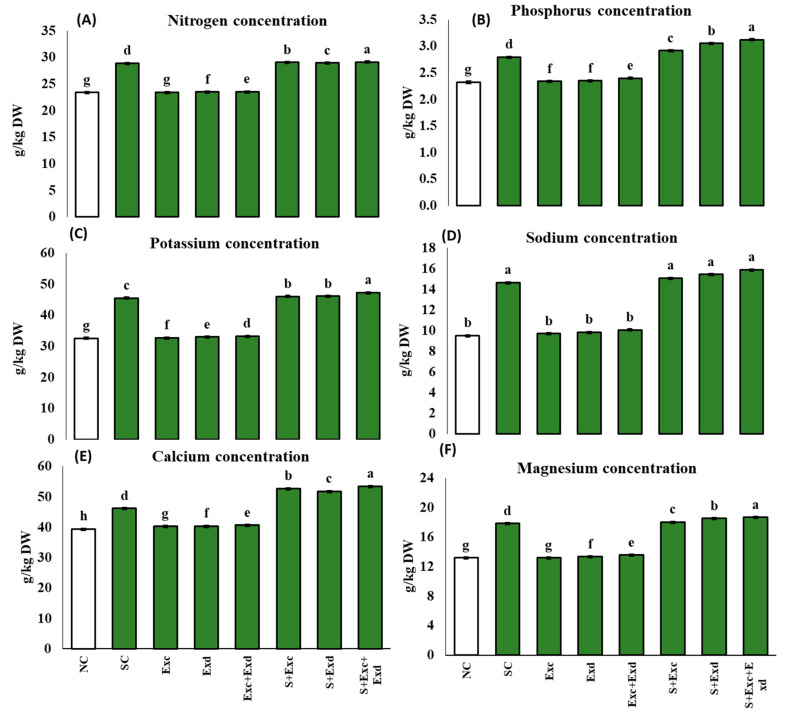
Salinity adversely affects the plant's morphological characteristics, but the utilization of aqueous algal extracts (AE) ameliorates this negative impact. In this study, the application of AE derived from and strains effectively reversed the decline in biomass allocation and water relations, both in normal and salt-stressed conditions. The simultaneous application of both extracts in salt-affected soil notably enhanced key parameters, such as chlorophyll content (15%), carotene content (1%), photosynthesis (25%), stomatal conductance (7%), and transpiration rate (23%), surpassing those observed in the application of both AE in salt-affected as compared to salinity stress control. Moreover, the AE treatments effectively mitigated lipid peroxidation and electrolyte leakage induced by salinity stress. The application of AE led to an increase in GB (6%) and the total concentration of free amino acids (47%) by comparing with salt-affected control. Additionally, salinity stress resulted in an elevation of antioxidant enzyme activities, including superoxide dismutase, ascorbate peroxidase, catalase, and glutathione reductase. Notably, the AE treatments significantly boosted the activity of these antioxidant enzymes under salinity conditions. Furthermore, salinity reduced mineral contents, but the application of AE effectively counteracted this decline, leading to increased mineral levels. In conclusion, the application of aqueous algal extracts, specifically those obtained from and strains, demonstrated significant efficacy in alleviating salinity-induced stress in plants.
盐度会对植物的形态特征产生不利影响,但利用藻类水提取物(AE)可改善这种负面影响。在本研究中,源自[具体菌株1]和[具体菌株2]菌株的AE应用,在正常和盐胁迫条件下均有效逆转了生物量分配和水分关系的下降。在盐渍土壤中同时施用这两种提取物显著提高了关键参数,如叶绿素含量(15%)、胡萝卜素含量(1%)、光合作用(25%)、气孔导度(7%)和蒸腾速率(23%),与盐胁迫对照相比,超过了在盐渍土壤中单独施用两种AE时观察到的数值。此外,AE处理有效减轻了盐胁迫诱导的脂质过氧化和电解质渗漏。与盐渍对照相比,AE的应用导致GB增加(6%)和游离氨基酸总浓度增加(47%)。此外,盐胁迫导致抗氧化酶活性升高,包括超氧化物歧化酶、抗坏血酸过氧化物酶、过氧化氢酶和谷胱甘肽还原酶。值得注意的是,AE处理在盐胁迫条件下显著提高了这些抗氧化酶的活性。此外,盐度降低了矿物质含量,但AE的应用有效抵消了这种下降,导致矿物质水平增加。总之,藻类水提取物的应用,特别是那些从[具体菌株1]和[具体菌株2]菌株获得的提取物,在缓解[植物名称]植物盐胁迫方面显示出显著效果。