Ray Arja, Hu Kenneth H, Kersten Kelly, Courau Tristan, Kuhn Nicholas F, Zaleta-Linares Itzia, Samad Bushra, Combes Alexis J, Krummel Matthew F
Department of Pathology, University of California, San Francisco, CA 94143, USA.
ImmunoX Initiative, University of California, San Francisco, CA 94143, USA.
bioRxiv. 2024 Jun 17:2023.10.31.560822. doi: 10.1101/2023.10.31.560822.
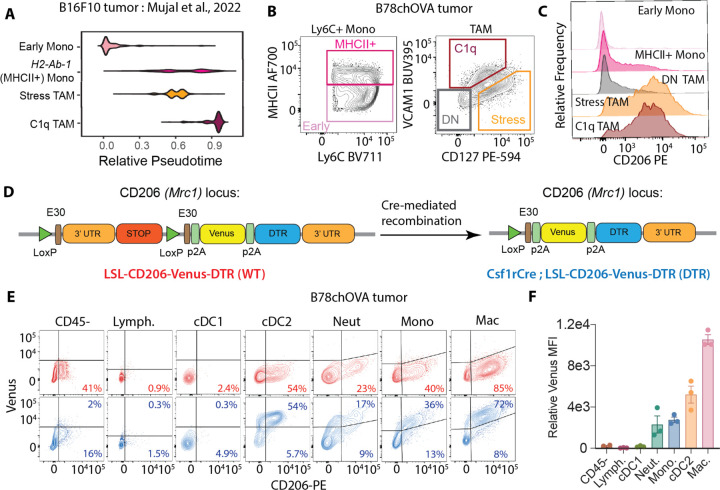
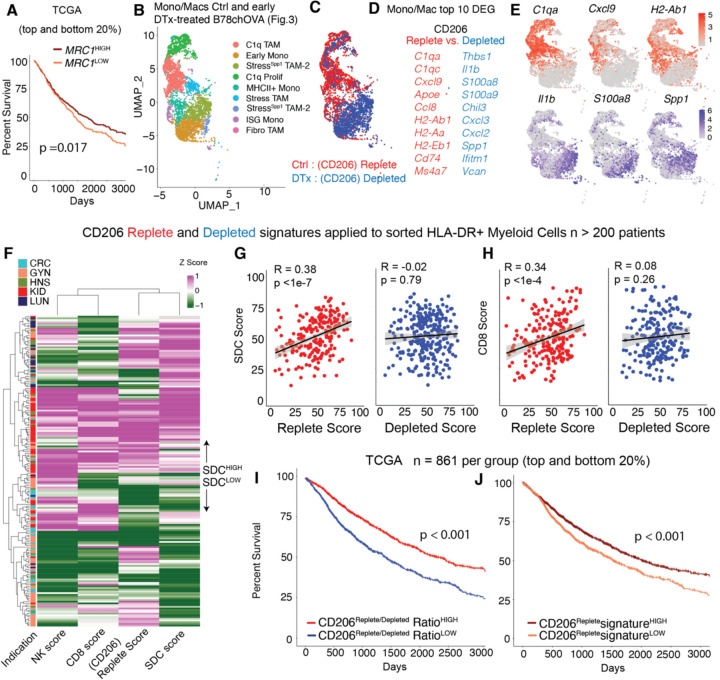
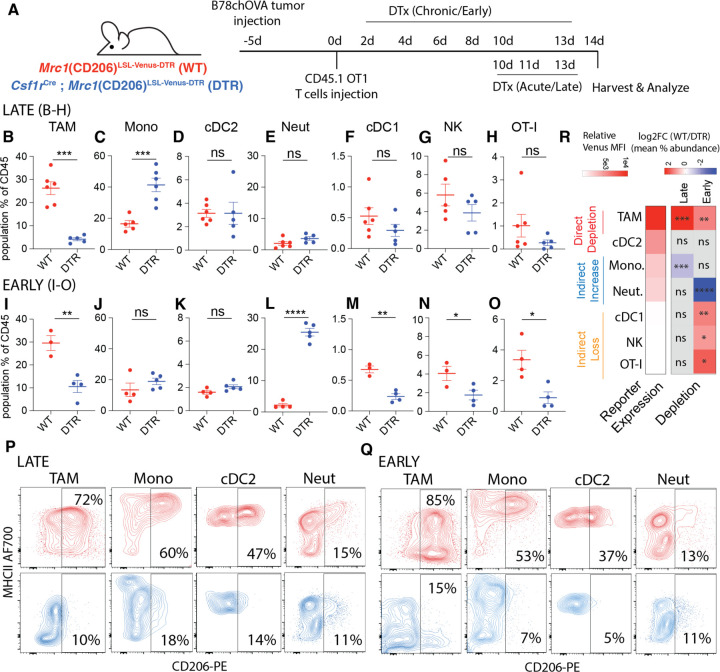
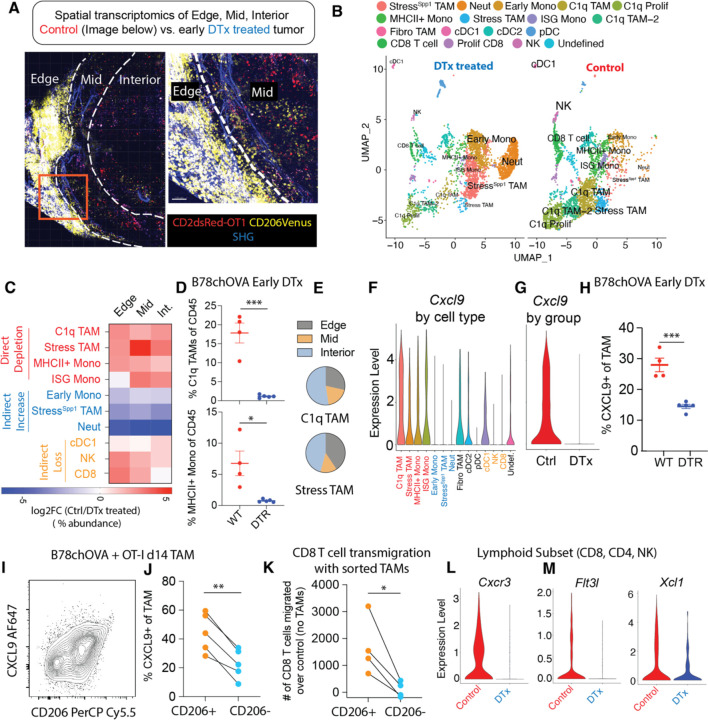
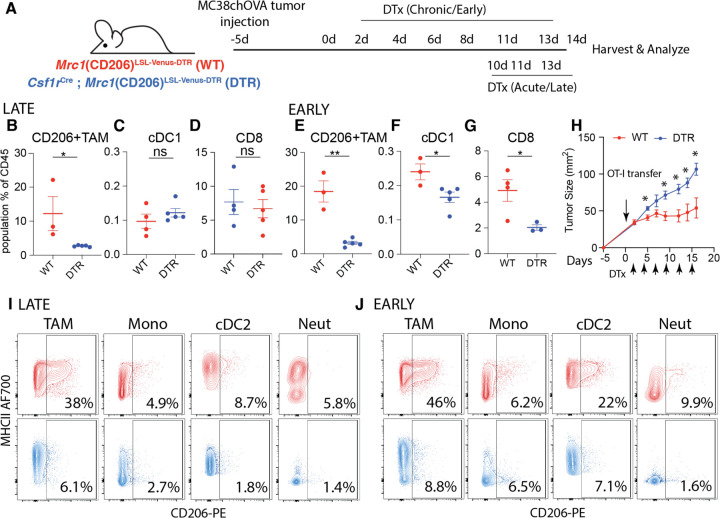
Tumor-associated macrophages (TAMs) are frequently categorized as being 'M1' or 'M2' polarized, even as substantial data challenges this binary modeling of macrophage cell state. One molecule consistently referenced as a delineator of a putative immunosuppressive 'M2' state is the surface protein CD206. We thus made a novel conditional CD206 () knock-in mouse to specifically visualize and/or deplete CD206+ 'M2-like' TAMs and assess their correspondence with pro-tumoral immunity. Early, but not late depletion of CD206+ macrophages and monocytes (here, 'Mono/Macs') led to an indirect loss of a key anti-tumor network of NK cells, conventional type I dendritic cells (cDC1) and CD8 T cells. Among myeloid cells, we found that the CD206+ TAMs are the primary producers of CXCL9, and able to differentially attract activated CD8 T cells. In contrast, a population of stress-responsive TAMs ("Hypoxic" or +) and immature monocytes, which lack CD206 expression and become prominent following early depletion, expressed markedly diminished levels of CXCL9. Those NK and CD8 T cells which enter CD206-depleted tumors express vastly reduced levels of the corresponding receptor , the cDC1-attracting chemokine and cDC1 growth factor transcripts. Consistent with the loss of this critical network, early CD206+ TAM depletion decreased tumor control by antigen specific CD8 T cells in mice. Likewise, in humans, the CD206, but not the CD206 Mono/Mac gene signature correlated robustly with CD8 T cell, NK cell and stimulatory cDC1 gene signatures and transcriptomic signatures skewed towards CD206 Mono/Macs associated with better survival. Together, these findings negate the unqualified classification of CD206+ 'M2-like' macrophages as immunosuppressive by illuminating contexts for their role in organizing a critical tumor-reactive archetype of immunity.
肿瘤相关巨噬细胞(TAMs)通常被归类为“M1”或“M2”极化状态,即便大量数据对这种巨噬细胞状态的二元模型提出了挑战。一种一直被认为是假定免疫抑制性“M2”状态标志物的分子是表面蛋白CD206。因此,我们构建了一种新型的条件性CD206()敲入小鼠,以特异性地可视化和/或清除CD206 +“M2样”TAMs,并评估它们与促肿瘤免疫的相关性。早期而非晚期清除CD206 +巨噬细胞和单核细胞(此处称为“单核细胞/巨噬细胞”)导致自然杀伤细胞(NK细胞)、传统I型树突状细胞(cDC1)和CD8 T细胞这一关键抗肿瘤网络的间接丧失。在髓系细胞中,我们发现CD206 + TAMs是CXCL9的主要产生者,并且能够差异性地吸引活化的CD8 T细胞。相比之下,一群缺乏CD206表达且在早期清除后变得突出的应激反应性TAMs(“缺氧型”或+)和未成熟单核细胞,其CXCL9表达水平明显降低。那些进入CD206缺失肿瘤的NK细胞和CD8 T细胞表达的相应受体、吸引cDC1的趋化因子和cDC1生长因子转录本水平大幅降低。与这个关键网络的丧失一致,早期清除CD206 + TAM会降低小鼠体内抗原特异性CD8 T细胞对肿瘤的控制能力。同样,在人类中,CD206而非CD206单核细胞/巨噬细胞基因特征与CD8 T细胞、NK细胞以及偏向与更好生存相关的CD206单核细胞/巨噬细胞的刺激性cDC1基因特征和转录组特征密切相关。总之,这些发现通过揭示CD206 +“M2样”巨噬细胞在组织关键肿瘤反应性免疫原型中的作用背景,否定了将其无条件归类为免疫抑制性细胞的观点。