Department of Paediatrics, University of Oxford, Oxford Vaccine Group, Oxford, Oxfordshire, UK
Department of Paediatrics, University of Oxford, Oxford Vaccine Group, Oxford, Oxfordshire, UK.
BMJ Open. 2023 Nov 14;13(11):e072938. doi: 10.1136/bmjopen-2023-072938.
Invasive non-typhoidal Salmonellosis (iNTS) is mainly caused by serovars Typhimurium and Enteritidis and is estimated to result in 77 500 deaths per year, disproportionately affecting children under 5 years of age in sub-Saharan Africa. Invasive non-typhoidal serovars are increasingly acquiring resistance to first-line antibiotics, thus an effective vaccine would be a valuable tool in reducing morbidity and mortality from infection. While NTS livestock vaccines are in wide use, no licensed vaccines exist for use in humans. Here, a first-in-human study of a novel vaccine (iNTS-GMMA) containing . Typhimurium and . Enteritidis Generalised Modules for Membrane Antigens (GMMA) outer membrane vesicles is presented.
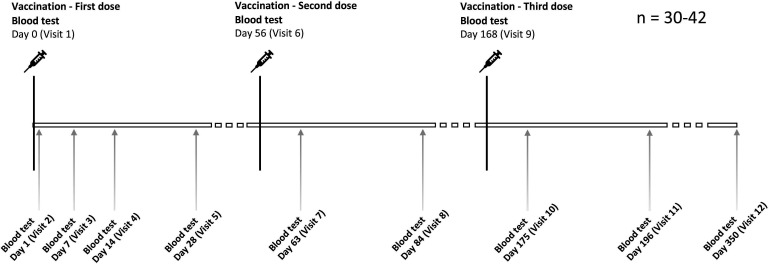
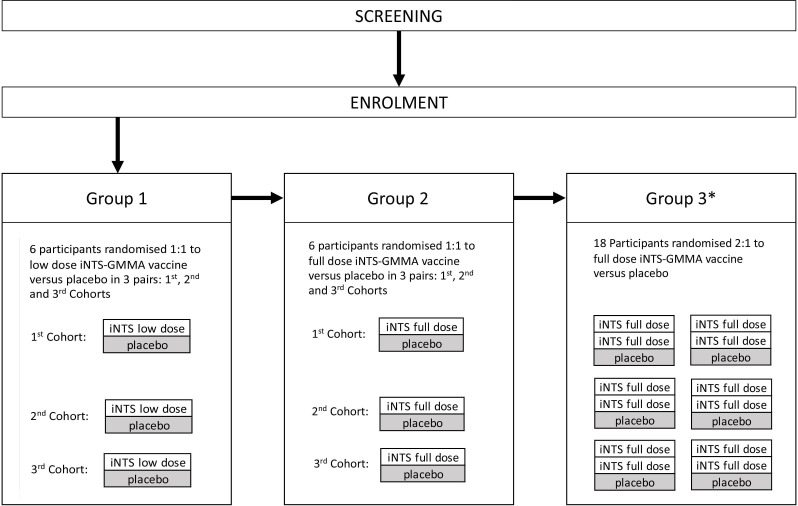
The Vaccine Study in Oxford is a randomised placebo-controlled participant-observer blind phase I study of the iNTS-GMMA vaccine. Healthy adult volunteers will be randomised to receive three intramuscular injections of the iNTS-GMMA vaccine, containing equal quantities of . Typhimurium and . Enteritidis GMMA particles adsorbed on Alhydrogel, or an Alhydrogel placebo at 0, 2 and 6 months. Participants will be sequentially enrolled into three groups: group 1, 1:1 randomisation to low dose iNTS-GMMA vaccine or placebo; group 2, 1:1 randomisation to full dose iNTS-GMMA vaccine or placebo; group 3, 2:1 randomisation to full dose or lower dose (dependant on DSMC reviews of groups 1 and 2) iNTS-GMMA vaccine or placebo.The primary objective is safety and tolerability of the vaccine. The secondary objective is immunogenicity as measured by O-antigen based ELISA. Further exploratory objectives will characterise the expanded human immune profile.
Ethical approval for this study has been obtained from the South Central-Oxford A Research Ethics Committee (Ethics REF:22/SC/0059). Appropriate documentation and regulatory approvals have been acquired. Results will be disseminated via peer-reviewed articles and conferences.
EudraCT Number: 2020-000510-14.
侵袭性非伤寒沙门氏菌病(iNTS)主要由肠炎沙门氏菌和鼠伤寒沙门氏菌血清型引起,估计每年导致 77500 人死亡,在撒哈拉以南非洲地区,5 岁以下儿童受影响不成比例。侵袭性非伤寒血清型越来越多地获得对一线抗生素的耐药性,因此,有效的疫苗将是减少感染发病率和死亡率的宝贵工具。虽然 NTS 牲畜疫苗已广泛使用,但尚无获准用于人类的疫苗。在此,介绍了一种含有鼠伤寒沙门氏菌和肠炎沙门氏菌通用膜抗原(GMMA)外膜囊泡的新型疫苗(iNTS-GMMA)的首次人体研究。
牛津疫苗研究是一项随机、安慰剂对照、参与者观察盲法的 iNTS-GMMA 疫苗的 I 期研究。健康成年志愿者将被随机分为三组,分别接受 3 次肌肉内注射 iNTS-GMMA 疫苗,疫苗含有等量吸附在 Alhydrogel 上的鼠伤寒沙门氏菌和肠炎沙门氏菌 GMMA 颗粒,或在 0、2 和 6 个月时接受 Alhydrogel 安慰剂。参与者将按顺序分为三组:第 1 组,1:1 随机分为低剂量 iNTS-GMMA 疫苗或安慰剂组;第 2 组,1:1 随机分为全剂量 iNTS-GMMA 疫苗或安慰剂组;第 3 组,2:1 随机分为全剂量或低剂量(取决于 1 组和 2 组的 DSMC 审查)iNTS-GMMA 疫苗或安慰剂。主要目标是评估疫苗的安全性和耐受性。次要目标是通过 O 抗原基于 ELISA 的免疫原性来测量。进一步的探索性目标将描述扩展的人类免疫概况。
这项研究已获得南中英格兰牛津郡研究伦理委员会(伦理 REF:22/SC/0059)的批准。已获得适当的文件和监管批准。结果将通过同行评议的文章和会议进行传播。
EudraCT 编号:2020-000510-14。