Navadurong Huttakan, Prasoppokakorn Thaninee, Siriwong Nanicha, Phathong Chonlada, Teeyapun Nattaya, Tanasanvimon Suebpong, Thanapirom Kessarin, Komolmit Piyawat, Tangkijvanich Pisit, Treeprasertsuk Sombat, Chaiteerakij Roongruedee
Department of Medicine, Division of Gastroenterology, Faculty of Medicine, Chulalongkorn University, Bangkok 10330, Thailand.
The Thai Red Cross Society, Bangkok 10330, Thailand.
World J Gastrointest Oncol. 2023 Oct 15;15(10):1771-1783. doi: 10.4251/wjgo.v15.i10.1771.
Modified albumin-bilirubin (mALBI) grade has been established as a survival determinant in hepatocellular carcinoma (HCC) patients who receive locoregional and targeted therapies.
To investigate whether mALBI could predict survival in unresectable HCC (uHCC) patients who were treated with atezolizumab plus bevacizumab (AB).
A single-center, retrospective cohort study enrolled uHCC patients who received AB treatment between September 2020 and April 2023 and were followed up until June 2023. An association between mALBI and patient survival was determined using Cox proportional hazards analysis.
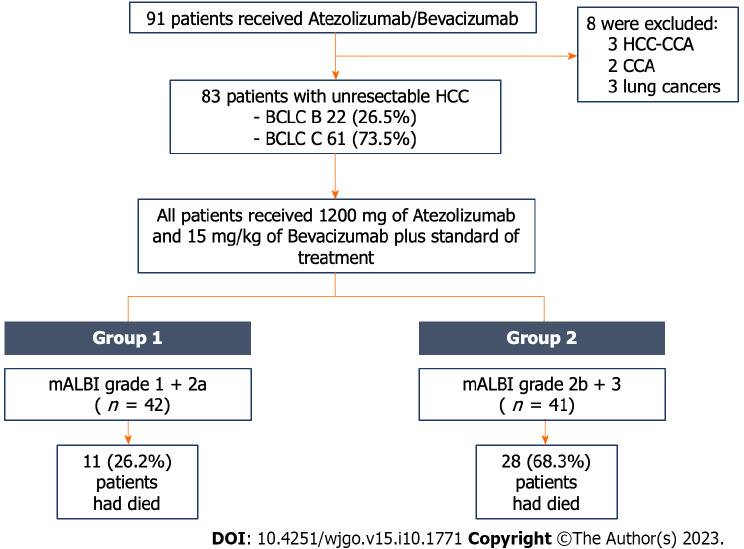
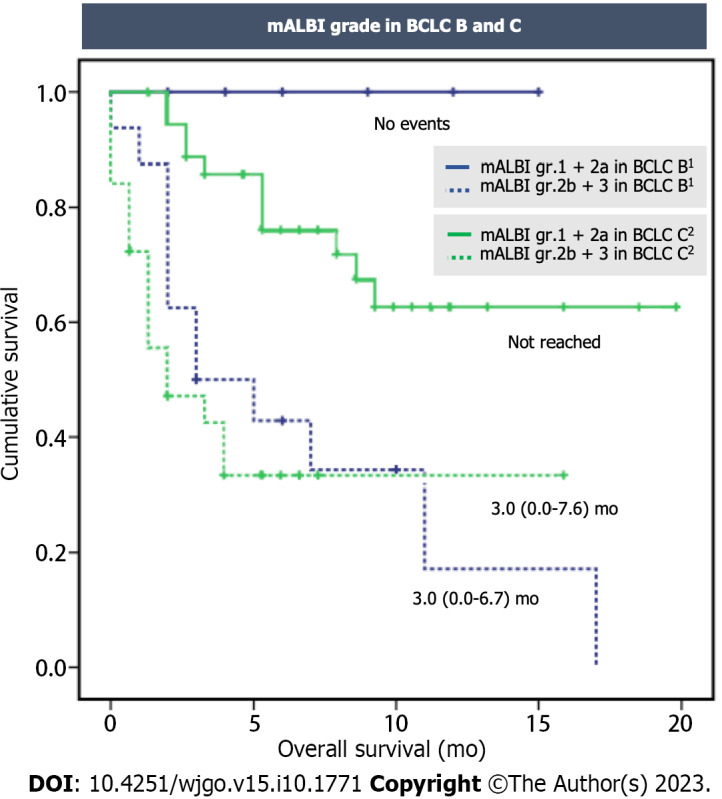
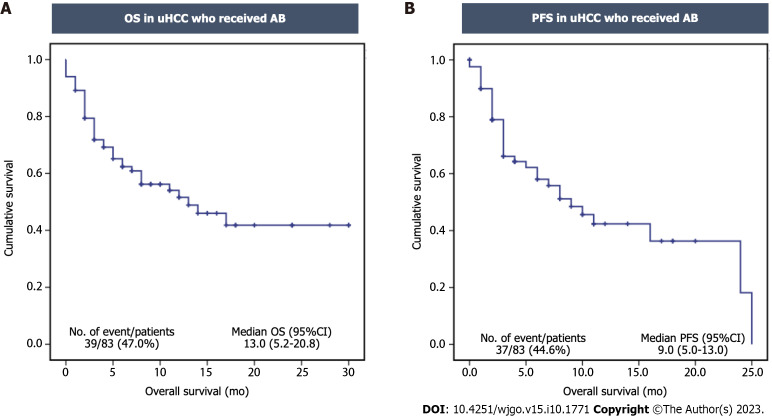
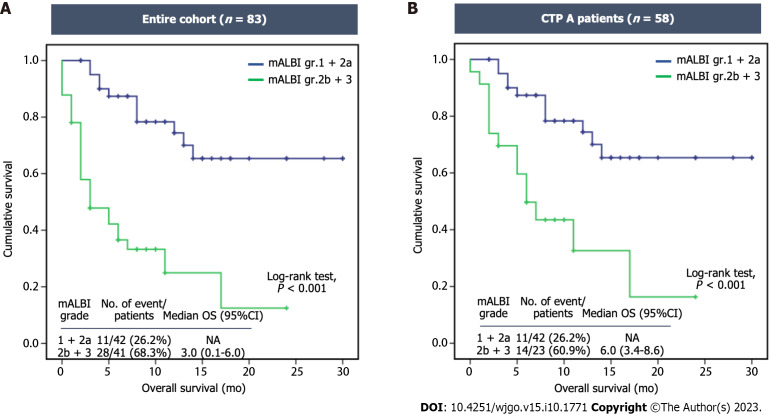
Of the 83 patients, 67 patients (80.7%) were male with the mean age of 60.6 years. Among them, 22 patients (26.5%) were classified as Barcelona Clinic Liver Cancer B, and 61 patients (73.5%) were classified as Barcelona Clinic Liver Cancer C. Cirrhosis was present in 76 patients (91.6%), with 58 patients classified as Child-Turcotte-Pugh (CTP) A and 18 as CTP B. The median overall survival (OS) and progression-free survival were 13.0 mo [95% confidence interval (CI): 5.2-20.8] and 9.0 mo (95%CI: 5.0-13.0), respectively. The patients were divided into two groups based on mALBI grades: 42 patients (50.6%) in the mALBI 1 + 2a group; and 41 patients (49.4%) in the mALBI 2b + 3 group. During the median follow-up period of 7.0 mo, the mALBI 1 + 2a group exhibited significantly better survival compared to the mALBI 2b + 3 group, with a median OS that was not reached 3.0 mo (95%CI: 0.1-6.0, < 0.001). In a subgroup of patients with CTP A, the mALBI 1 + 2a group also showed significantly longer survival compared to the mALBI 2b + 3 group, with a median OS that was not reached 6.0 mo (95%CI: 3.4-8.6, < 0.001). In the multivariate analysis, both CTP class and mALBI grade were independently associated with survival, with adjusted hazard ratios (95%CI) of 2.63 (1.19-5.78, = 0.020) and 3.90 (1.71-8.90, = 0.001), respectively.
mALBI grades can determine survival of uHCC patients receiving AB treatment, particularly those who have mildly impaired liver function. This highlights the importance of assessing mALBI before initiating AB treatment to optimize therapeutic efficacy in clinical practice.
改良白蛋白-胆红素(mALBI)分级已被确立为接受局部区域和靶向治疗的肝细胞癌(HCC)患者的生存决定因素。
探讨mALBI能否预测接受阿替利珠单抗联合贝伐珠单抗(AB)治疗的不可切除HCC(uHCC)患者的生存情况。
一项单中心回顾性队列研究纳入了2020年9月至2023年4月期间接受AB治疗并随访至2023年6月的uHCC患者。采用Cox比例风险分析确定mALBI与患者生存之间的关联。
83例患者中,67例(80.7%)为男性,平均年龄60.6岁。其中,22例(26.5%)被归类为巴塞罗那临床肝癌B期,61例(73.5%)被归类为巴塞罗那临床肝癌C期。76例(91.6%)患者存在肝硬化,其中58例被归类为Child-Turcotte-Pugh(CTP)A 级,18例为CTP B级。中位总生存期(OS)和无进展生存期分别为13.0个月[95%置信区间(CI):5.2 - 20.8]和9.0个月(95%CI:5.0 - 13.0)。根据mALBI分级将患者分为两组:mALBI 1 + 2a组42例(50.6%);mALBI 2b + 3组41例(49.4%)。在中位随访期7.0个月期间,mALBI 1 + 2a组的生存情况明显优于mALBI 2b + 3组,中位OS未达到,而mALBI 2b + 3组为3.0个月(95%CI:0.1 - 6.0,<0.001)。在CTP A级患者亚组中,mALBI 1 + 2a组的生存期也明显长于mALBI 2b + 3组,中位OS未达到,而mALBI 2b + 3组为6.0个月(95%CI:3.4 - 8.6,<0.001)。多因素分析显示,CTP分级和mALBI分级均与生存独立相关,调整后的风险比(95%CI)分别为2.63(1.19 - 5.78,P = 0.020)和3.90(1.71 - 8.90,P = 0.001)。
mALBI分级可决定接受AB治疗的uHCC患者的生存情况,尤其是肝功能轻度受损的患者。这突出了在开始AB治疗前评估mALBI以优化临床实践中治疗效果的重要性。