Shaha Chironjit Kumar, Sarker Bithy, Mahalanobish Shurid Kishore, Hossain Md Sharif, Karmaker Subarna, Saha Tapan Kumar
Department of Chemistry, Jahangirnagar University, Savar, Dhaka 1342, Bangladesh.
Veterinary Drug Residue Analysis Division, Institute of Food and Radiation Biology, Atomic Energy Research Establishment (AERE), Gonokbari, Savar, Dhaka 1349, Bangladesh.
ACS Omega. 2023 Oct 24;8(44):41612-41623. doi: 10.1021/acsomega.3c05804. eCollection 2023 Nov 7.
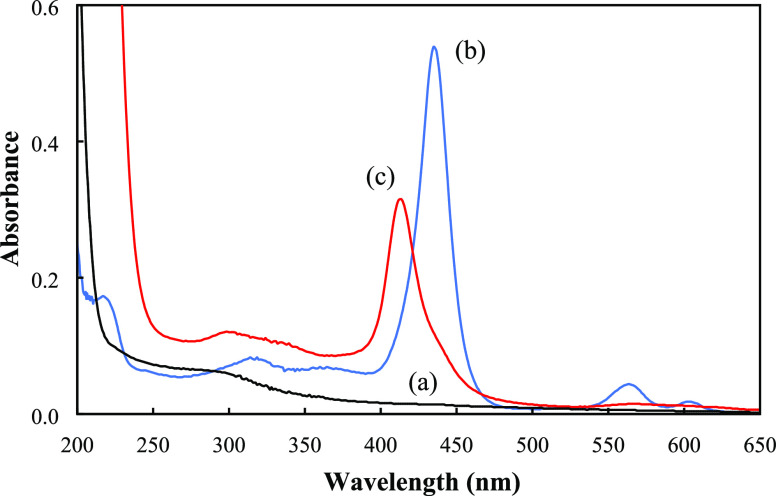
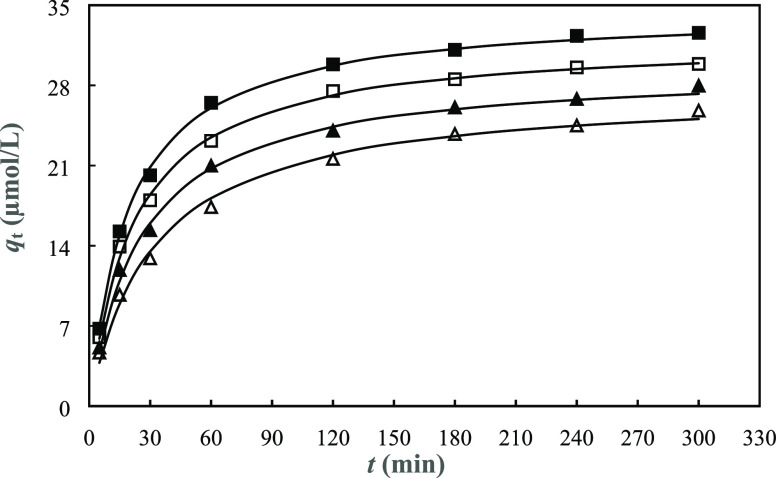
This study investigated the conjugation of chitosan with the insulin-mimetic [-tetrakis(4-sulfonatophenyl)porphyrinato]oxovanadate(IV)(4-), VO(tpps), in an aqueous medium as a function of conjugation time, VO(tpps) concentrations, and temperatures. To validate the synthesis of chitosan-VO(tpps) conjugate, UV-visible and Fourier transform infrared spectrophotometric techniques were utilized. Conjugate formation is ascribed to the electrostatic interaction between the NH units of chitosan and the SO units of VO(tpps). Chitosan enhances the stability of VO(tpps) in an aqueous medium (pH 2.5). VO(tpps) conjugation with chitosan was best explained by pseudo-second-order kinetic and Langmuir isotherm models based on kinetic and isotherm studies. The Langmuir equation determined that the maximal ability of VO(tpps) conjugated with each gram of chitosan was 39.22 μmol at a solution temperature of 45 °C. Activation energy and thermodynamic studies (: 8.78 kJ/mol, Δ: -24.52 to -27.55 kJ/mol, Δ: 204.22 J/(mol K), and Δ: 37.30 kJ/mol) reveal that conjugation is endothermic and physical in nature. The discharge of VO(tpps) from conjugate was analyzed in freshly prepared 0.1 mol/L phosphate buffer (pH 7.4) at 37 °C. The release of VO(tpps) from the conjugate is a two-phase process best explained by the Higuchi model, according to a kinetic analysis of the release data. Taking into consideration all experimental findings, it is proposed that chitosan can be used to formulate both solid and liquid insulin-mimetic chitosan-VO(tpps) conjugates.
本研究考察了壳聚糖与模拟胰岛素的[四(4 - 磺酸苯基)卟啉合氧钒(IV)](4 - ),即VO(tpps),在水介质中作为共轭时间、VO(tpps)浓度和温度的函数的共轭作用。为验证壳聚糖 - VO(tpps)共轭物的合成,采用了紫外 - 可见和傅里叶变换红外光谱技术。共轭物的形成归因于壳聚糖的NH单元与VO(tpps)的SO单元之间的静电相互作用。壳聚糖提高了VO(tpps)在水介质(pH 2.5)中的稳定性。基于动力学和等温线研究,用拟二级动力学和朗缪尔等温线模型能最好地解释VO(tpps)与壳聚糖的共轭作用。朗缪尔方程确定,在溶液温度为45℃时,每克壳聚糖共轭的VO(tpps)的最大能力为39.22 μmol。活化能和热力学研究(:8.78 kJ/mol,Δ: - 24.52至 - 27.55 kJ/mol,Δ:204.22 J/(mol·K),以及Δ:37.30 kJ/mol)表明共轭作用是吸热的且本质上是物理过程。在37℃下,在新制备的0.1 mol/L磷酸盐缓冲液(pH 7.4)中分析了VO(tpps)从共轭物中的释放。根据释放数据的动力学分析,VO(tpps)从共轭物中的释放是一个两相过程,用Higuchi模型能最好地解释。考虑到所有实验结果,建议壳聚糖可用于制备固体和液体模拟胰岛素的壳聚糖 - VO(tpps)共轭物。