Department of Civil and Environmental Engineering, University of Pittsburgh, Pittsburgh, Pennsylvania 15261, United States.
Department of Pediatrics, University of Pittsburgh School of Medicine, Pittsburgh, Pennsylvania 15261, United States.
Environ Sci Technol. 2023 Dec 5;57(48):20360-20369. doi: 10.1021/acs.est.3c05272. Epub 2023 Nov 16.
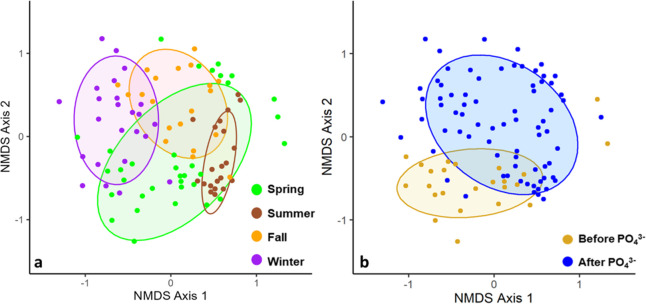
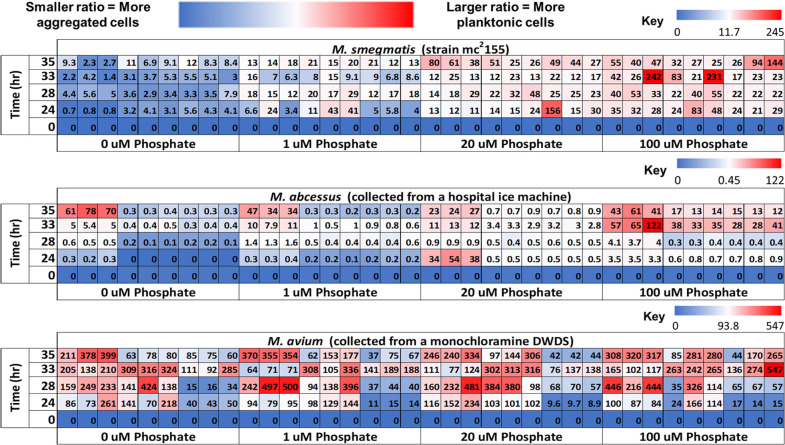
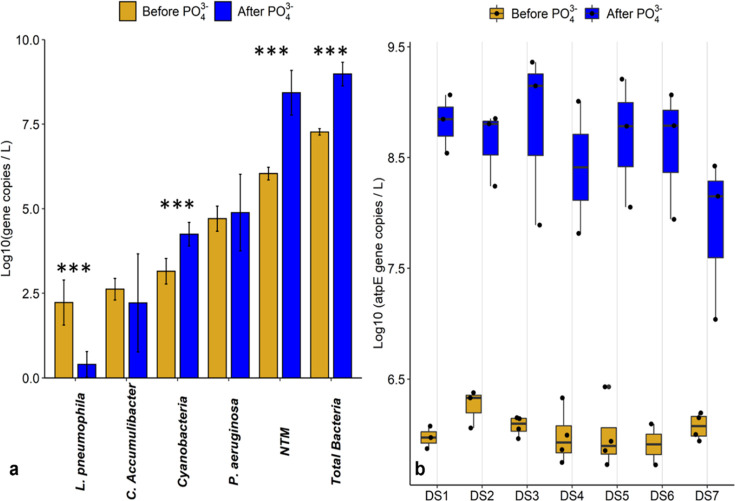
Increases in phosphate availability in drinking water distribution systems (DWDSs) from the use of phosphate-based corrosion control strategies may result in nutrient and microbial community composition shifts in the DWDS. This study assessed the year-long impacts of full-scale DWDS orthophosphate addition on both the microbial ecology and density of drinking-water-associated pathogens that infect the immunocompromised (DWPIs). Using 16S rRNA gene amplicon sequencing and droplet digital PCR, drinking water microbial community composition and DWPI density were examined. Microbial community composition analysis suggested significant compositional changes after the orthophosphate addition. Significant increases in total bacterial density were observed after orthophosphate addition, likely driven by a 2 log 10 increase in nontuberculous mycobacteria (NTM). Linear effect models confirmed the importance of phosphate addition with phosphorus concentration explaining 17% and 12% of the variance in NTM and density, respectively. To elucidate the impact of phosphate on NTM aggregation, a comparison of planktonic and aggregate fractions of NTM cultures grown at varying phosphate concentrations was conducted. Aggregation assay results suggested that higher phosphate concentrations cause more disaggregation, and the interaction between phosphate and NTM is species specific. This work reveals new insight into the consequences of orthophosphate application on the DWDS microbiome and highlights the importance of proactively monitoring the DWDS for DWPIs.
饮用水分配系统(DWDS)中使用基于磷酸盐的腐蚀控制策略增加了磷酸盐的供应,可能导致 DWDS 中的营养物质和微生物群落组成发生变化。本研究评估了全规模 DWDS 正磷酸盐添加对饮用水相关病原体(感染免疫功能低下者的病原体,DWPIs)的微生物生态学和密度的长达一年的影响。使用 16S rRNA 基因扩增子测序和液滴数字 PCR,检查了饮用水微生物群落组成和 DWPIs 密度。微生物群落组成分析表明,正磷酸盐添加后存在显著的组成变化。正磷酸盐添加后,总细菌密度显著增加,可能是由于非结核分枝杆菌(NTM)的对数 10 增加了 2 倍。线性效应模型证实了磷酸盐添加的重要性,磷浓度分别解释了 NTM 和 密度变化的 17%和 12%。为了阐明磷酸盐对 NTM 聚集的影响,比较了在不同磷酸盐浓度下生长的 NTM 浮游和聚集部分的培养物。聚集实验结果表明,较高的磷酸盐浓度会导致更多的解聚集,并且磷酸盐和 NTM 之间的相互作用是特定于物种的。这项工作揭示了正磷酸盐应用对 DWDS 微生物组的后果的新见解,并强调了主动监测 DWDS 中 DWPIs 的重要性。