FHI 360, Guzape, Nigeria.
School of Population and Public Health, University of British Columbia, Vancouver, BC, Canada.
PLoS One. 2023 Nov 16;18(11):e0289507. doi: 10.1371/journal.pone.0289507. eCollection 2023.
With stagnating funding for HIV and AIDS control programs in Nigeria, alternative funding models for antiretroviral therapy (ART) including out of pocket payment are being considered to sustain momentum epidemic control targets. We assessed willingness to pay for ART related services, and factors associated with willingness to pay.
Between July and August 2019, we conducted a survey among people living with HIV (PLHIV) on ART in 3 states in southern Nigeria. Randomly sampled respondents on ART for at least 6 months, aged ≥ 18 years, able to communicate in English or pidgin English, and consenting to the survey were enrolled. Respondents were asked if they were willing to pay for clinical consultation, antiretroviral drugs (ARVs), viral load testing services and premium ART services (including fast track services). Respondents indicating willingness to pay for any of these services were asked the maximum amount they were willing to pay using contingent valuation methodology. We assessed the weighted proportions of PLHIV on ART willing to pay for ART and used survey-featured logistic regression measures to assess sociodemographic and ART related factors associated with willingness to pay for ART services.
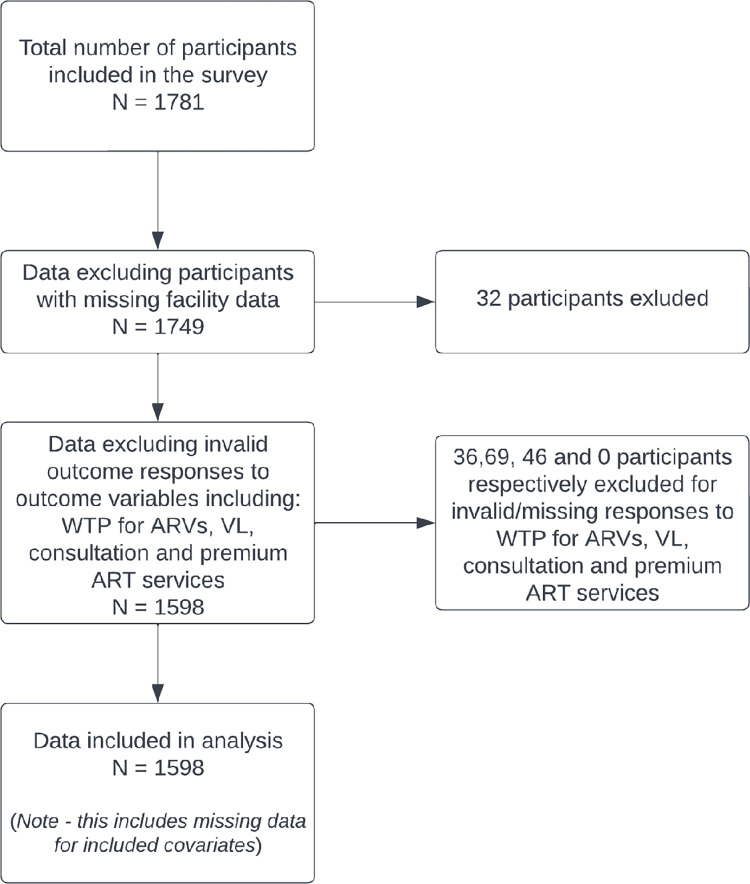
Overall, 1,598 PLHIV with a mean age of 39.03 years (standard deviation [SD]: 11.23 years), were included in this analysis. Of these, 65.8% (1,079), 73.9% (1,192), 61.0% (995) and 33.6% (472) were willing to pay for ART consultation, ARVs, viral load testing services and premium ART services respectively. The median maximum amount PLHIV were willing to pay for clinical consultation and for ARVs was NGN1,000 (USD equivalent of $2.78; interquartile range [IQR]: 500-2,000) respectively, and NGN2,500 (USD equivalent of $6.94; IQR: NGN1,000-5,000) and NGN2,000 (USD equivalent of $5.56; IQR: NGN1,000-3,000) for viral load testing and premium ART services respectively. Receiving ART in Lagos state, being employed and having a monthly income of NGN100,000 or more was associated with willingness to pay for the various ART services.
We found generally high-level of willingness to pay for ART consultation, ARVs and viral load testing services but low willingness to pay for premium ART services among PLHIV on ART. The maximum amount PLHIV were willing to pay for various ART services fell short of benchmarks for alternative funding but can potentially supplement ART by funding differentiated service delivery models that require nominal amounts to facilitate person-centered differentiated service delivery models.
随着尼日利亚艾滋病毒和艾滋病控制项目资金停滞不前,正在考虑包括自费支付在内的抗逆转录病毒疗法 (ART) 的替代融资模式,以维持疫情控制目标的势头。我们评估了对 ART 相关服务的支付意愿以及与支付意愿相关的因素。
2019 年 7 月至 8 月,我们在尼日利亚南部 3 个州对接受 ART 的艾滋病毒感染者 (PLHIV) 进行了一项调查。随机抽取至少接受了 6 个月 ART 治疗、年龄≥18 岁、能够用英语或洋泾浜英语交流且同意参与调查的患者进行登记。受访者被问及他们是否愿意为临床咨询、抗逆转录病毒药物 (ARV)、病毒载量检测服务和优质 ART 服务(包括快速通道服务)付费。表示愿意为任何这些服务付费的受访者被要求使用条件价值评估方法,最多愿意支付多少费用。我们评估了接受 ART 的 PLHIV 中愿意支付 ART 的比例,并使用调查特征逻辑回归措施来评估与支付 ART 服务意愿相关的社会人口统计学和 ART 相关因素。
总体而言,我们对 1598 名接受 ART 治疗、平均年龄为 39.03 岁(标准差 [SD]:11.23 岁)的 PLHIV 进行了分析。其中,65.8%(1079 人)、73.9%(1192 人)、61.0%(995 人)和 33.6%(472 人)分别愿意支付 ART 咨询、ARV、病毒载量检测服务和优质 ART 服务的费用。PLHIV 愿意支付临床咨询和 ARV 的最高金额中位数分别为 NGN1,000(相当于 2.78 美元;四分位距 [IQR]:500-2,000)和 NGN2,500(相当于 6.94 美元;IQR:NGN1,000-5,000)和 NGN2,000(相当于 5.56 美元;IQR:NGN1,000-3,000)用于病毒载量检测和优质 ART 服务。在拉各斯州接受 ART 治疗、有工作和月收入达到 100,000 奈拉或以上与支付各种 ART 服务的意愿相关。
我们发现,接受 ART 治疗的 PLHIV 对 ART 咨询、ARV 和病毒载量检测服务的支付意愿普遍较高,但对优质 ART 服务的支付意愿较低。PLHIV 愿意支付的各种 ART 服务的最高金额低于替代供资的基准,但有可能通过为不同的服务交付模式提供资金来补充 ART,这些模式只需要少量资金即可促进以患者为中心的差异化服务交付模式。