FHI 360, Abuja, Nigeria.
FHI 360, Washington, DC, USA.
J Int AIDS Soc. 2021 Oct;24 Suppl 6(Suppl 6):e25820. doi: 10.1002/jia2.25820.
The rapid increase in the number of people living with HIV (PLHIV) on antiretroviral therapy (ART) in Akwa Ibom and Cross River states in Nigeria led to overcrowding at clinics. Patients were devolved to receive ART refills through five differentiated service delivery (DSD) models: fast-track (FT), adolescent refill clubs (ARCs), community pharmacy ART refill programs (CPARPs), community ART refill clubs (CARCs) and community ART refill groups (CARGs) designed to meet the needs of different groups of PLHIV. In the context of COVID-19-related travel restrictions, out-of-facility models offered critical mechanisms for continuity of treatment. We compared retention and viral suppression among those devolved to DSD with those who continued standard care at facilities.
A retrospective cohort study was conducted among patients devolved to DSD from January 2018 to December 2020. Bivariate analyses were conducted to assess differences in retention and viral suppression by socio-demographic characteristics. Kaplan-Meier assessed retention at 3, 6, 9 and 12 months. Differences in proportions were compared using the chi-square test; a p-value of <0.05 was considered significant.
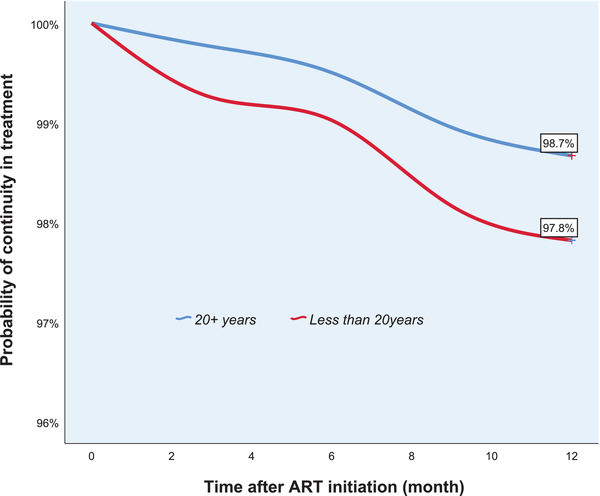
A total of 40,800 PLHIV from 84 facilities received ART through the five models: CARC (53%), FT (19.1%), ARC (12.1%), CPARP (10.4%) and CARG (5.4%). Retention rates at 6 months exceeded 96% for all models compared to 94% among those continuing standard care. Among those using DSD, retention rate at 12 months was higher among adults than children (97.8% vs. 96.7%, p = 0.04). No significant sex differences in retention rates were found among those enrolled in DSD. Viral suppression rates among PLHIV served through DSD were significantly higher among adults than children (95.4% vs. 89.2%; p <0.01). Among adults, 95.4% enrolled in DSD were virally suppressed compared to 91.8% of those in standard care (p <0.01). For children, 89.2% enrolled in DSD were virally suppressed compared to 83.2% in standard care (p <0.01).
PLHIV receiving ART through DSD models had retention but higher viral suppression rates compared to those receiving standard care. Expanding DSD during COVID-19 has helped ensure uninterrupted access to ART in Nigeria. Further scale-up is warranted to decongest facilities and improve clinical outcomes.
在尼日利亚的阿克瓦伊博姆州和十字河流州,接受抗逆转录病毒疗法 (ART) 的艾滋病毒感染者 (PLHIV) 人数迅速增加,导致诊所人满为患。患者通过五种差异化服务提供 (DSD) 模式接受 ART 续药:快速通道 (FT)、青少年续药俱乐部 (ARC)、社区药房 ART 续药计划 (CPARPs)、社区 ART 续药俱乐部 (CARCs) 和社区 ART 续药小组 (CARGs),旨在满足不同群体 PLHIV 的需求。在与 COVID-19 相关的旅行限制背景下,非机构模式提供了治疗连续性的关键机制。我们比较了分流到 DSD 的患者与继续在机构接受标准护理的患者的保留率和病毒抑制率。
对 2018 年 1 月至 2020 年 12 月期间分流到 DSD 的患者进行回顾性队列研究。采用单变量分析评估社会人口特征对保留率和病毒抑制率的差异。Kaplan-Meier 评估了 3、6、9 和 12 个月时的保留率。使用卡方检验比较比例差异;p 值<0.05 被认为具有统计学意义。
来自 84 个设施的 40800 名 PLHIV 通过五种模式接受 ART:CARCs(53%)、FT(19.1%)、ARC(12.1%)、CPARP(10.4%)和 CARG(5.4%)。与继续接受标准护理的患者相比,所有模式的 6 个月保留率均超过 96%。在使用 DSD 的患者中,12 个月时的保留率在成年人中高于儿童(97.8% vs. 96.7%,p = 0.04)。在 DSD 中,成年人的保留率在性别上没有显著差异。与儿童相比,通过 DSD 接受治疗的 PLHIV 的病毒抑制率显著更高(95.4% vs. 89.2%;p<0.01)。在成年人中,95.4%接受 DSD 的患者病毒得到抑制,而接受标准护理的患者为 91.8%(p<0.01)。对于儿童,89.2%接受 DSD 的患者病毒得到抑制,而接受标准护理的患者为 83.2%(p<0.01)。
与接受标准护理的患者相比,通过 DSD 模式接受 ART 的 PLHIV 的保留率更高,但病毒抑制率更高。在 COVID-19 期间扩大 DSD 有助于确保尼日利亚不间断地获得 ART。需要进一步扩大规模以减轻设施负担并改善临床结果。