School of Public Health, Global Health Institute, Fudan University, Shanghai, China.
Prime Institute of Public Health, Peshawar Medical College, Peshawar, Pakistan.
J Glob Health. 2023 Nov 17;13:04155. doi: 10.7189/jogh.13.04155.
In South Asia, women often experience intimate partner violence (IPV) and have limited access to maternal health services (MHS). However, the effects of IPV on antenatal care (ANC) visits remain unclear. This study aimed to examine the impact of IPV of different forms and severities on ANC visits in South Asia.
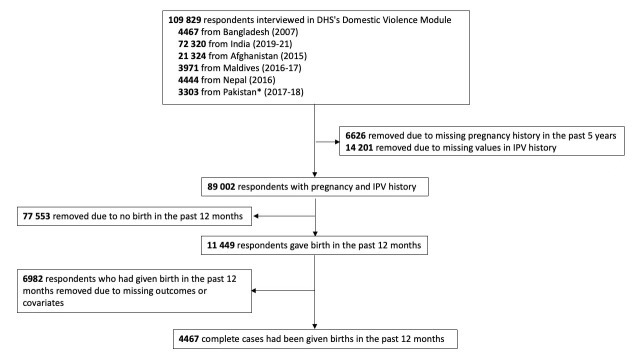
This cross-sectional study used the latest available data from demographic and health surveys conducted in Bangladesh, India, Afghanistan, Nepal, Maldives, and Pakistan. The study sampled 4467 women who had given birth within the past 12 months and were interviewed for IPV. IPV was measured by binary variables indicating the presence of physical violence (PV), categorised into less severe (LSPV) and severe physical violence (SPV), emotional violence (EV), and sexual violence (SV). ANC utilization was measured using binary variables indicating whether respondents had any, at least four, or at least eight ANC visits, as recommended by World Health Organization (WHO). Logistic regressions adjusted for survey weights were used to assess associations between ANC utilization and exposure to IPV during pregnancy and lifetime.
The prevalence of LSPV, SPV, EV, and SV during pregnancy were 14.5%, 4.4%, 11.6%, and 4.1%. LSPV experience during pregnancy was associated with decreased likelihoods of at least four ANC visits (odds ratio (OR) = 0.55; 95% confidence interval (CI) = 0.40-0.76) and eight ANC visits (OR = 0.53; 95% CI = 0.31-0.90). Results of lifetime exposure to IPV followed similar patterns. Lifetime exposure to LSPV was associated with decreased likelihoods of at least four ANC visits (OR = 0.55; 95% CI = 0.41-0.74) and eight ANC visits (OR = 0.47; 95% CI = 0.29-0.77).
This study highlights the negativities of LSPV on the frequency of women seeking ANC visits. Policies are necessary to identify women at risk of the often-overlooked LSPV early and provide protective interventions to promote maternal health in South Asia.
在南亚,女性经常遭受亲密伴侣暴力(IPV),获得孕产妇保健服务(MHS)的机会有限。然而,IPV 对产前护理(ANC)就诊的影响尚不清楚。本研究旨在探讨不同形式和严重程度的 IPV 对南亚 ANC 就诊的影响。
这是一项横断面研究,使用了孟加拉国、印度、阿富汗、尼泊尔、马尔代夫和巴基斯坦最新的人口与健康调查数据。该研究对过去 12 个月内分娩的 4467 名妇女进行了抽样调查,并对其进行了 IPV 访谈。IPV 通过表示存在身体暴力(PV)的二项变量来衡量,分为轻度严重(LSPV)和严重身体暴力(SPV)、情绪暴力(EV)和性暴力(SV)。ANC 利用率通过表示受访者是否接受过任何、至少 4 次或至少 8 次 ANC 就诊的二项变量来衡量,这是世界卫生组织(WHO)推荐的。使用调整了调查权重的逻辑回归来评估 ANC 利用率与怀孕期间和一生中接触 IPV 之间的关联。
怀孕期间 LSPV、SPV、EV 和 SV 的患病率分别为 14.5%、4.4%、11.6%和 4.1%。怀孕期间经历 LSPV 与至少 4 次 ANC 就诊的可能性降低相关(比值比(OR)=0.55;95%置信区间(CI)=0.40-0.76)和 8 次 ANC 就诊(OR=0.53;95%CI=0.31-0.90)。终生接触 IPV 的结果也呈现出类似的模式。终生接触 LSPV 与至少 4 次 ANC 就诊的可能性降低相关(OR=0.55;95%CI=0.41-0.74)和 8 次 ANC 就诊(OR=0.47;95%CI=0.29-0.77)。
本研究强调了 LSPV 对女性寻求 ANC 就诊频率的负面影响。有必要制定政策,尽早发现经常被忽视的 LSPV 风险妇女,并提供保护干预措施,以促进南亚的孕产妇健康。