Mohammed Bedru Hussen, Johnston Janice Mary, Harwell Joseph I, Yi Huso, Tsang Katrina Wai-Kay, Haidar Jemal Ali
School of Public Health, The University of Hong Kong, G09, G/F, Patrick Manson Building, 7 Sassoon Road, Pokfulam, Hong Kong.
Clinton Health Access Initiative, Boston, USA.
BMC Health Serv Res. 2017 Mar 7;17(1):178. doi: 10.1186/s12913-017-2121-7.
Despite its prominence, intimate partner violence (IPV) against women has received little attention in Ethiopia. And as many of sub-Saharan African countries, maternal health care services utilization remains poor. Full access and utilization of maternal health care services is a key to significant reduction in maternal and child mortality, and eliminate new HIV infection in infants. Identifying the factors that contribute to the poor access and utilization should aid the design of appropriate policy and intervention strategies. Thus the objective of this study was to examine the association between IPV and use of maternal health care services in Addis Ababa, Ethiopia.
A cross sectional study on couples (N = 210; male/female pairs) with an infant less than 6 months of age was conducted. The dependent variable was use of maternal health care services and the main independent variable was IPV. Data was collected using face-to-face self-reported questionnaires and analyzed using SPSS version 20.0. Bivariate and multivariate logistic regression models were used to examine the relationship between the dependent and independent variables.
The mean age of the women was 28.7 years (SD = 5.4), on average women were 7.4 years (SD = 7.4) younger than their partners. Although most of the women (95.2%) had at least one antenatal care (ANC), only 35 (2%) had ≥4 ANC visits and about half (49.0%) had their first ANC visit within the first trimester. Women who experienced emotional IPV in their relationship were less likely to have their 1 ANC within three months of pregnancy (AOR = 0.69; 95%CI = 0.49-0.96). Women who reported physical IPV in their relationship were less likely to use ≥4 ANC (AOR = 0.48; 95%CI = 0.21-0.71), be tested for HIV (AOR = 0.26; 95%CI = 0.09-0.79), have skilled delivery attendant (AOR = 0.31; 95%CI = 0.12-0.98), and deliver in a health facility (AOR = 0.35; 95%CI = 0.14-0.88). Likewise, women experienced sexual IPV or partner control in their relationship were less likely to use ANC ≥4 times (AOR = 0.91; 95%CI = 0.84-0.98 and AOR = 0.38; 95%CI = 0.17-0.85 respectively).
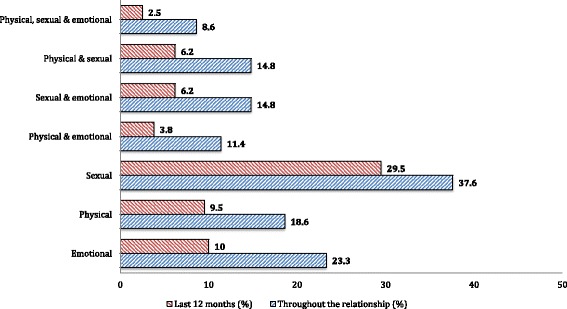
IPV is prevalent among couples in Addis Ababa, Ethiopia where three out of four women reported having experienced one or more type of IPV in their current relationship. And all types of IPV showed significant association with poor utilization of one or more maternal health care services. Thus efforts to sustain the recent success in maternal health and further improvement should give due consideration to IPV.
尽管亲密伴侣对女性的暴力行为(IPV)很突出,但在埃塞俄比亚却很少受到关注。与许多撒哈拉以南非洲国家一样,孕产妇保健服务的利用率仍然很低。充分获得和利用孕产妇保健服务是大幅降低孕产妇和儿童死亡率以及消除婴儿新感染艾滋病毒的关键。确定导致获得和利用不足的因素应有助于制定适当的政策和干预策略。因此,本研究的目的是调查埃塞俄比亚亚的斯亚贝巴亲密伴侣暴力行为与孕产妇保健服务利用之间的关联。
对有一名6个月以下婴儿的夫妇(N = 210;男女配对)进行了一项横断面研究。因变量是孕产妇保健服务的利用情况,主要自变量是亲密伴侣暴力行为。使用面对面的自我报告问卷收集数据,并使用SPSS 20.0版进行分析。使用双变量和多变量逻辑回归模型来检验因变量和自变量之间的关系。
女性的平均年龄为28.7岁(标准差=5.4),平均而言,女性比其伴侣年轻7.4岁(标准差=7.4)。尽管大多数女性(95.2%)至少进行了一次产前检查(ANC),但只有35名(2%)进行了≥4次产前检查,约一半(49.0%)在孕早期进行了第一次产前检查。在恋爱关系中遭受情感亲密伴侣暴力行为的女性在怀孕三个月内进行第一次产前检查的可能性较小(调整后比值比[AOR]=0.69;95%置信区间[CI]=0.49-0.96)。在恋爱关系中报告遭受身体亲密伴侣暴力行为的女性使用≥4次产前检查的可能性较小(AOR=0.48;95%CI=0.21-0.71),接受艾滋病毒检测的可能性较小(AOR=0.26;95%CI=0.09-0.79),有熟练接生员的可能性较小(AOR=0.31;95%CI=0.12-0.98),在医疗机构分娩的可能性较小(AOR=0.35;95%CI=0.14-0.88)。同样,在恋爱关系中遭受性亲密伴侣暴力行为或伴侣控制的女性进行≥4次产前检查的可能性较小(AOR分别为0.91;95%CI=0.84-0.98和AOR=0.38;95%CI=0.17-0.85)。
亲密伴侣暴力行为在埃塞俄比亚亚的斯亚贝巴的夫妇中很普遍,四分之三的女性报告在当前恋爱关系中经历过一种或多种亲密伴侣暴力行为。所有类型的亲密伴侣暴力行为都与一种或多种孕产妇保健服务利用不足有显著关联。因此,为维持近期在孕产妇保健方面取得的成功并进一步改善,应适当考虑亲密伴侣暴力行为。