• 文献检索
  • 文档翻译
  • 深度研究
  • 学术资讯
  • Suppr Zotero 插件Zotero 插件
  • 邀请有礼
  • 套餐&价格
  • 历史记录
应用&插件
Suppr Zotero 插件Zotero 插件浏览器插件Mac 客户端Windows 客户端微信小程序
定价
高级版会员购买积分包购买API积分包
服务
文献检索文档翻译深度研究API 文档MCP 服务
关于我们
关于 Suppr公司介绍联系我们用户协议隐私条款
关注我们

Suppr 超能文献

核心技术专利:CN118964589B侵权必究
粤ICP备2023148730 号-1Suppr @ 2026

文献检索

告别复杂PubMed语法,用中文像聊天一样搜索,搜遍4000万医学文献。AI智能推荐,让科研检索更轻松。

立即免费搜索

文件翻译

保留排版,准确专业,支持PDF/Word/PPT等文件格式,支持 12+语言互译。

免费翻译文档

深度研究

AI帮你快速写综述,25分钟生成高质量综述,智能提取关键信息,辅助科研写作。

立即免费体验

“继续进行筛查”——对医疗系统的建议,基于对新诊断的结直肠癌患者的访谈得出的关于林奇综合征常规筛查的建议 。

"Go ahead and screen" - advice to healthcare systems for routine lynch syndrome screening from interviews with newly diagnosed colorectal cancer patients.

作者信息

Schneider Jennifer L, Firemark Alison J, Gille Sara, Davis James, Pawloski Pamala A, Liang Su-Ying, Epstein Mara M, Lowery Jan, Lu Christine Y, Sharaf Ravi N, Burnett-Hartman Andrea N, Schlieder Victoria, Salvati Zachary M, Cragun Deborah, Rahm Alanna Kulchak, Hunter Jessica Ezzell

机构信息

Kaiser Permanente Center for Health Research, 3800 N Interstate Ave, 97227, Portland, OR, USA.

HealthPartners Institute, Bloomington, MN, USA.

出版信息

Hered Cancer Clin Pract. 2023 Nov 17;21(1):24. doi: 10.1186/s13053-023-00270-4.

DOI:10.1186/s13053-023-00270-4
PMID:37978552
原文链接:https://pmc.ncbi.nlm.nih.gov/articles/PMC10657118/
Abstract

BACKGROUND

Lynch syndrome (LS) is the most common cause of inherited colorectal cancer (CRC). Universal tumor screening (UTS) of newly diagnosed CRC cases is recommended to aid in diagnosis of LS and reduce cancer-related morbidity and mortality. However, not all health systems have adopted UTS processes and implementation may be inconsistent due to system and patient-level complexities.

METHODS

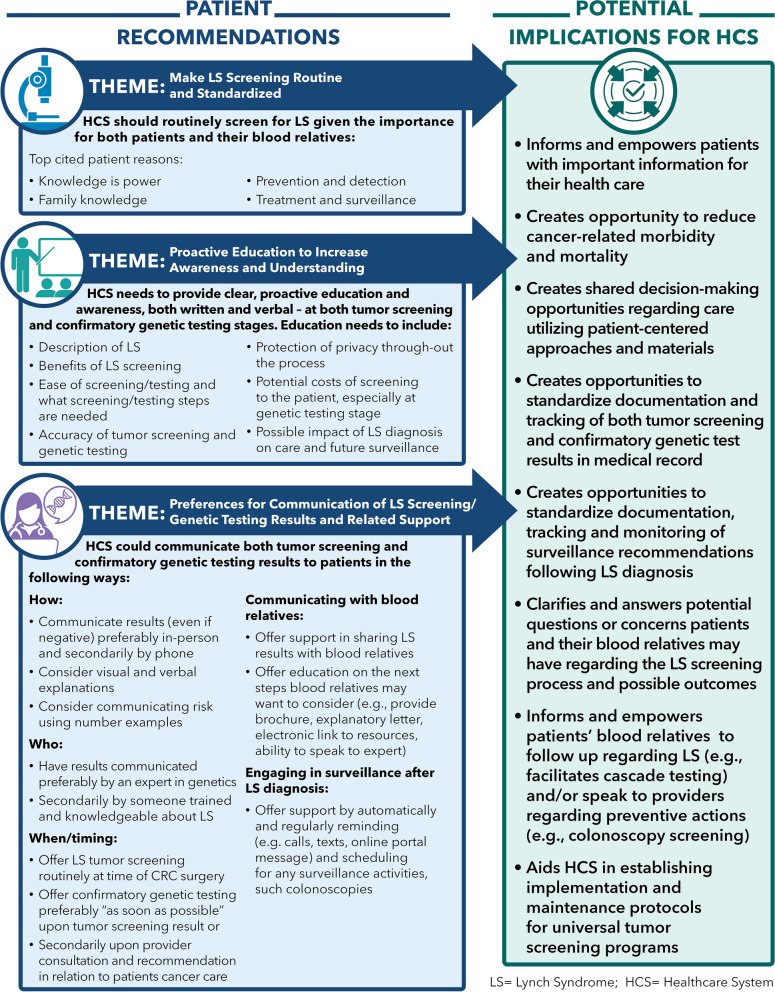
To identify barriers, facilitators, and suggestions for improvements of the UTS process from the patient perspective, we conducted in-depth, semi-structured interviews with patients recently diagnosed with CRC, but not screened for or aware of LS. Patients were recruited from eight regionally diverse US health systems. Interviews were conducted by telephone, 60-minutes, audio-recorded, and transcribed. An inductive, constant comparative analysis approach was employed.  RESULTS: We completed 75 interviews across the eight systems. Most participants were white (79%), about half (52%) were men, and the mean age was 60 years. Most self-reported either no (60%) or minimal (40%) prior awareness of LS. Overall, 96% of patients stated UTS should be a routine standard of care for CRC tumors, consistently citing four primary motivations for wanting to know their LS status and engage in the process for LS identification: "knowledge is power"; "family knowledge"; "prevention and detection"; and "treatment and surveillance." Common concerns pertaining to the process of screening for and identifying LS included: creating anticipatory worry for patients, the potential cost and the accuracy of the genetic test, and possibly having one's health insurance coverage impacted by the LS diagnosis. Patients suggested health systems communicate LS results in-person or by phone from a trained expert in LS; offer proactive verbal and written education about LS, the screening steps, and any follow-up surveillance recommendations; and support patients in communicating their LS screening to any of their blood relatives.

CONCLUSION

Our qualitative findings demonstrate patients with CRC have a strong desire for healthcare systems to regularly implement and offer UTS. Patients offer key insights for health systems to guide future implementation and optimization of UTS and other LS screening programs and maximize diagnosis of individuals with LS and improve cancer-related surveillance and outcomes.

TRIAL REGISTRATION

Not available: not a clinical trial.

摘要

背景

林奇综合征(LS)是遗传性结直肠癌(CRC)最常见的病因。建议对新诊断的CRC病例进行普遍肿瘤筛查(UTS),以协助LS的诊断,并降低癌症相关的发病率和死亡率。然而,并非所有卫生系统都采用了UTS流程,由于系统和患者层面的复杂性,实施可能并不一致。

方法

为了从患者角度识别UTS流程的障碍、促进因素和改进建议,我们对最近诊断为CRC但未进行LS筛查或知晓LS的患者进行了深入的半结构化访谈。患者从美国八个地域不同的卫生系统中招募。访谈通过电话进行,时长60分钟,进行录音并转录。采用归纳性的持续比较分析方法。

结果

我们在八个系统中完成了75次访谈。大多数参与者为白人(79%),约一半(52%)为男性,平均年龄为60岁。大多数人自我报告之前对LS没有(60%)或仅有极少(40%)的了解。总体而言,96%的患者表示UTS应该成为CRC肿瘤的常规护理标准,并一致列举了想要了解自己LS状态并参与LS识别过程的四个主要动机:“知识就是力量”;“家族了解”;“预防与检测”;以及“治疗与监测”。与LS筛查和识别过程相关的常见担忧包括:给患者造成预期焦虑、基因检测的潜在成本和准确性,以及LS诊断可能对健康保险覆盖范围产生的影响。患者建议卫生系统由LS方面的专业人员亲自或通过电话传达LS检测结果;提供关于LS、筛查步骤以及任何后续监测建议的主动口头和书面教育;并支持患者将其LS筛查情况告知任何有血缘关系的亲属。

结论

我们的定性研究结果表明,CRC患者强烈希望医疗保健系统定期实施并提供UTS。患者为卫生系统提供了关键见解,以指导UTS及其他LS筛查项目的未来实施和优化,并最大限度地提高LS患者的诊断率,改善癌症相关监测及结果。

试验注册

不可用:非临床试验。

https://cdn.ncbi.nlm.nih.gov/pmc/blobs/150b/10657118/e00bc4a73af5/13053_2023_270_Fig1_HTML.jpg

相似文献

1
"Go ahead and screen" - advice to healthcare systems for routine lynch syndrome screening from interviews with newly diagnosed colorectal cancer patients.“继续进行筛查”——对医疗系统的建议,基于对新诊断的结直肠癌患者的访谈得出的关于林奇综合征常规筛查的建议 。
Hered Cancer Clin Pract. 2023 Nov 17;21(1):24. doi: 10.1186/s13053-023-00270-4.
2
Identifying patients with Lynch syndrome using a universal tumor screening program in an integrated healthcare system.在综合医疗保健系统中,通过通用肿瘤筛查计划识别林奇综合征患者。
Hered Cancer Clin Pract. 2022 Apr 18;20(1):17. doi: 10.1186/s13053-022-00217-1.
3
Implementing universal Lynch syndrome screening (IMPULSS): protocol for a multi-site study to identify strategies to implement, adapt, and sustain genomic medicine programs in different organizational contexts.实施林奇综合征通用筛查(IMPULSS):一项多中心研究方案,旨在确定在不同组织环境中实施、调整和维持基因组医学项目的策略。
BMC Health Serv Res. 2018 Oct 30;18(1):824. doi: 10.1186/s12913-018-3636-2.
4
Universal screening for Lynch syndrome among patients with colorectal cancer: patient perspectives on screening and sharing results with at-risk relatives.对结直肠癌患者进行林奇综合征的普遍筛查:患者对筛查及与高危亲属分享结果的看法。
Fam Cancer. 2017 Jul;16(3):377-387. doi: 10.1007/s10689-017-9972-2.
5
Patient and provider perspectives on adherence to and care coordination of lynch syndrome surveillance recommendations: findings from qualitative interviews.患者及医疗服务提供者对林奇综合征监测建议的依从性和护理协调的看法:定性访谈结果
Hered Cancer Clin Pract. 2018 May 10;16:11. doi: 10.1186/s13053-018-0090-4. eCollection 2018.
6
Implementation of Universal Tumor Screening of Colorectal Cancer for Detection of Lynch Syndrome at a Hispanic-Rich County Hospital.在一个西班牙裔人群集中的县级医院实施大肠癌普遍肿瘤筛查以检测林奇综合征。
JCO Oncol Pract. 2020 Sep;16(9):e948-e957. doi: 10.1200/JOP.19.00508. Epub 2020 May 22.
7
Molecular testing for Lynch syndrome in people with colorectal cancer: systematic reviews and economic evaluation.结直肠癌患者林奇综合征的分子检测:系统评价和经济评估。
Health Technol Assess. 2017 Sep;21(51):1-238. doi: 10.3310/hta21510.
8
Lessons learnt from the implementation of a colorectal cancer screening programme for lynch syndrome in a tertiary public hospital.在一家三级公立医院实施林奇综合征结直肠癌筛查项目所汲取的经验教训。
Cancer Epidemiol. 2023 Feb;82:102291. doi: 10.1016/j.canep.2022.102291. Epub 2022 Nov 18.
9
What would I do? Perspectives on the factors underlying Lynch syndrome genetic testing and results sharing decisions for high-risk colorectal cancer patients.我会怎么做?探讨林奇综合征遗传检测和高危结直肠癌患者检测结果共享决策的潜在因素。
Psychooncology. 2022 Apr;31(4):587-596. doi: 10.1002/pon.5840. Epub 2021 Nov 8.
10
Challenges in the diagnosis and management of Lynch Syndrome in an Indigenous family living in a remote West Australian community.西澳大利亚偏远社区一个原住民家庭中林奇综合征诊断与管理面临的挑战。
Rural Remote Health. 2011;11(4):1836. Epub 2011 Dec 22.

本文引用的文献

1
Development of a theory-informed questionnaire to assess the acceptability of healthcare interventions.理论导向型问卷评估医疗干预措施可接受性的开发。
BMC Health Serv Res. 2022 Mar 1;22(1):279. doi: 10.1186/s12913-022-07577-3.
2
Economic Evaluation of Universal Lynch Syndrome Screening Protocols among Newly Diagnosed Patients with Colorectal Cancer.新诊断结直肠癌患者中林奇综合征通用筛查方案的经济学评估
J Pers Med. 2021 Dec 2;11(12):1284. doi: 10.3390/jpm11121284.
3
Assessment of Patient Preferences for Telehealth in Post-COVID-19 Pandemic Health Care.
评估新冠疫情后医疗保健中患者对远程医疗的偏好。
JAMA Netw Open. 2021 Dec 1;4(12):e2136405. doi: 10.1001/jamanetworkopen.2021.36405.
4
Telehealth genetic services during the COVID-19 Pandemic: Implementation and patient experiences across multiple specialties in Nebraska.新冠肺炎疫情期间的远程医疗遗传服务:内布拉斯加州多个专业的实施情况和患者体验。
J Genet Couns. 2021 Oct;30(5):1233-1243. doi: 10.1002/jgc4.1507. Epub 2021 Oct 7.
5
The COVID-19 pandemic and reproductive genetic counseling: Changes in access and service delivery at an academic medical center in the United States.COVID-19 大流行与生殖遗传咨询:美国一家学术医疗中心在咨询途径和服务提供方面的变化。
J Genet Couns. 2021 Aug;30(4):958-968. doi: 10.1002/jgc4.1462. Epub 2021 Jul 5.
6
How Should We Test for Lynch Syndrome? A Review of Current Guidelines and Future Strategies.我们应如何检测林奇综合征?当前指南与未来策略综述。
Cancers (Basel). 2021 Jan 22;13(3):406. doi: 10.3390/cancers13030406.
7
Universal tumor screening for lynch syndrome: perspectives of patients regarding willingness and informed consent.林奇综合征的肿瘤普筛:患者对意愿和知情同意的看法。
Per Med. 2020 Sep;17(5):373-387. doi: 10.2217/pme-2020-0026. Epub 2020 Sep 2.
8
NCCN Guidelines Insights: Genetic/Familial High-Risk Assessment: Colorectal, Version 2.2019.NCCN 指南解读:遗传/家族性高风险评估:结直肠癌,第 2.2019 版。
J Natl Compr Canc Netw. 2019 Sep 1;17(9):1032-1041. doi: 10.6004/jnccn.2019.0044.
9
Implementation of a Systematic Tumor Screening Program for Lynch Syndrome in an Integrated Health Care Setting.在综合性医疗保健环境中实施林奇综合征的系统性肿瘤筛查计划。
Fam Cancer. 2019 Jul;18(3):317-325. doi: 10.1007/s10689-019-00123-x.
10
Universal tumor screening for Lynch syndrome: perspectives of Canadian pathologists and genetic counselors.林奇综合征的通用肿瘤筛查:加拿大病理学家和遗传咨询师的观点
J Community Genet. 2019 Jul;10(3):335-344. doi: 10.1007/s12687-018-0398-9. Epub 2018 Nov 21.