Hao Jing, Hassen Dina, Gudgeon James M, Snyder Susan R, Hampel Heather, Williams Marc S, Sharaf Ravi N, Lu Christine Y, Williams Janet L, Schlieder Victoria, Rahm Alanna Kulchak
Department of Population Health Sciences, Geisinger, Danville, PA 17822, USA.
Genomic Medicine Institute, Geisinger, Danville, PA 17822, USA.
J Pers Med. 2021 Dec 2;11(12):1284. doi: 10.3390/jpm11121284.
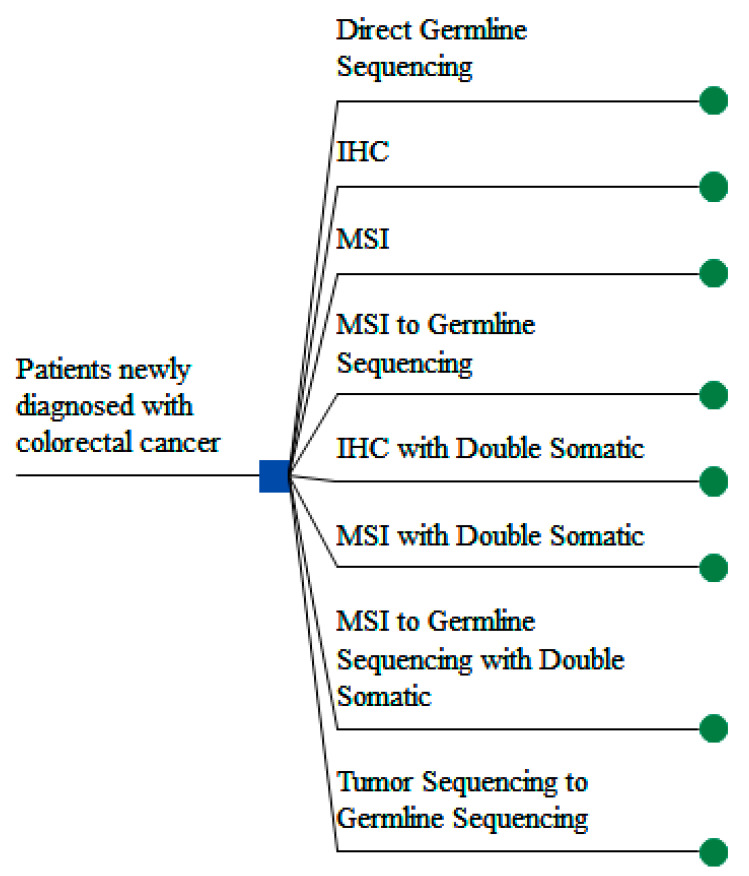
We conducted an updated economic evaluation, from a healthcare system perspective, to compare the relative effectiveness and efficiency of eight Lynch syndrome (LS) screening protocols among newly diagnosed colorectal cancer (CRC) patients. We developed decision analytic models for a hypothetical cohort of 1000 patients. Model assumptions and parameter values were based on literature and expert opinion. All costs were in 2018 USD. For identifying LS cases, the direct germline sequencing (DGS) protocol provided the best performance (sensitivity 99.90%, 99.57-99.93%; specificity 99.50%, 97.28-99.85%), followed by the tumor sequencing to germline sequencing (TSGS) protocol (sensitivity, 99.42%, 96.55-99.63%; specificity, 96.58%, 96.46-96.60%). The immunohistochemistry (IHC) protocol was most efficient at $20,082 per LS case identified, compared to microsatellite instability (MSI) ($22,988), DGS ($31,365), and TSGS ($104,394) protocols. Adding double-somatic testing to IHC and MSI protocols did not change sensitivity and specificity, increased costs by 6% and 3.5%, respectively, but reduced unexplained cases by 70% and 50%, respectively. DGS would be as efficient as the IHC protocol when the cost of germline sequencing declines under $368 indicating DGS could be an efficient option in the near future. Until then, IHC and MSI protocols with double-somatic testing would be the optimal choices.
我们从医疗保健系统的角度进行了一项更新的经济评估,以比较八种林奇综合征(LS)筛查方案在新诊断的结直肠癌(CRC)患者中的相对有效性和效率。我们为一个假设的1000名患者队列开发了决策分析模型。模型假设和参数值基于文献和专家意见。所有成本均以2018年美元计算。对于识别LS病例,直接种系测序(DGS)方案表现最佳(敏感性99.90%,99.57 - 99.93%;特异性99.50%,97.28 - 99.85%),其次是肿瘤测序到种系测序(TSGS)方案(敏感性99.42%,96.55 - 99.63%;特异性96.58%,96.46 - 96.60%)。免疫组织化学(IHC)方案在每识别出一例LS病例时成本为20,082美元,是最有效的,相比之下,微卫星不稳定性(MSI)方案(22,988美元)、DGS方案(31,365美元)和TSGS方案(104,394美元)。在IHC和MSI方案中添加双体细胞检测并未改变敏感性和特异性,成本分别增加了6%和3.5%,但分别减少了70%和50%的不明原因病例。当种系测序成本降至368美元以下时,DGS将与IHC方案一样有效,这表明DGS在不久的将来可能是一个有效的选择。在此之前,采用双体细胞检测的IHC和MSI方案将是最佳选择。