Department of Neurology, Leonard M. Miller School of Medicine University of Miami Miami FL.
University of South Florida Morsani College of Medicine Tampa FL.
J Am Heart Assoc. 2023 Nov 21;12(22):e030272. doi: 10.1161/JAHA.123.030272. Epub 2023 Nov 20.
Guideline-based hypertension management is integral to the prevention of stroke. We examine trends in antihypertensive medications prescribed after stroke and assess how well a prescriber's blood pressure (BP) medication choice adheres to clinical practice guidelines (BP-guideline adherence).
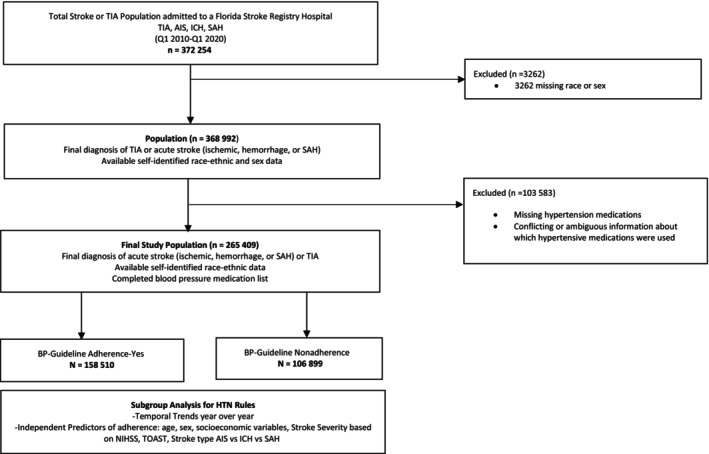
The FSR (Florida Stroke Registry) uses statewide data prospectively collected for all acute stroke admissions. Based on established guidelines, we defined optimal BP-guideline adherence using the following hierarchy of rules: (1) use of an angiotensin-converting enzyme inhibitor or angiotensin receptor blocker as first-line antihypertensive among diabetics; (2) use of thiazide-type diuretics or calcium channel blockers among Black patients; (3) use of beta blockers among patients with compelling cardiac indication; (4) use of thiazide, angiotensin-converting enzyme inhibitor/angiotensin receptor blocker, or calcium channel blocker class as first line in all others; (5) beta blockers should be avoided as first line unless there is a compelling cardiac indication. A total of 372 254 cases from January 2010 to March 2020 are in the FSR with a diagnosis of acute ischemic stroke, hemorrhagic stroke, transient ischemic attack, or subarachnoid hemorrhage; 265 409 with complete data were included in the final analysis. Mean age was 70±14 years; 50% were women; and index stroke subtypes were 74% acute ischemic stroke, 11% intracerebral hemorrhage, 11% transient ischemic attack, and 4% subarachnoid hemorrhage. BP-guideline adherence to each specific rule ranged from 48% to 74%, which is below quality standards of 80%, and was lower among Black patients (odds ratio, 0.7 [95% CI, 0.7-0.83]; <0.001) and those with atrial fibrillation (odds ratio, 0.53 [95% CI, 0.50-0.56]; <0.001) and diabetes (odds ratio, 0.65 [95% CI, 0.61-0.68]; <0.001).
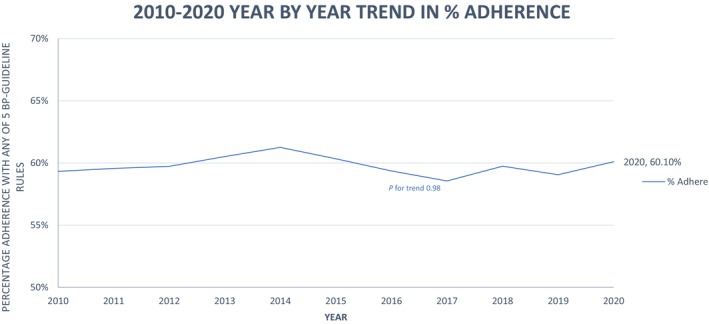
This large data set demonstrates consistently low rates of BP-guideline adherence over 10 years. There is an opportunity for monitoring hypertensive management after stroke.
基于指南的高血压管理是预防中风的关键。我们研究了中风后开具的降压药物的趋势,并评估了医生的血压(BP)药物选择与临床实践指南(BP 指南依从性)的符合程度。
FSR(佛罗里达中风登记处)使用前瞻性收集的全州范围内所有急性中风入院数据。根据既定的指南,我们使用以下规则的层次结构来定义最佳的 BP 指南依从性:(1)糖尿病患者一线使用血管紧张素转换酶抑制剂或血管紧张素受体阻滞剂;(2)黑人患者一线使用噻嗪类利尿剂或钙通道阻滞剂;(3)有明确心脏适应证的患者一线使用β受体阻滞剂;(4)无明确心脏适应证的患者一线使用噻嗪类、血管紧张素转换酶抑制剂/血管紧张素受体阻滞剂或钙通道阻滞剂;(5)除非有明确的心脏适应证,否则应避免将β受体阻滞剂作为一线药物。从 2010 年 1 月至 2020 年 3 月,FSR 共收录了 372254 例急性缺血性中风、出血性中风、短暂性脑缺血发作或蛛网膜下腔出血的诊断病例;其中 265409 例有完整数据纳入最终分析。平均年龄为 70±14 岁;50%为女性;指数性中风亚型为 74%急性缺血性中风、11%颅内出血、11%短暂性脑缺血发作和 4%蛛网膜下腔出血。每个具体规则的 BP 指南依从性在 48%至 74%之间,低于 80%的质量标准,黑人患者(比值比,0.7[95%可信区间,0.7-0.83];<0.001)和心房颤动患者(比值比,0.53[95%可信区间,0.50-0.56];<0.001)以及糖尿病患者(比值比,0.65[95%可信区间,0.61-0.68];<0.001)的依从性较低。
这项大型数据集表明,在 10 多年的时间里,BP 指南的依从率一直很低。有机会监测中风后的高血压管理。