Nursing Department, Kangwon National University Hospital, Chuncheon, Republic of Korea.
Department of Orthopaedic Surgery, Kangwon National University School of Medicine, Chuncheon, Republic of Korea.
Ann Geriatr Med Res. 2024 Mar;28(1):20-26. doi: 10.4235/agmr.23.0123. Epub 2023 Nov 21.
This study investigated the prevalence of adrenal insufficiency among patients admitted for total knee arthroplasty (TKA) due to osteoarthritis and identified factors contributing to adrenal insufficiency.
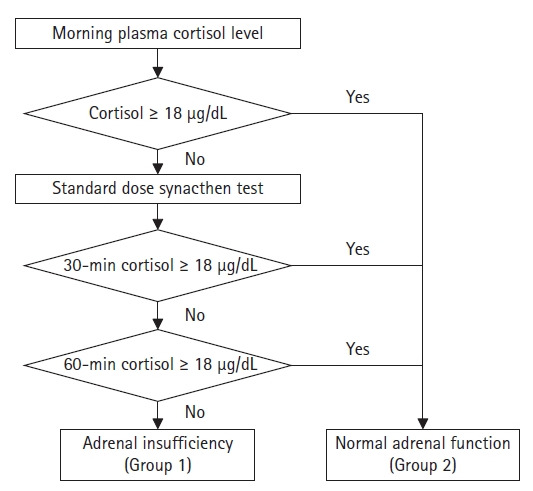
We divided the patients into two groups based on the results of preoperative standard-dose short synchronous stimulation tests: group 1 (adrenal insufficiency) and group 2 (normal adrenal function). We also assessed the prevalence of adrenal insufficiency and compared the numbers of patients who received oral steroids, the frequency of previous steroid injection use, and the frequency of systemic symptoms of steroid depletion such as fatigue and loss of appetite between the two groups. Multiple regression analysis was performed to identify factors related to adrenal insufficiency.
The prevalence of adrenal insufficiency was 60.0% (120/200). Group 1 had higher numbers of previous steroid injections (12.8±10.2 vs. 6.8±7.9) and patients taking oral steroids (18/120 vs. 3/80) (p<0.001 and p=0.011, respectively). The frequency of systemic symptoms of steroid depletion, such as fatigue and loss of appetite, was also higher in group 1 (94/120 vs. 42/80, p<0.001). Recent steroid injections and loss of appetite were associated with adrenal insufficiency (p=0.002 and p=0.009, respectively).
The results of this study revealed a high prevalence of adrenal insufficiency in Korean patients hospitalized for TKA due to end-stage osteoarthritis. Recent steroid injections were causally related to the development of adrenal insufficiency. Therefore, adrenal function should be assessed preoperatively to prevent postoperative complications related to adrenal insufficiency.
本研究调查了因骨关节炎接受全膝关节置换术(TKA)的患者中肾上腺功能不全的患病率,并确定了导致肾上腺功能不全的因素。
我们根据术前标准剂量短同步刺激试验的结果将患者分为两组:组 1(肾上腺功能不全)和组 2(正常肾上腺功能)。我们还评估了肾上腺功能不全的患病率,并比较了两组患者接受口服类固醇、既往类固醇注射使用频率以及类固醇耗竭全身症状(如疲劳和食欲不振)的频率。进行多因素回归分析以确定与肾上腺功能不全相关的因素。
肾上腺功能不全的患病率为 60.0%(120/200)。组 1 既往类固醇注射次数更多(12.8±10.2 比 6.8±7.9),口服类固醇患者更多(18/120 比 3/80)(p<0.001 和 p=0.011)。类固醇耗竭的全身症状(如疲劳和食欲不振)在组 1 中也更为常见(94/120 比 42/80,p<0.001)。近期类固醇注射和食欲不振与肾上腺功能不全相关(p=0.002 和 p=0.009)。
本研究结果显示,因终末期骨关节炎接受 TKA 的韩国患者中肾上腺功能不全的患病率较高。近期类固醇注射与肾上腺功能不全的发生有因果关系。因此,术前应评估肾上腺功能,以预防与肾上腺功能不全相关的术后并发症。