Xu Maodi, Wang Yaqin, Wang Xiaohu, Pu Zhichen, Liu Ya, Jiang Cuilian, Shen Xiaokun, Sun Hua, Xie Haitang
The Drug Evaluation Center, Yijishan Hospital of Wannan Medical College, Wuhu, Anhui, China.
Department of Pharmaceutics, China Pharmaceutical University, Nanjing, China.
Drugs R D. 2024 Mar;24(1):41-50. doi: 10.1007/s40268-023-00448-0. Epub 2023 Nov 20.
Glucokinase (GK) plays a pivotal role in maintaining glucose homeostasis; globalagliatin, a newly developed drug, is a GK activator (GKA). This study constitutes a randomized, open-label, two-cycle, two-crossover, single-dose, phase I clinical trial conducted at a single center with healthy Chinese volunteers, aiming to examine the influence of a high-fat meal on the pharmacokinetics (PK) of orally administered globalagliatin.
Twenty-four healthy volunteers were randomly divided into two groups, with a washout period of 16 days between the two cycles. The first cycle involved Group 1 volunteers who were orally administered globalagliatin 80 mg with 240 mL of water while fasting on Day 1. In contrast, Group 2 volunteers began oral administration of globalagliatin 80 mg with 240 mL of water, 30 min after consuming a high-fat meal (where high-fat content contributed to 54% of the total calories; the high-calorie meal amounted to 988.4 kcal). After the washout period, both groups of volunteers entered the second cycle of drug administration, with meals and medication being swapped on Day 17. Each volunteer collected blood samples at the following time points: 0 h (within 1 h before administration), and 0.5, 1, 2, 3, 4, 5, 6, 8, 12, 24, 48, 72, 96, 120, and 168 h after administration on both trial Day 1 and Day 17. The primary and secondary PK parameters were collected. The validated liquid chromatography-tandem mass spectrometry (LC-MS/MS) method was used to determine the concentration of globalagliatin in collected plasma samples, and the results were analyzed using Phoenix WinNonlin software. Safety evaluation was conducted by detecting or observing various adverse events (AEs) and serious AEs (SAEs).
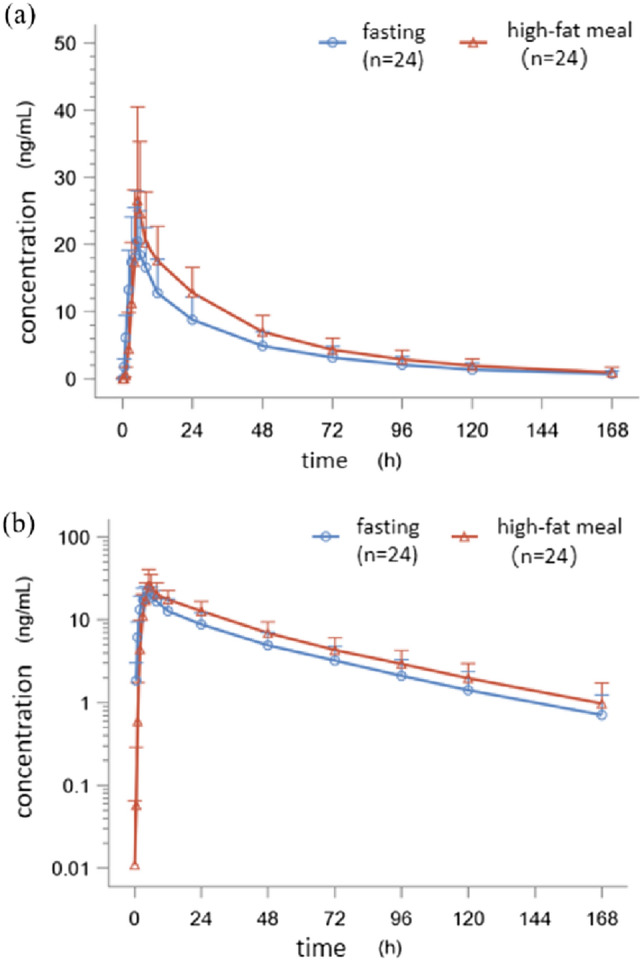
All 24 healthy Chinese volunteers enrolled completed the study and underwent PK analysis. The maximum concentration (C; ng/mL), area under the plasma concentration-time curve (AUC) from time zero to time of the last quantifiable concentration (AUC; h·ng/mL), and AUC from time zero extrapolated to infinity (AUC; h·ng/mL) of fasting administration were 22.35 ± 7.02, 725.74 ± 303.04, and 774.07 ± 343.89, respectively, while the C, AUC, and AUC administered after a high-fat meal were 28.95 ± 12.60, 964.84 ± 333.99, and 1031.28 ± 392.80, respectively. The geometric mean ratios of C, AUC, and AUC for high-fat meal/fasting administration of globalagliatin were 124.81%, 135.24%, and 135.42%, respectively, with 90% confidence intervals of 109.97-141.65, 124.24-147.20, and 124.42-147.39, respectively. Compared with the fasting state, healthy volunteers who consumed a high-fat meal showed a 24.8% increase in C, a 35.2% increase in AUC, and a 35.4% increase in AUC. The geometric mean of T was 4.69 h under fasting conditions and 5.93 h in a high-fat state, with a median of 4.98 h. Among the 24 enrolled volunteers, 9 cases (37.5%) had 11 AEs, and 6 cases (25.0%) had 7 adverse drug reactions (ADRs) after medication, all of which were cured or improved without taking any treatment measures. There were no SAEs in this study, no volunteers withdrew from the study due to AEs or ADRs, and no hypoglycemic events occurred during the trial.
A high-fat meal increased the C, AUC, and AUC of globalagliatin compared with fasting conditions in healthy Chinese adult volunteers. Meanwhile, globalagliatin showed favorable safety and tolerability under fasting or high-fat meal conditions.
葡萄糖激酶(GK)在维持血糖稳态中起关键作用;新型药物曲格列汀是一种葡萄糖激酶激活剂(GKA)。本研究是一项在单一中心对健康中国志愿者进行的随机、开放标签、两周期、两交叉、单剂量I期临床试验,旨在研究高脂餐对口服曲格列汀药代动力学(PK)的影响。
24名健康志愿者随机分为两组,两个周期之间有16天的洗脱期。第一个周期,第1组志愿者在第1天禁食时口服80mg曲格列汀和240mL水。相比之下,第2组志愿者在食用高脂餐(高脂肪含量占总热量的54%;高热量餐为988.4千卡)30分钟后,口服80mg曲格列汀和240mL水。洗脱期后,两组志愿者进入第二个给药周期,在第17天交换饮食和用药情况。每位志愿者在以下时间点采集血样:给药前1小时内的0小时,以及试验第1天和第17天给药后的0.5、1、2、3、4、5、6、8、12、24、48、72、96、120和168小时。收集主要和次要PK参数。采用经过验证的液相色谱 - 串联质谱(LC - MS/MS)方法测定采集的血浆样品中曲格列汀的浓度,并使用Phoenix WinNonlin软件分析结果。通过检测或观察各种不良事件(AE)和严重不良事件(SAE)进行安全性评估。
所有24名入选的健康中国志愿者均完成研究并进行了PK分析。禁食给药的最大浓度(C;ng/mL)、血浆浓度 - 时间曲线下从零到最后可定量浓度的面积(AUC;h·ng/mL)以及从零外推到无穷大的AUC(AUC;h·ng/mL)分别为22.35±7.02、725.74±303.04和774.07±343.89,而高脂餐后给药的C、AUC和AUC分别为28.95±12.60、964.84±333.99和1031.28±392.80。曲格列汀高脂餐/禁食给药的C、AUC和AUC的几何平均比值分别为124.81%、135.24%和135.42%,90%置信区间分别为109.97 - 141.65、124.24 - 147.20和124.42 - 147.39。与禁食状态相比,食用高脂餐的健康志愿者C增加24.8%,AUC增加35.2%,AUC增加35.4%。禁食条件下T的几何平均值为4.69小时,高脂状态下为5.93小时,中位数为4.98小时。在24名入选志愿者中,9例(37.5%)出现11次AE,6例(25.0%)用药后出现7次药物不良反应(ADR),所有这些均在未采取任何治疗措施的情况下治愈或改善。本研究中无SAE,无志愿者因AE或ADR退出研究,试验期间未发生低血糖事件。
与禁食条件相比,高脂餐使健康中国成年志愿者中曲格列汀的C、AUC和AUC增加。同时,曲格列汀在禁食或高脂餐条件下显示出良好的安全性和耐受性。
