Juliano Jonathan J, Giesbrecht David J, Simkin Alfred, Fola Abebe A, Lyimo Beatus M, Pereus Dativa, Bakari Catherine, Madebe Rashid A, Seth Misago D, Mandara Celine I, Popkin-Hall Zachary R, Moshi Ramadhan, Mbwambo Ruth B, Niaré Karamoko, MacInnis Bronwyn, Francis Filbert, Mbwambo Daniel, Garimo Issa, Chacky Frank, Aaron Sijenunu, Lusasi Abdallah, Molteni Fabrizio, Njau Ritha J A, Lazaro Samwel, Mohamed Ally, Bailey Jeffrey A, Ishengoma Deus S
University of North Carolina, Chapel Hill, NC, USA.
Brown University, Providence, RI, USA.
medRxiv. 2023 Nov 30:2023.11.07.23298207. doi: 10.1101/2023.11.07.23298207.
Emergence of artemisinin partial resistance (ART-R) in is a growing threat to the efficacy of artemisinin combination therapies (ACT) and the efforts for malaria elimination. The emergence of Kelch13 (K13) R561H in Rwanda raised concern about the impact in neighboring Tanzania. In addition, regional concern over resistance affecting sulfadoxine-pyrimethamine (SP), which is used for chemoprevention strategies, is high.
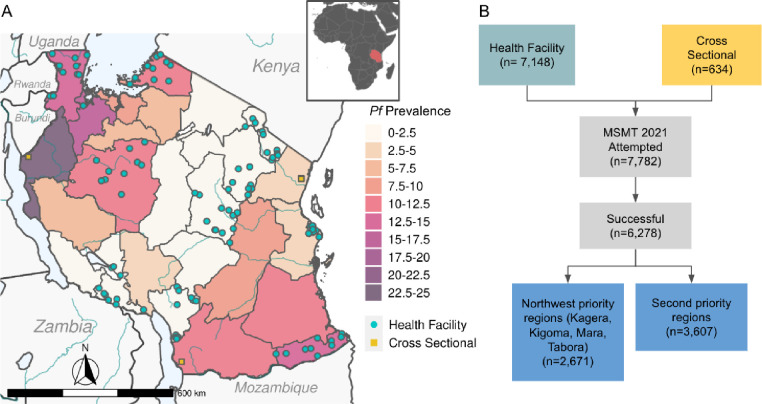
To enhance longitudinal monitoring, the Molecular Surveillance of Malaria in Tanzania (MSMT) project was launched in 2020 with the goal of assessing and mapping antimalarial resistance. Community and clinic samples were assessed for resistance polymorphisms using a molecular inversion probe platform.
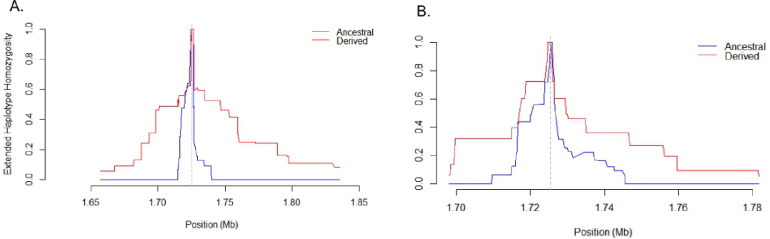
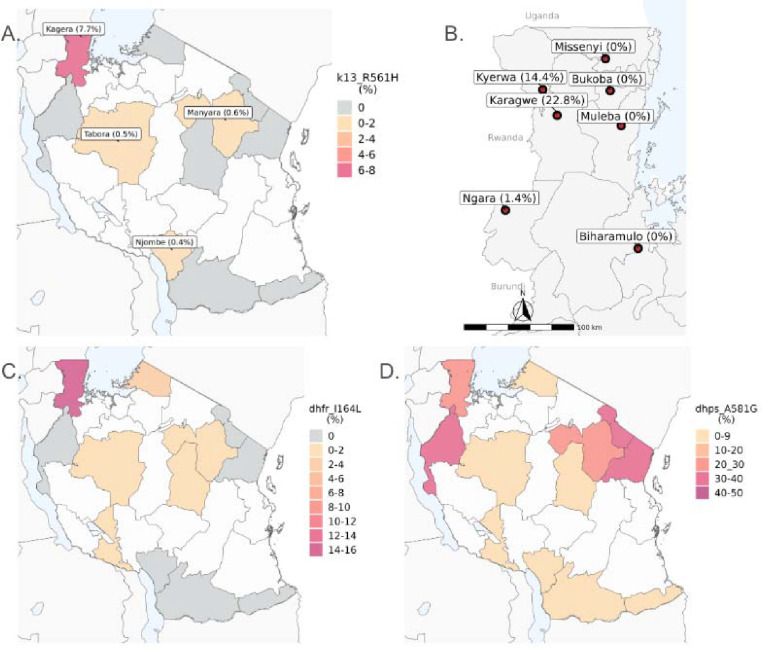
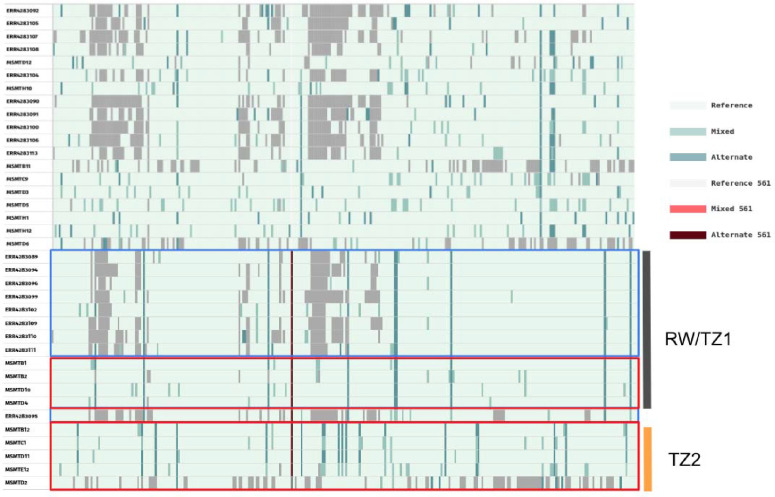
Genotyping of 6,278 samples collected countrywide in 2021 revealed a focus of K13 561H mutants in northwestern Tanzania (Kagera) with prevalence of 7.7% (50/649). A small number of 561H mutants (about 1%) were found as far as 800 km away in Tabora, Manyara, and Njombe. Genomic analysis suggests some of these parasites are highly related to isolates collected in Rwanda in 2015, supporting regional spread of 561H. However, a novel haplotype was also observed, likely indicating a second origin in the region. Other validated resistance polymorphisms (622I and 675V) were also identified. A focus of high sulfadoxine-pyrimethamine drug resistance was also identified in Kagera with a prevalence of dihydrofolate reductase 164L of 15% (80/526).
These findings demonstrate the K13 561H mutation is entrenched in the region and that multiple origins of ART-R, similar as to what was seen in Southeast Asia, have occurred. Mutations associated with high levels of SP resistance are increasing. These results raise concerns about the long-term efficacy of artemisinin and chemoprevention antimalarials in the region.
This study was funded by the Bill and Melinda Gates Foundation and the National Institutes of Health.
青蒿素部分抗性(ART-R)的出现对青蒿素联合疗法(ACT)的疗效以及疟疾消除工作构成了日益严重的威胁。卢旺达出现的 Kelch13(K13)R561H 引发了对邻国坦桑尼亚影响的担忧。此外,该地区对影响用于化学预防策略的磺胺多辛-乙胺嘧啶(SP)的耐药性也高度关注。
为加强纵向监测,坦桑尼亚疟疾分子监测(MSMT)项目于2020年启动,目标是评估和绘制抗疟药物耐药性情况。使用分子倒置探针平台对社区和诊所样本进行耐药性多态性评估。
2021年在全国范围内收集的6278份样本的基因分型显示,坦桑尼亚西北部(卡盖拉)存在K13 561H突变体聚集区,患病率为7.7%(50/649)。在距离此地800公里远的塔博拉、曼亚拉和恩泽姆贝发现了少量561H突变体(约1%)。基因组分析表明,其中一些寄生虫与2015年在卢旺达收集的分离株高度相关,支持561H在该地区的传播。然而,还观察到一种新的单倍型,可能表明该地区存在第二个起源。还鉴定出了其他经过验证的耐药性多态性(622I和675V)。在卡盖拉还发现了一个磺胺多辛-乙胺嘧啶高耐药性聚集区,二氢叶酸还原酶164L的患病率为15%(80/526)。
这些发现表明K13 561H突变在该地区已根深蒂固,并且与东南亚所见情况类似,ART-R出现了多个起源。与高水平SP耐药性相关的突变正在增加。这些结果引发了对该地区青蒿素和化学预防抗疟药物长期疗效的担忧。
本研究由比尔及梅琳达·盖茨基金会和美国国立卫生研究院资助。