Babón Juan C, Boudreault Pierre-Luc T, Esteruelas Miguel A, Gaona Miguel A, Izquierdo Susana, Oliván Montserrat, Oñate Enrique, Tsai Jui-Yi, Vélez Andrea
Departamento de Química Inorgánica - Instituto de Síntesis Química y Catálisis Homogénea (ISQCH) - Centro de Innovación en Química Avanzada (ORFEO-CINQA), Universidad de Zaragoza - CSIC, 50009 Zaragoza, Spain.
Universal Display Corporation, Ewing, New Jersey 08618, United States.
Inorg Chem. 2023 Dec 11;62(49):19821-19837. doi: 10.1021/acs.inorgchem.3c03133. Epub 2023 Nov 21.
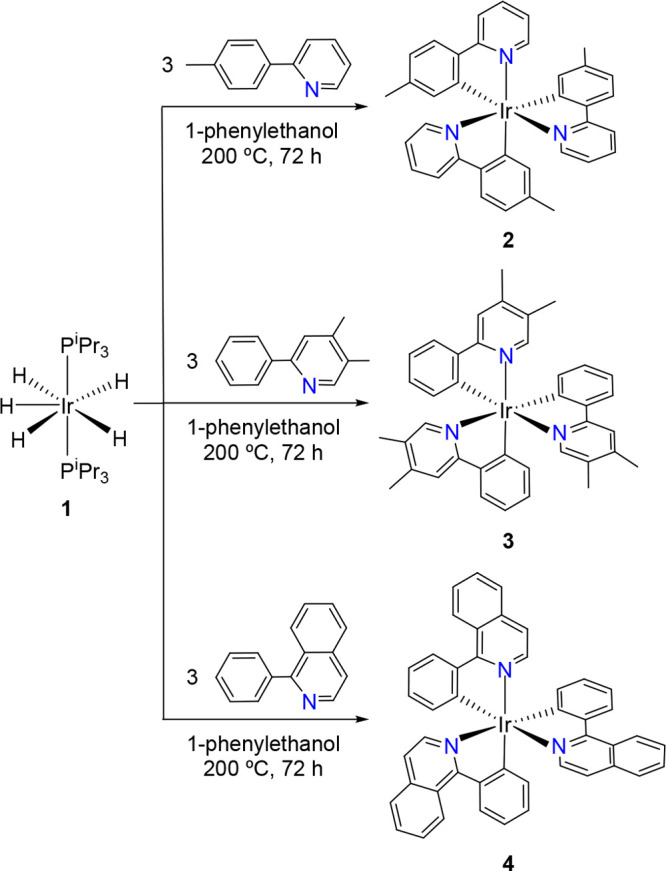
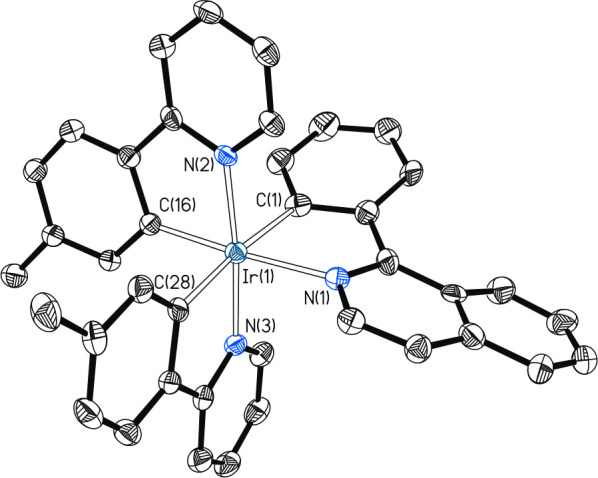
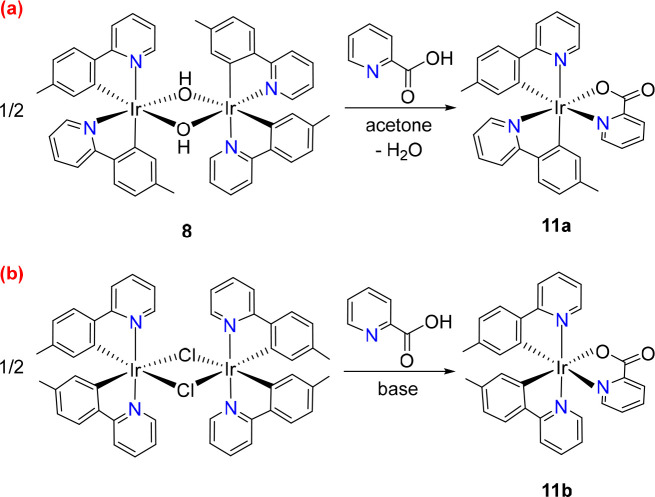
Two complementary procedures are presented to prepare -pyridyl-iridium(III) emitters of the class [++] with two orthometalated ligands of the 2-phenylpyridine type () and a third ligand (). They allowed to obtain four emitters of this class and to compare their properties with those of the -pyridyl isomers. The finding starts from IrH(PPr), which reacts with 2-(-tolyl)pyridine to give -[Ir{κ--[CMeH-py]}] with an almost quantitative yield. Stirring the latter in the appropriate amount of a saturated solution of HCl in toluene results in the -pyridyl adduct IrCl{κ--[CMeH-py]}{κ--[Cl-H-py-CMeH]} stabilized with -tolylpyridinium chloride, which can also be transformed into dimer -[Ir(μ-OH){κ--[CMeH-py]}]. Adduct IrCl{κ--[CMeH-py]}{κ--[Cl-H-py-CMeH]} directly generates -[Ir{κ--[CMeH-py]}{κ--[CH-Isoqui]}] and -[Ir{κ--[CMeH-py]}{κ--[CH-py]}] by transmetalation from Li[2-(isoquinolin-1-yl)-CH] and Li[py-2-CH]. Dimer -[Ir(μ-OH){κ--[CMeH-py]}] is also a useful starting complex when the precursor molecule of has a fairly acidic hydrogen atom, suitable for removal by hydroxide groups. Thus, its reactions with 2-picolinic acid and acetylacetone (Hacac) lead to -Ir{κ--[CMeH-py]}{κ--[OC(O)-py]} and -Ir{κ--[CMeH-py]}{κ--[acac]}. The stereochemistry of the emitter does not significantly influence the emission wavelengths. On the contrary, its efficiency is highly dependent on and associated with the stability of the isomer. The more stable isomer shows a higher quantum yield and color purity.
本文介绍了两种互补的方法来制备[++]类的 - 吡啶基 - 铱(III)发射体,该发射体具有两个2 - 苯基吡啶类型的邻位金属化配体()和第三个配体()。通过这两种方法获得了该类别的四个发射体,并将它们的性质与 - 吡啶基异构体的性质进行了比较。研究从IrH(PPr)开始,它与2 - (- 甲苯基)吡啶反应,以几乎定量的产率生成 - [Ir{κ--[CMeH - py]}]。在适量的甲苯中HCl饱和溶液中搅拌后者,得到由 - 甲苯基吡啶鎓氯化物稳定的 - 吡啶基加合物IrCl{κ--[CMeH - py]}{κ--[Cl - H - py - CMeH]},它也可以转化为二聚体 - [Ir(μ - OH){κ--[CMeH - py]}]。加合物IrCl{κ--[CMeH - py]}{κ--[Cl - H - py - CMeH]}通过与Li[2 - (异喹啉 - 1 - 基)-CH]和Li[py - 2 - CH]进行金属转移反应,直接生成 - [Ir{κ--[CMeH - py]}{κ--[CH - Isoqui]}]和 - [Ir{κ--[CMeH - py]}{κ--[CH - py]}]。当 的前体分子具有相当酸性的氢原子,适合被羟基去除时,二聚体 - [Ir(μ - OH){κ--[CMeH - py]}]也是一种有用的起始配合物。因此,它与2 - 吡啶甲酸和乙酰丙酮(Hacac)反应生成 - Ir{κ--[CMeH - py]}{κ--[OC(O)-py]}和 - Ir{κ--[CMeH - py]}{κ--[acac]}。发射体的立体化学对发射波长没有显著影响。相反,其效率高度依赖于异构体的稳定性并与之相关。更稳定的异构体显示出更高的量子产率和颜色纯度。