CONICET, Laboratorio de Paleoecología Humana, Instituto Interdisciplinario de Ciencias Básicas, Universidad Nacional de Cuyo, Mendoza, Argentina.
Center of Andean Studies, University of Warsaw, Warsaw, Poland.
PLoS One. 2023 Nov 22;18(11):e0288798. doi: 10.1371/journal.pone.0288798. eCollection 2023.
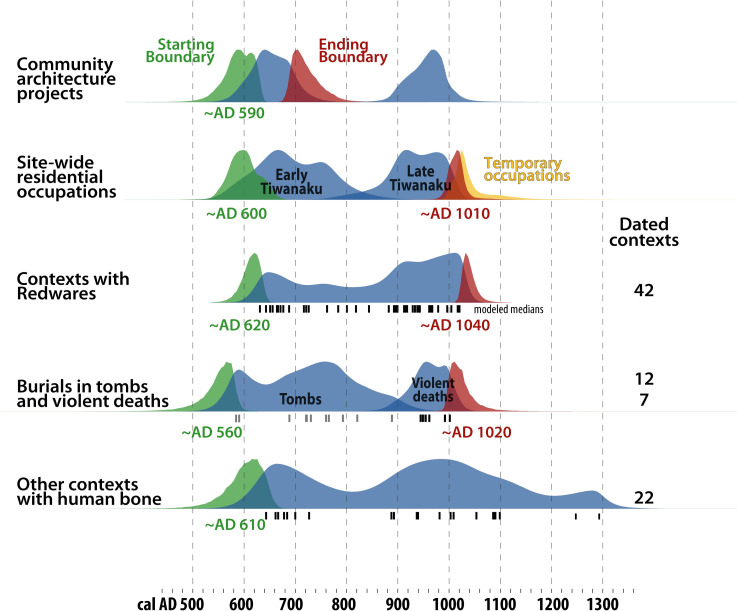
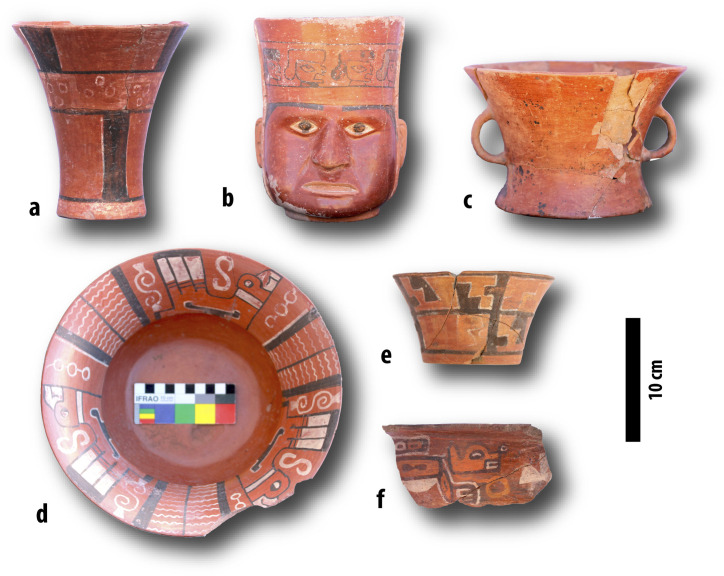
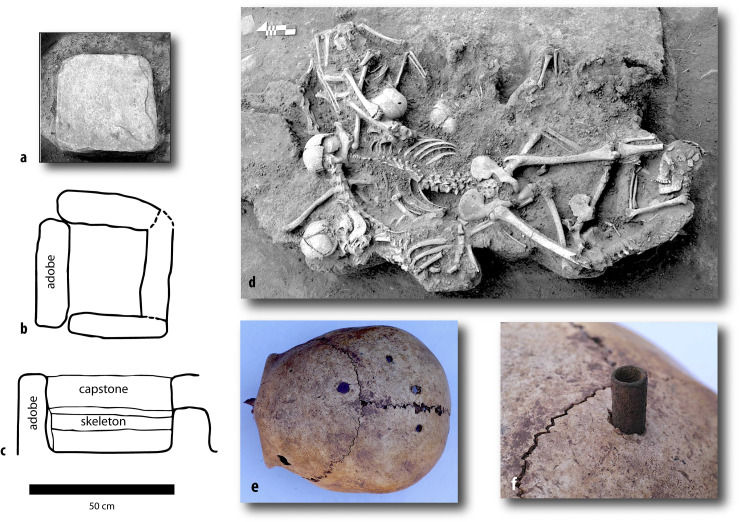
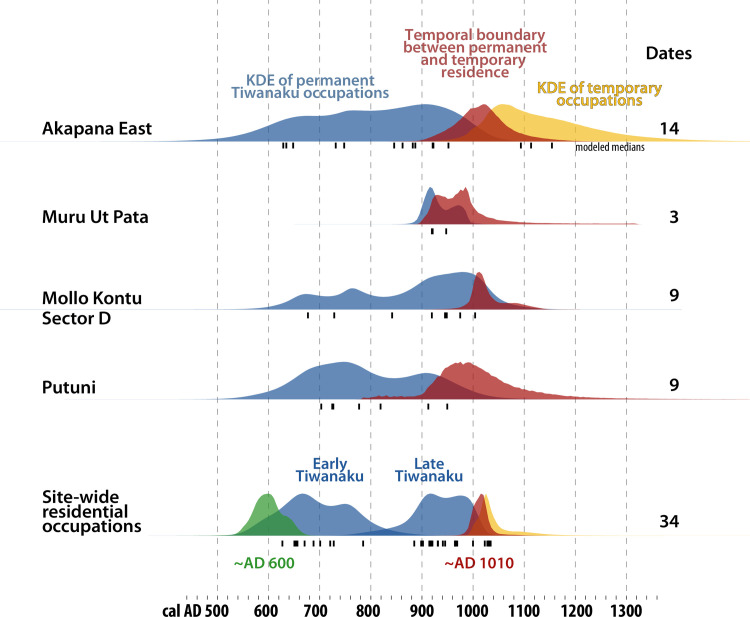
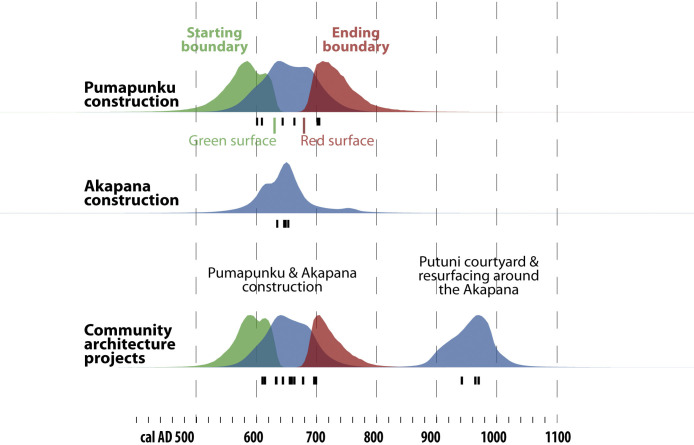
The timing of Tiwanaku's collapse remains contested. Here we present a generational-scale chronology of Tiwanaku using Bayesian models of 102 radiocarbon dates, including 45 unpublished dates. This chronology tracks four community practices: residing short- vs. long-term, constructing monuments, discarding decorated ceramics, and leaving human burials. Tiwanaku was founded around AD 100 and around AD 600, it became the region's principal destination for migrants. It grew into one of the Andes' first cities and became famous for its decorated ceramics, carved monoliths, and large monuments. Our Bayesian models show that monument building ended ~AD 720 (the median of the ending boundary). Around ~AD 910, burials in tombs ceased as violent deaths began, which we document for the first time in this paper. Ritualized murders are limited to the century leading up to ~AD 1020. Our clearest proxy for social networks breaking down is a precise estimate for the end of permanent residence, ~AD 1010 (970-1050, 95%). This major inflection point was followed by visitors who used the same ceramics until ~AD 1040. Temporary camps lasted until roughly ~AD 1050. These four events suggest a rapid, city-wide collapse at ~AD 1010-1050, lasting just ~20 years (0-70 years, 95%). These results suggest a cascading breakdown of community practices and social networks that were physically anchored at Tiwanaku, though visitors continued to leave informal burials for centuries. This generation-scale chronology suggests that collapse 1) took place well before reduced precipitation, hence this was not a drought-induced societal change and 2) a few resilient communities sustained some traditions at other sites, hence the chronology for the site of Tiwanaku cannot be transposed to all sites with similar material culture.
蒂瓦纳库的崩溃时间仍然存在争议。在这里,我们使用 102 个放射性碳测年数据的贝叶斯模型,包括 45 个未发表的数据,为蒂瓦纳库提供了一个世代规模的年代序列。这个年代序列跟踪了四个社区实践:短期居住与长期居住、建造纪念碑、丢弃装饰陶器和留下人类埋葬。蒂瓦纳库始建于公元 100 年左右,公元 600 年左右,它成为该地区移民的主要目的地。它发展成为安第斯山脉的第一个城市之一,并以其装饰陶器、雕刻巨石和大型纪念碑而闻名。我们的贝叶斯模型显示,纪念碑的建造在公元 720 年左右结束(结束边界的中位数)。大约在公元 910 年,随着暴力死亡的开始,墓穴中的埋葬停止了,这是我们在本文中首次记录到的。有组织的谋杀仅限于公元 1020 年之前的一个世纪。我们对社会网络崩溃的最明确的代理是对永久居住结束的精确估计,大约在公元 1010 年(970-1050,95%)。在这个主要的拐点之后,游客们一直使用相同的陶器,直到公元 1040 年左右。临时营地一直持续到大约公元 1050 年。这四个事件表明,公元 1010-1050 年左右,蒂瓦纳库发生了迅速的、全市范围的崩溃,持续了大约 20 年(0-70 年,95%)。这些结果表明,社区实践和社会网络的崩溃是一个级联式的过程,这些实践和网络在蒂瓦纳库有实体支撑,尽管游客们在几个世纪里仍继续留下非正式的埋葬。这个世代规模的年代序列表明,1)崩溃发生在降水减少之前,因此这不是干旱引起的社会变化,2)少数有弹性的社区在其他地点维持了一些传统,因此蒂瓦纳库遗址的年代序列不能转用到具有类似物质文化的所有遗址。