Department of Pediatrics, Seoul National University Children's Hospital, Seoul, Republic of Korea.
Department of Pediatrics, Seoul National University College of Medicine, Seoul, Republic of Korea.
Eur Thyroid J. 2023 Dec 18;12(6). doi: 10.1530/ETJ-23-0219. Print 2023 Dec 1.
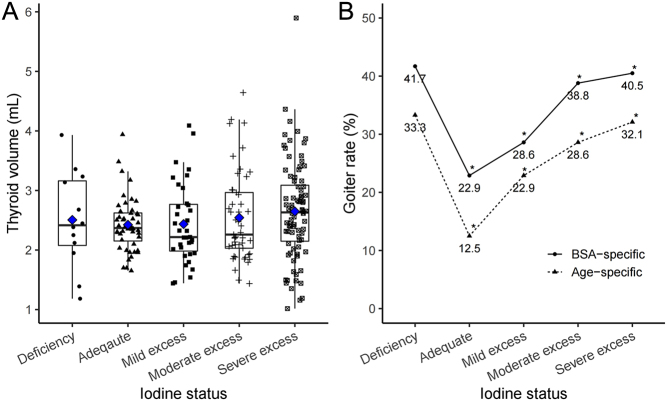
Adequate iodine intake is essential for growing children, and thyroid volume (Tvol) is considered as an indicator of iodine status. We investigated Tvol and goiter using ultrasonography (US) and their association with iodine status in 228 6-year-old children living in Korea.
Iodine status was assessed using urine iodine concentration (UIC) and categorized as deficient (<100 μg/L), adequate (100-299 μg/L), mild excess (300-499 μg/L), moderate excess (500-999 μg/L), and severe excess (≥1000 μg/L). Tvol was measured using US, and a goiter on the US (goiter-US) was defined as Tvol greater than 97th percentile value by age- and body surface area (BSA)-specific international references.
The median Tvol was 2.4 mL, larger than the international reference value (1.6 mL). The age- and BSA-specific goiter-US rates were 25.9% (n = 59) and 34.6% (n = 79), respectively. The prevalence of excess iodine was 73.7% (n = 168). As iodine status increased from adequate to severe excess, the goiter-US rate significantly increased (P for trend <0.05). The moderate and severe iodine excess groups showed higher risk of goiter-US (adjusted odds ratio (aOR) = 3.1 (95% CI: 1.1-9.2) and aOR = 3.1 (95% CI: 1.2-8.3), respectively; age-specific criteria) than the iodine-adequate group.
Excess iodine was prevalent in Korean children, and their Tvol was higher than the international reference values. Goiter rate was associated with iodine excess, which significantly increased in the moderate and severe iodine excess groups. Further studies are warranted to define optimal iodine intake in children.
儿童成长过程中需要摄入充足的碘,甲状腺体积(Tvol)被认为是碘营养状况的一个指标。本研究旨在通过超声检查(US)评估 228 名韩国 6 岁儿童的 Tvol 和甲状腺肿情况,并探讨其与碘营养状况的关系。
通过尿碘浓度(UIC)评估碘营养状况,分为碘缺乏(<100μg/L)、碘适量(100-299μg/L)、轻度碘过量(300-499μg/L)、中度碘过量(500-999μg/L)和重度碘过量(≥1000μg/L)。采用 US 测量 Tvol,当 Tvol 大于按年龄和体表面积(BSA)校正的国际参考值第 97 百分位值时定义为甲状腺肿-US(goiter-US)。
Tvol 的中位数为 2.4mL,大于国际参考值(1.6mL)。年龄和 BSA 特异性的 goiter-US 发生率分别为 25.9%(n=59)和 34.6%(n=79)。碘过量的患病率为 73.7%(n=168)。随着碘营养状况从适量增加到重度过量,goiter-US 发生率显著增加(趋势 P<0.05)。中度和重度碘过量组发生 goiter-US 的风险更高(调整后的优势比(aOR)=3.1(95%可信区间:1.1-9.2)和 aOR=3.1(95%可信区间:1.2-8.3);年龄特异性标准),高于碘适量组。
韩国儿童碘过量较为常见,Tvol 高于国际参考值。甲状腺肿发生率与碘过量有关,在中度和重度碘过量组中显著增加。需要进一步研究来确定儿童的最佳碘摄入量。