Department of Bioengineering, University of California San Diego, 9500 Gliman Dr, La Jolla, CA, USA.
Novo Nordisk Foundation Center for Biosustainability, Technical University of Denmark, Kemitorvet, Building 220, 2800 Kgs, Lyngby, Denmark.
Nat Commun. 2023 Nov 22;14(1):7606. doi: 10.1038/s41467-023-43173-7.
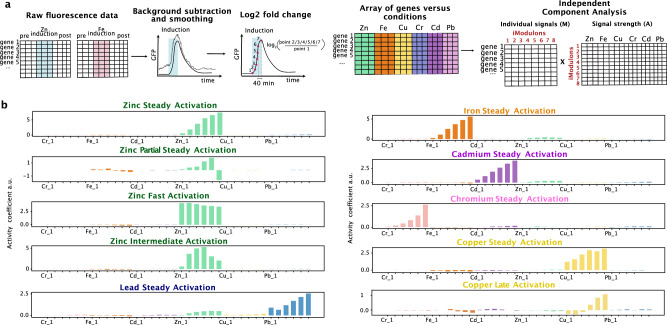
Understanding how cells dynamically adapt to their environment is a primary focus of biology research. Temporal information about cellular behavior is often limited by both small numbers of data time-points and the methods used to analyze this data. Here, we apply unsupervised machine learning to a data set containing the activity of 1805 native promoters in E. coli measured every 10 minutes in a high-throughput microfluidic device via fluorescence time-lapse microscopy. Specifically, this data set reveals E. coli transcriptome dynamics when exposed to different heavy metal ions. We use a bioinformatics pipeline based on Independent Component Analysis (ICA) to generate insights and hypotheses from this data. We discovered three primary, time-dependent stages of promoter activation to heavy metal stress (fast, intermediate, and steady). Furthermore, we uncovered a global strategy E. coli uses to reallocate resources from stress-related promoters to growth-related promoters following exposure to heavy metal stress.
了解细胞如何动态适应其环境是生物学研究的主要焦点。细胞行为的时间信息通常受到数据时间点数量少和用于分析这些数据的方法的限制。在这里,我们将无监督机器学习应用于一个数据集,该数据集包含在高通量微流控设备中通过荧光延时显微镜每 10 分钟测量的 1805 个天然启动子的活性,具体而言,该数据集揭示了大肠杆菌在暴露于不同重金属离子时的转录组动力学。我们使用基于独立成分分析(ICA)的生物信息学管道从该数据中生成见解和假设。我们发现了重金属胁迫下启动子激活的三个主要的、依赖时间的阶段(快速、中间和稳定)。此外,我们发现了大肠杆菌在暴露于重金属胁迫后,从与应激相关的启动子重新分配资源到与生长相关的启动子的全局策略。