Research Cluster, Molecular & Cognitive Neuroscience, Division of Neurobiology, University of Basel, 4002, Basel, Switzerland.
Neurobiology Lab for Brain Aging and Mental Health, Medical Faculty, Psychiatric University Clinics Basel, University of Basel, 4002, Basel, Switzerland.
Sci Rep. 2023 Nov 22;13(1):20524. doi: 10.1038/s41598-023-47726-0.
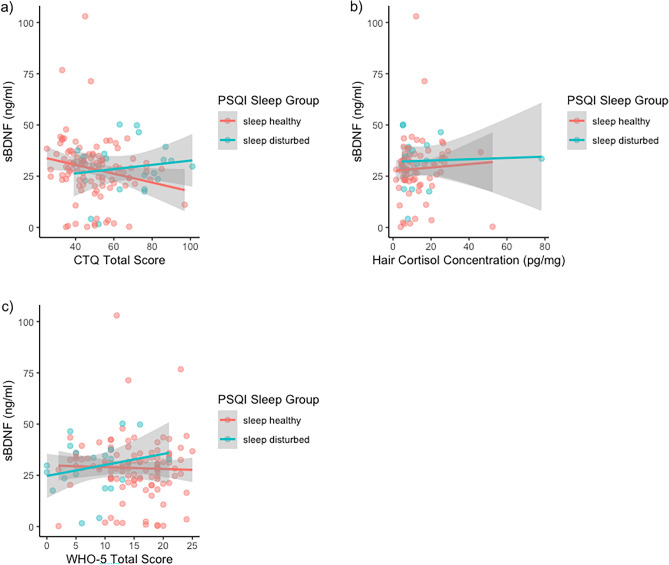
Children in institutional care have a high risk to experience childhood adversities (CAs), with consequences for physical and mental well-being. The long-term effects of CAs on the brain, including consequences for neuronal plasticity and sleep, are poorly understood. This study examined the interplay between stress (including CAs), sleep, and brain-derived neurotrophic factor (BDNF), a prominent marker for neuronal plasticity. Participants (N = 131, mean age = 26.3±3.4 years, 40 females) with residential youth-care history completed questionnaires measuring CAs (Childhood Trauma Questionnaire, CTQ), psychological well-being (World Health Organization-Five Well-Being Index, WHO-5), and sleep disturbances (Pittsburgh Sleep Quality Inventory, PSQI). Hair cortisol and serum BDNF concentration were measured using enzyme-linked immunosorbent assays. The analyses were conducted by using bootstrap regression models. There was no association of stress parameters or sleep with BDNF concentration. However, we found a significant association of CAs and well-being with sleep disturbances. Last, we found an association between CAs and BDNF in sleep-healthy but not sleep-disturbed participants. Our findings indicated a role of sleep disturbance in the association between stress and BDNF. Still, further studies are warranted using vulnerable groups at-risk to understand long-term effects on mental health and sleep.
机构照料中的儿童有很高的风险经历童年逆境(CA),这对身心健康都有影响。CA 对大脑的长期影响,包括对神经元可塑性和睡眠的影响,还知之甚少。本研究考察了应激(包括 CA)、睡眠和脑源性神经营养因子(BDNF)之间的相互作用,BDNF 是神经元可塑性的重要标志物。有居住青年照料史的参与者(N=131,平均年龄 26.3±3.4 岁,40 名女性)完成了问卷测量,包括 CA(童年创伤问卷,CTQ)、心理幸福感(世界卫生组织五维健康指数,WHO-5)和睡眠障碍(匹兹堡睡眠质量指数,PSQI)。使用酶联免疫吸附测定法测量头发皮质醇和血清 BDNF 浓度。分析采用自举回归模型进行。应激参数或睡眠与 BDNF 浓度之间没有关联。然而,我们发现 CA 和幸福感与睡眠障碍之间存在显著关联。最后,我们发现 CA 与睡眠健康但无睡眠障碍参与者的 BDNF 之间存在关联。我们的研究结果表明,睡眠障碍在应激和 BDNF 之间的关联中起着重要作用。然而,仍需要使用处于风险中的弱势群体进行进一步的研究,以了解对心理健康和睡眠的长期影响。