Department of Survey Research and Data Analytics, International Institute for Population Sciences, Deonar, Mumbai, 400088, India.
Institute of Health Management Research, Bangalore, 560105, India.
Sci Rep. 2023 Nov 22;13(1):20464. doi: 10.1038/s41598-023-47191-9.
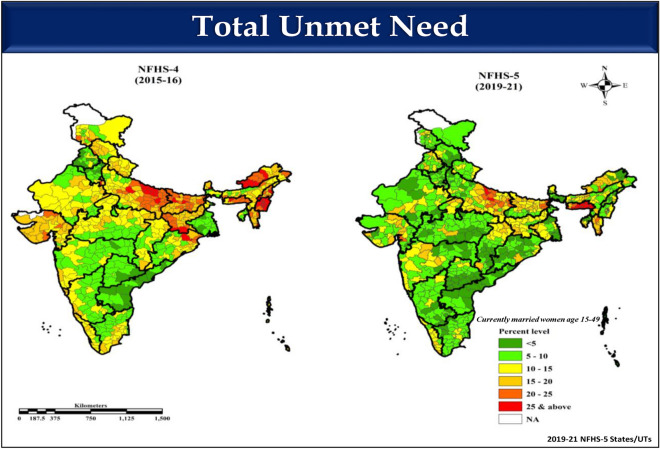
Unmet needs for contraception in India have declined over time but the rate has not been uniform among women across geographies and socio-economic strata. Identifying the characteristics of women in communities where unmet need is still high is important to devise appropriate strategies to ensure access and uptake of modern contraceptive methods. The current study examined whether there was a national decline in unmet need over time and if regional disparities exist in unmet need. Demographic variations in unmet need based on factors such as maternal age, education, religion, caste, wealth index quintile, family size, and access to antenatal care (ANC) were also documented. Our approach was to document the prevalence of total unmet need for family planning and unmet need for spacing among married Indian women and quantify variability based on socio-economic and demographic drivers within a hierarchal framework, thus providing both macro and micro perspectives. We used data from the fourth and fifth rounds of the National Family Health Survey (NFHS) collected from all the States and Union Territories (UTs) in India. Quantile regression analysis and multilevel regression techniques were used to understand the predictors for the total unmet need for family planning and the unmet need for spacing. Results show a considerable decline in the prevalence of unmet need for family planning in India from NFHS-4 to 5 (from 12.9 to 9.3%) in the last six6 years. The north-eastern states show a significant reduction in unmet need for family planning in Manipur (17.8%), Nagaland (13.5%), and followed by Sikkim (9.1%). The predictors such as years of schooling, place of residence, caste, religion, wealth quintile, number of antenatal care (ANC) visits, and children ever born have a significant association with unmet needs for family planning and spacing among married women in India. There is a significant association between years of schooling with the total unmet needs for family planning at (q25) quantiles and the unmet need for spacing at (q25, q50) quantiles. Results reveal that the demand for unmet need for spacing and limiting was the highest among the women in the age categories 15-19 (17.8%) and 20-24 (17.3%). The demand for limiting was the highest (6.8%) among Muslim women. Across wealth quantile categories, the overall unmet demand (11.4%) for spacing and limiting was the highest among the women in the lowest socioeconomic groups. We conclude that greater access to frontline health workers among young wives, and significant investment in education in general, will continue to reduce the unmet needs for family planning in India.
印度的避孕需求未得到满足的情况随着时间的推移而有所减少,但各地域和社会经济阶层之间的比例并不均衡。确定避孕需求未得到满足的社区中妇女的特征对于制定适当的策略以确保现代避孕方法的获取和采用非常重要。本研究考察了避孕需求未得到满足的情况是否随着时间的推移而在全国范围内下降,以及避孕需求未得到满足的情况是否存在地区差异。还记录了基于产妇年龄、教育程度、宗教信仰、种姓、财富指数五分位数、家庭规模和获得产前保健 (ANC) 等因素的避孕需求未得到满足的情况的人口统计学差异。我们的方法是记录已婚印度妇女对计划生育的总避孕需求未得到满足的情况以及对生育间隔的避孕需求未得到满足的情况,并在分层框架内根据社会经济和人口统计学驱动因素对这些情况进行量化,从而提供宏观和微观视角。我们使用了来自印度所有邦和联邦属地的第四次和第五次国家家庭健康调查 (NFHS) 的数据。使用分位数回归分析和多层次回归技术来了解计划生育总避孕需求未得到满足和生育间隔避孕需求未得到满足的预测因素。结果表明,在过去六年中,印度的计划生育总避孕需求未得到满足的情况从 NFHS-4 到 5 显著下降(从 12.9%降至 9.3%)。东北部的曼尼普尔邦、那加兰邦和锡金邦的计划生育总避孕需求未得到满足的情况显著减少,分别减少了 17.8%、13.5%和 9.1%。受教育年限、居住地、种姓、宗教信仰、财富五分位数、产前保健 (ANC) 就诊次数和生育子女数量等预测因素与印度已婚妇女的计划生育和生育间隔的避孕需求未得到满足情况显著相关。受教育年限与计划生育总避孕需求未得到满足情况(q25 分位数)和生育间隔避孕需求未得到满足情况(q25、q50 分位数)之间存在显著关联。结果表明,在 15-19 岁(17.8%)和 20-24 岁(17.3%)年龄段的妇女中,对生育间隔和限制的需求最高。穆斯林妇女对限制的需求最高(6.8%)。在所有财富五分位数类别中,处于社会经济地位最低群体的妇女对生育间隔和限制的总体避孕需求(11.4%)最高。我们的结论是,更多的年轻妻子获得基层卫生工作者的服务,以及对教育的大力投资,将继续减少印度的计划生育需求未得到满足的情况。