Gupta Lalima, Gumashta Raghvendra, Mahor Rajendra, Gupta Girjesh, Ojha Maharshi N, Gumashta Jyotsna
Community Medicine, People's College of Medical Sciences and Research Centre, Bhopal, IND.
Community Medicine, Index Medical College, Hospital and Research Centre, Indore, IND.
Cureus. 2025 Jun 12;17(6):e85827. doi: 10.7759/cureus.85827. eCollection 2025 Jun.
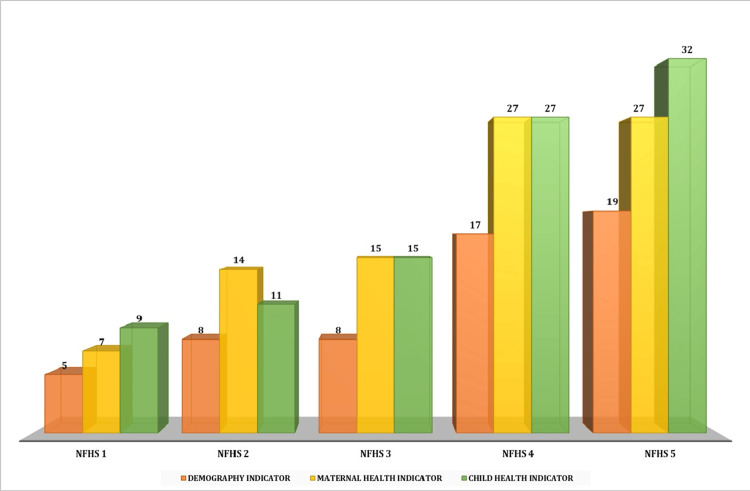
The effective development of health programs requires the practical application of evidence-based strategies, equitable financial allocation, and the integration of operational research into public health actions. These elements are essential for attaining measurable improvements in healthcare systems and population well-being. By aligning research-driven approaches with policy implementation, we can accelerate progress toward achieving Sustainable Development Goal 3 (SDG-3) targets. This study aimed to engage in an in-depth, evidence-based quantitative and qualitative analysis of National Family Health Survey (NFHS) datasets, as well as a category and sub-category-wise comparability assessment of health indicators. Each round of the NFHS outcomes was analyzed for its application towards programmatic development, implementation, and evaluation. Studies analyzed were representative of each of the studied categories, i.e., demography, maternal health, child health, and behavioral pattern. Literature published under the subheads demography (159), maternal health (286), child health (318), and behavioral pattern (94) and indexed on PubMed Central were analyzed for inferential patterned study. This was followed by the outcome comparability and Strength-Weakness-Opportunity-Challenges (SWOC) analysis of trends, emphasis, and applicability. This trend analysis was quantitatively and qualitatively analyzed. There was a deviation in sub-criterion identification over various rounds, posing challenges to the use of NFHS data with multiple, varied, and rich resources available for healthcare and support. The lowest expected decline per round compared to their previous rounds in stunting, wasting, and unmet need for family planning was -2.5%, -4.3%, and 1%, respectively. In contrast, the lowest increase per round for female sterilization and antenatal care (ANC) was +1.3% and +1%, respectively. Strengths include the quality of data, sub-categorization over NFHS rounds, use of new tools for assessments, and elimination of some parameters. Weakness was illustrated through unsynchronized conduct of rounds, viz., 6, 7, 10, and 5 years' time gap observed in NFHS-1, 2, 3, 4, and 5, respectively. Opportunity of using data for national development initiatives and fulfilling Sustainable Development Goal-3 can be availed to benefit the healthcare-deprived masses. Threats include intrinsic limitations of data collection, processes of outcome measures for addressing upgradation needs, especially of Reproductive, Maternal, Neonatal, Child Health + Adolescents (RMNCH+A), National Programme for Prevention and Control of Non-Communicable Disease (NPNCD), and national nutrition programs. The policy development, programmatic design, intervention implementation, effectiveness assessment, and National Health Program evaluation need stronger, consecutive, and appropriate evidence datasets for public health action. The felt need of public health intervention can be augmented significantly by using NFHS datasets over time while ensuring adaptable, flexible, and resource-friendly mechanisms of action. Triangulating NFHS datasets, programmatic needs, and financial allocations will hence help create user-friendly public health networks.
卫生项目的有效开展需要切实应用循证策略、进行公平的资金分配,并将运筹学纳入公共卫生行动。这些要素对于实现医疗系统和民众福祉的可衡量改善至关重要。通过使基于研究的方法与政策实施保持一致,我们能够加速朝着实现可持续发展目标3(SDG-3)的目标迈进。本研究旨在对全国家庭健康调查(NFHS)数据集进行深入的、基于证据的定量和定性分析,以及对健康指标进行类别和子类别层面的可比性评估。对NFHS的每一轮结果进行分析,以用于项目开发、实施和评估。所分析的研究代表了每个研究类别,即人口统计学、孕产妇健康、儿童健康和行为模式。对在人口统计学(159篇)、孕产妇健康(286篇)、儿童健康(318篇)和行为模式(94篇)子标题下发表并在PubMed Central上索引的文献进行了推断性模式研究分析。随后对趋势、重点和适用性进行了结果可比性和优势-劣势-机会-挑战(SWOC)分析。对这种趋势分析进行了定量和定性分析。在不同轮次中,子标准的识别存在偏差,这给利用拥有多个、多样且丰富的医疗保健和支持资源的NFHS数据带来了挑战。与上一轮相比,每轮发育迟缓、消瘦和计划生育未满足需求的最低预期下降率分别为-2.5%、-4.3%和1%。相比之下,女性绝育和产前护理(ANC)每轮的最低增长率分别为+1.3%和+1%。优势包括数据质量、NFHS各轮的子分类、使用新的评估工具以及消除一些参数。劣势通过各轮次不同步进行得到体现,即在NFHS-1、2、3、4和5中分别观察到6年、7年、10年和5年的时间间隔。可以利用将数据用于国家发展倡议和实现可持续发展目标3的机会,使缺乏医疗保健的人群受益。威胁包括数据收集的内在局限性、应对升级需求(特别是生殖、孕产妇、新生儿、儿童健康+青少年(RMNCH+A)、国家非传染性疾病预防和控制计划(NPNCD)以及国家营养计划)的结果测量过程。政策制定、项目设计、干预实施、效果评估和国家卫生项目评价需要更有力、连贯且适当的循证数据集用于公共卫生行动。随着时间的推移,通过使用NFHS数据集,同时确保行动机制具有适应性、灵活性和资源友好性,可以显著增强对公共卫生干预的实际需求。因此,将NFHS数据集、项目需求和资金分配进行三角测量,将有助于创建用户友好的公共卫生网络。