Fundação de Medicina Tropical Dr. Heitor Vieira Dourado, Manaus, Amazonas, CEP 69.040-000, Brazil.
Programa de Pós-Graduação em Medicina Tropical, Fundação de Medicina Tropical Heitor Vieira Dourado, Universidade do Estado do Amazonas, Manaus, Amazonas, CEP 69.040-000, Brazil.
Sci Rep. 2023 Nov 22;13(1):20472. doi: 10.1038/s41598-023-47830-1.
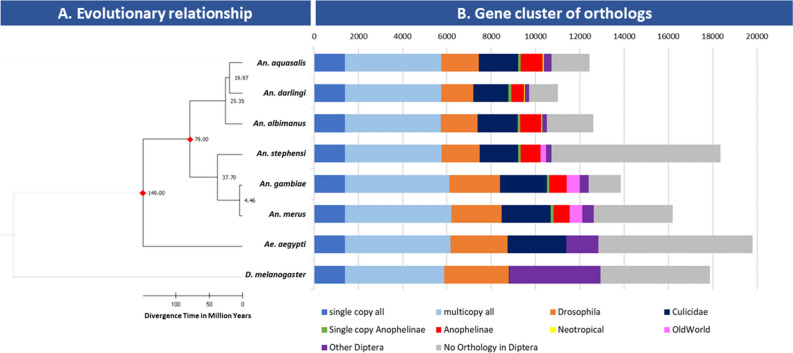
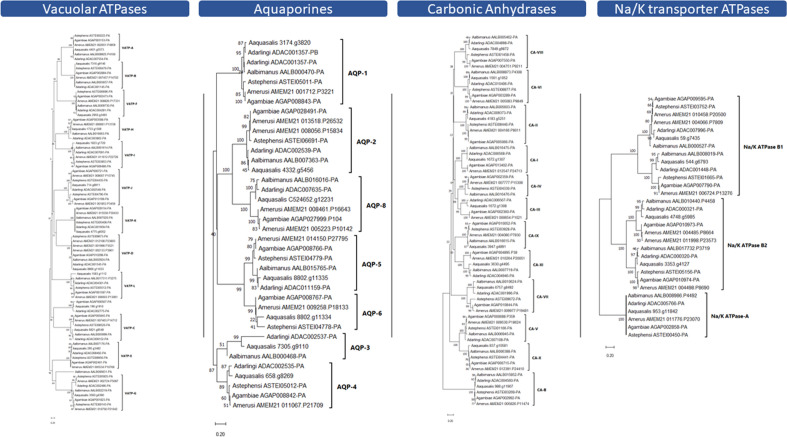
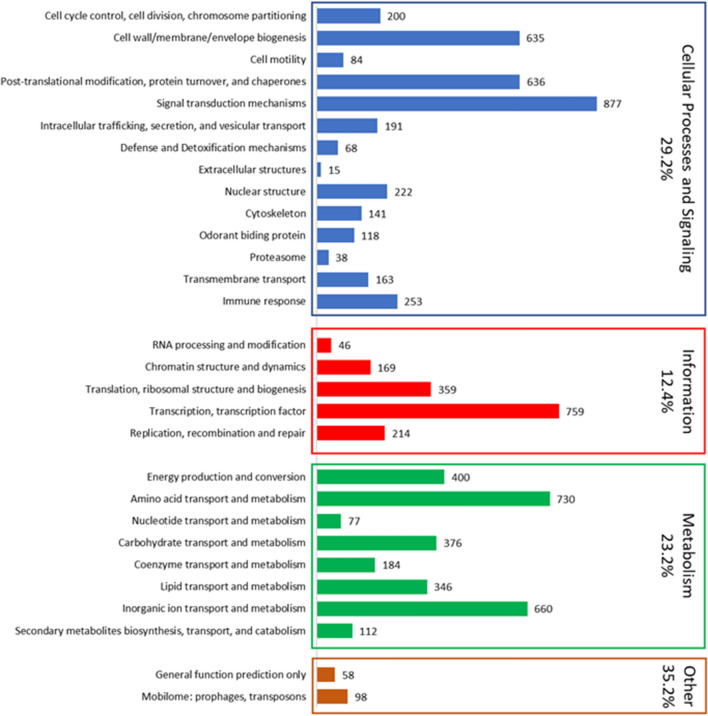
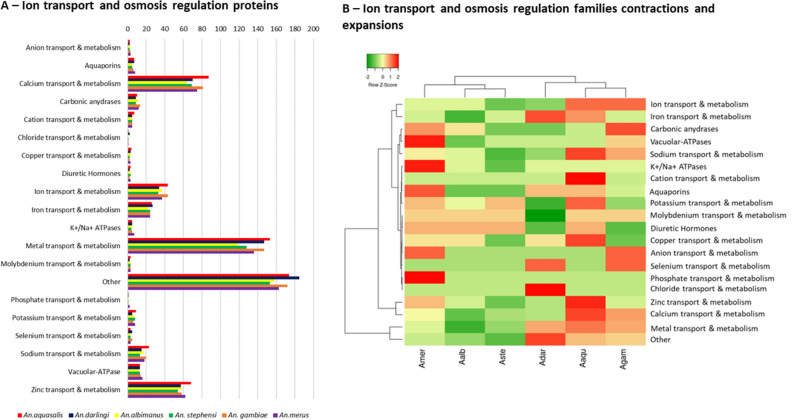
Malaria is a severe public health problem in several developing tropical and subtropical countries. Anopheles aquasalis is the primary coastal malaria vector in Central and South America and the Caribbean Islands, and it has the peculiar feature of living in water with large changes in salinity. Recent research has recognised An. aquasalis as an important model for studying the interactions of murine and human Plasmodium parasites. This study presents the complete genome of An. aquasalis and offers insights into its evolution and physiology. The genome is similar in size and gene content to other Neotropical anophelines, with 162 Mb and 12,446 protein-coding genes. There are 1387 single-copy orthologs at the Diptera level (eg. An. gambiae, An. darlingi and Drosophila melanogaster). An. aquasalis diverged from An. darlingi, the primary malaria vector in inland South America, nearly 20 million years ago. Proteins related to ion transport and metabolism belong to the most abundant gene families with 660 genes. We identified gene families relevant to osmosis control (e.g., aquaporins, vacuolar-ATPases, Na+/K+-ATPases, and carbonic anhydrases). Evolutionary analysis suggests that all osmotic regulation genes are under strong purifying selection. We also observed low copy number variation in insecticide resistance and immunity-related genes for all known classical pathways. The data provided by this study offers candidate genes for further studies of parasite-vector interactions and for studies on how anophelines of brackish water deal with the high fluctuation in water salinity. We also established data and insights supporting An. aquasalis as an emerging Neotropical malaria vector model for genetic and molecular studies.
疟疾是几个发展中热带和亚热带国家严重的公共卫生问题。冈比亚按蚊是中美洲和加勒比地区的主要沿海疟疾媒介,其特点是生活在盐度变化较大的水中。最近的研究已经将 An. aquasalis 确认为研究鼠类和人类疟原虫相互作用的重要模型。本研究提供了 An. aquasalis 的完整基因组,并深入了解了其进化和生理学。该基因组在大小和基因内容上与其他新热带按蚊相似,大小为 162 Mb,包含 12446 个蛋白质编码基因。在双翅目水平上有 1387 个单拷贝直系同源物(例如,An. gambiae、An. darlingi 和 Drosophila melanogaster)。An. aquasalis 与主要的内陆南美洲疟疾媒介 An. darlingi 分化已有近 2000 万年。与离子转运和代谢相关的蛋白质属于最丰富的基因家族,有 660 个基因。我们鉴定了与渗透调节相关的基因家族(例如,水通道蛋白、液泡型 ATP 酶、Na+/K+-ATP 酶和碳酸酐酶)。进化分析表明,所有渗透调节基因都受到强烈的纯化选择。我们还观察到所有已知经典途径的杀虫剂抗性和免疫相关基因的拷贝数变异较低。本研究提供的数据为进一步研究寄生虫-媒介相互作用以及研究咸水按蚊如何应对高波动的水盐度提供了候选基因。我们还建立了数据和见解,支持 An. aquasalis 作为新兴的新热带疟疾媒介模型,用于遗传和分子研究。