Herrmann Julia, Burgener-Gasser Anne-Valérie, Goldenberger Daniel, Roth Jan, Weisser Maja, Tamma Pranita D, Tschudin-Sutter Sarah
Division of Infectious Diseases and Hospital Epidemiology, University Hospital Basel and University of Basel, Petersgraben 4, CH-4031, Basel, Switzerland.
Division of Clinical Bacteriology and Mycology, University Hospital Basel and University of Basel, Basel, Switzerland.
Eur J Clin Microbiol Infect Dis. 2024 Feb;43(2):213-221. doi: 10.1007/s10096-023-04715-5. Epub 2023 Nov 23.
Cefepime is recommended for treating infections caused by AmpC beta-lactamase-producing Enterobacterales (AmpC-PE), though supporting evidence is limited. Therefore, this study compared outcomes associated with cefepime versus carbapenem therapy for bloodstream infections (BSIs) caused by AmpC-PE after phenotypic exclusion of ESBL-co-producing isolates.
This retrospective cohort study compared definite cefepime versus carbapenem treatment for AmpC-PE BSI in hospitalized patients of the University Hospital Basel, Switzerland, between 01/2015 and 07/2020. Primary outcomes included in-hospital death, renal impairment and neurologic adverse events; secondary outcomes included length of hospital stay and recurrent infection.
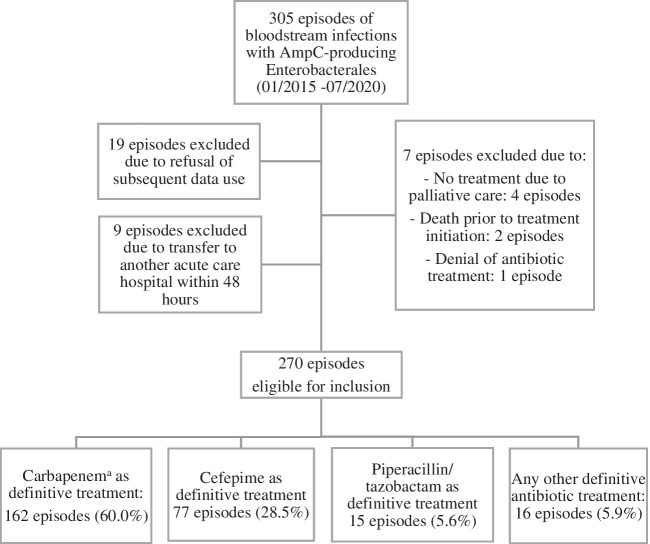
Two hundred and seventy episodes of AmpC-PE BSI were included, 162, 77 and 31 were treated with a carbapenem, cefepime and other antibiotics, respectively. Patients treated with carbapenems were more likely to be transferred to the ICU on admission and more frequently had central venous catheter as a source of infection. In uni- and multivariable analyses, primary and secondary outcomes did not differ between the two treatment groups, except for more frequent occurrence of neurological adverse events among patients treated with carbapenems and shorter length of hospital stay among survivors treated with cefepime.
After excluding isolates with phenotypic ESBL-co-production, cefepime was not associated with adverse outcomes compared to carbapenems when used to treat BSIs caused by AmpC-PE. Our study provides evidence to support the use of cefepime as a safe treatment strategy for AmpC-PE BSI, particularly in clinically stable patients without initial renal impairment or increased susceptibility to neurological adverse events.
尽管支持证据有限,但头孢吡肟仍被推荐用于治疗由产AmpCβ-内酰胺酶肠杆菌科细菌(AmpC-PE)引起的感染。因此,本研究比较了在对产超广谱β-内酰胺酶(ESBL)共生产株进行表型排除后,头孢吡肟与碳青霉烯类疗法治疗AmpC-PE引起的血流感染(BSI)的结局。
这项回顾性队列研究比较了2015年1月至2020年7月期间瑞士巴塞尔大学医院住院患者中,明确使用头孢吡肟与碳青霉烯类药物治疗AmpC-PE BSI的情况。主要结局包括住院死亡、肾功能损害和神经系统不良事件;次要结局包括住院时间和反复感染。
共纳入270例AmpC-PE BSI病例,分别有162例、77例和31例接受了碳青霉烯类药物、头孢吡肟和其他抗生素治疗。接受碳青霉烯类药物治疗的患者入院时更有可能被转入重症监护病房(ICU),且更频繁地以中心静脉导管作为感染源。在单变量和多变量分析中,除了接受碳青霉烯类药物治疗的患者中神经系统不良事件更频繁发生,以及接受头孢吡肟治疗的幸存者住院时间更短外,两个治疗组的主要和次要结局并无差异。
在排除表型产ESBL共生产株后,头孢吡肟用于治疗AmpC-PE引起的BSI时,与碳青霉烯类药物相比,并未导致不良结局。我们的研究提供了证据,支持将头孢吡肟作为AmpC-PE BSI的安全治疗策略,特别是在没有初始肾功能损害或对神经系统不良事件易感性增加的临床稳定患者中。