Martínez-Barro Daniel, Rivera-Bello Joel Dair, Cruz-López Jannet Mercedes, Hernández-Amaro Hermelinda, Rojano-Mejía David
Instituto Mexicano del Seguro Social, Unidad de Medicina Física y Rehabilitación Norte de la UMAE Traumatología, Ortopedia y Rehabilitación, "Dr. Victorio de la Fuente Narváez", Servicio de Rehabilitación. Ciudad de México, México.
Hospital Ángeles Pedregal, Servicio de Neurofisiología Clínica. Ciudad de México, México.
Rev Med Inst Mex Seguro Soc. 2023 Nov 6;61(6):788-795. doi: 10.5281/zenodo.10064325.
Prolotherapy may be a good option in the complementary treatment of knee osteoarthritis (OA) patients, specifically for the increase of functionality.
To determine the effectiveness of prolotherapy in OA grade II - III in the functionality and muscular work of knee flexors and extensors.
a double-blind randomized controlled clinical trial was conducted. It included patients diagnosed with OA grades II-III. The experimental group was infiltrated in both knees with 6 ml of 25% glucose solution and 0.05% lidocaine; control group with 0.45% saline solution and 0.05% lidocaine. All patients received a comprehensive rehabilitation program. The isokinetic work of the knee flexor and extensor muscles, pain and functionality were measured, prior to infiltration and at 3-month follow-up. To compare the difference in means, the Student's T test was applied, considering P<0.05 as significant. The project was approved by the local ethics and research committee.
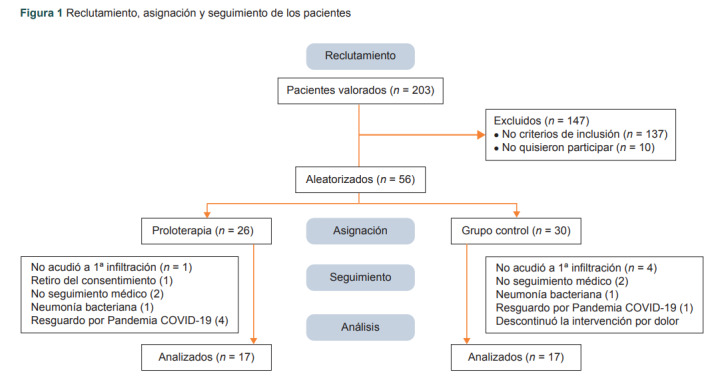
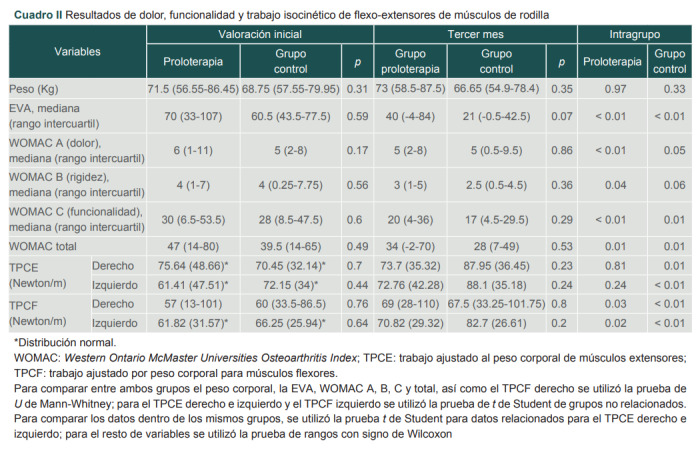
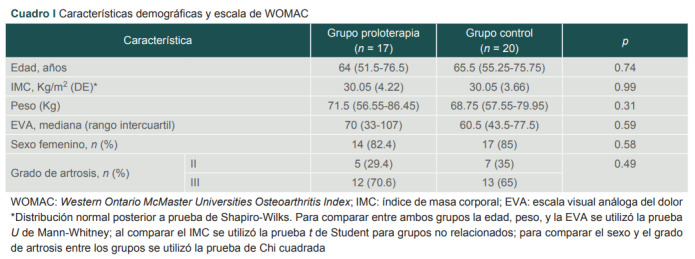
37 patients were recruited, 17 in the prolotherapy group. There were no intergroup differences in functionality, isokinetic knee flexor/extensor work, and pain at baseline, or during follow-up up to 12 weeks.
In the present study we identify that both prolotherapy and saline infiltration increased functionality, strength, and decreased pain; however, no statistically significant difference was found between the two group.
注射疗法可能是膝关节骨关节炎(OA)患者辅助治疗的一个好选择,特别是在提高功能方面。
确定注射疗法对II - III级OA患者膝关节屈伸肌功能和肌肉做功的有效性。
进行了一项双盲随机对照临床试验。纳入诊断为II - III级OA的患者。实验组双膝注射6毫升25%葡萄糖溶液和0.05%利多卡因;对照组注射0.45%盐水溶液和0.05%利多卡因。所有患者均接受综合康复计划。在注射前和3个月随访时测量膝关节屈伸肌的等速做功、疼痛和功能。为比较均值差异,应用了学生t检验,将P<0.05视为有统计学意义。该项目获得当地伦理和研究委员会批准。
共招募37例患者,注射疗法组17例。在基线时以及随访至12周期间,两组在功能、膝关节屈伸肌等速做功和疼痛方面均无组间差异。
在本研究中,我们发现注射疗法和盐水注射均能提高功能、增强力量并减轻疼痛;然而,两组之间未发现统计学上的显著差异。